Dwell time in a RoRo terminal is not merely a lag in the schedule; it is a direct tax on physical capacity, and the industry has been paying it without realizing the cost. As recent data from European automotive ports like Zeebrugge show, vehicles are sitting for over twelve months, consuming scarce parking positions even as overall volumes decline. This tells an uncomfortable truth: throughput metrics alone can mask a terminal's real operational strain, much like a congested gate can obscure broader trade bottlenecks, as we examined in Gate Delays Expose Critical Link in National Trade Flow.
The structural problem is that every vehicle in a RoRo terminal occupies a dedicated parking slot; unlike containers, which stack, or bulk cargo, which piles, a car that lingers for an extra week permanently removes that space from circulation. The knock-on effects are measurable and compounding: longer dwell time reduces yard availability, increases congestion, and lowers effective terminal capacity. This is why measuring average dwell time, yard occupancy, vehicle ageing, and internal movement frequency matters more than counting how many vehicles crossed the gate. Terminals that track these metrics gain the ability to pinpoint exactly where time is lost, whether in inspection queues, processing bottlenecks, or the waiting period for onward truck or rail transportation. The critical insight is that dwell time is not a static reality but a variable operators can control, provided they have integrated visibility.
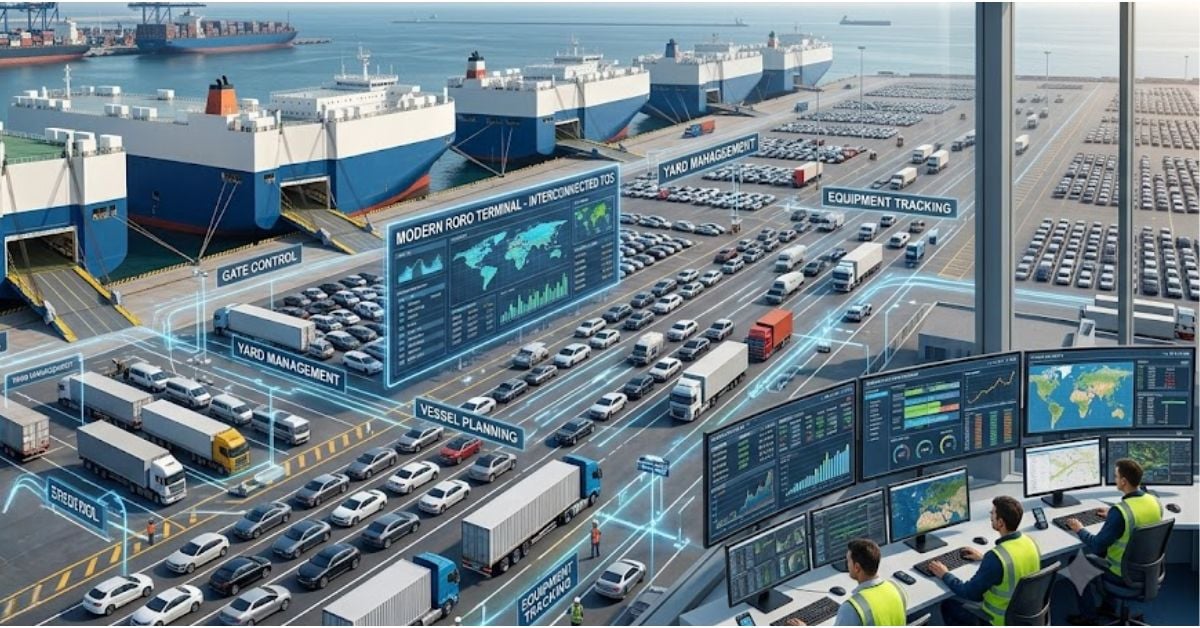
Infrastructure is only half the answer. A terminal may have sufficient processing shops and EV handling protocols, but without a connected view of vehicle location and status, operators cannot schedule movement efficiently. A modern RoRo terminal operating system that links yard planning, gate operations, inspection records, and outbound transportation scheduling can turn dwell time from a lagging indicator into a live diagnostic. It allows operators to ask specific questions: Are vehicles sitting because processing capacity is misaligned with arrival peaks? Is a missing scan creating an unnecessary search that delays release? Are EVs waiting longer due to new battery-monitoring steps that were never embedded into the workflow? When these data points are integrated, the terminal can act on the bottleneck, not just report it.
The concrete takeaway is this: terminals must stop treating dwell time as an afterthought of vessel schedules and start treating it as a primary performance metric, measured and acted upon in real time. The cost of inaction is not abstract, it is a parking position wasted every day a vehicle sits idle. The open question for every operator is whether they have the visibility to identify where those days are being spent, or whether they are simply absorbing the cost.