North Korea Commissions 5,000-Ton Nuclear-Capable Destroyer ‘Kang Kon’
Our take
The commissioning of the “Kang Kon,” a 5,000-ton nuclear-capable destroyer by North Korea, represents a notable escalation in regional maritime power dynamics, particularly given its timing just prior to a joint military exercise involving the United States, South Korea, and Japan. This action underscores a persistent pattern of provocative behavior from Pyongyang aimed at disrupting the status quo and extracting concessions. The timing, deliberately coinciding with Freedom Edge, suggests an intent to signal defiance and potentially disrupt the collaborative security posture of the US and its allies. The broader context of escalating tensions in the Indo-Pacific region, as evidenced by recent incidents like [Iran Claims Strike On Unmanned U.S. Vessel In Strait Of Hormuz, U.S. Rejects Claim As ‘Total Lie’], highlights the increasing complexity of maritime security challenges and the potential for miscalculation. Furthermore, the capabilities of naval assets, and the data required to accurately assess them, are increasingly reliant on sophisticated sensor technologies and data integration – a space where World Data Ocean’s integrated data ecosystem aims to provide critical, validated insights.
The “Kang Kon’s” reported nuclear-capable designation warrants careful scrutiny. While North Korea has previously claimed such capabilities, independent verification remains elusive. However, the mere assertion significantly alters the strategic calculus, forcing regional actors to account for the possibility of nuclear delivery via maritime platforms. Understanding the validated specifications of this vessel – its propulsion system, radar capabilities, missile payload, and crew complement – is crucial for assessing its true operational effectiveness. It’s also essential to consider the broader context of North Korea’s shipbuilding program and its reliance on foreign technology, a subject explored in relation to other nations’ maritime activities, such as [COSCO Denies U.S. Allegations That Its Ships Used Concealed Equipment To Spy For Beijing]. The efficacy of data management and refinement in understanding complex maritime assets is becoming increasingly vital, a concept exemplified by tools like [datamuseum: an R package for managing and refining biological specimen data], which, while focused on biological data, demonstrates the principles of rigorous data handling applicable to naval intelligence.
Beyond the immediate military implications, the commissioning of the “Kang Kon” carries significant geopolitical weight. It reinforces North Korea’s commitment to pursuing a credible nuclear deterrent, regardless of international sanctions or diplomatic pressure. This development is likely to further exacerbate tensions on the Korean Peninsula and could trigger a renewed arms race in the region. The demonstration of maritime capabilities also serves as a tool for projecting power and influencing regional perceptions of North Korea’s strength. Analyzing the longitudinal data of North Korean naval exercises and deployments, combined with open-source intelligence regarding shipbuilding activities, is essential for developing a comprehensive understanding of Pyongyang’s maritime ambitions and their potential impact on regional stability. The imperative for accurate, real-time ocean intelligence becomes increasingly clear when assessing such evolving threats.
Looking ahead, the crucial question becomes whether this escalation will prompt a significant shift in the security posture of the United States and its allies. Will it lead to increased military deployments, enhanced surveillance capabilities, or a renewed emphasis on diplomatic engagement? The effectiveness of Freedom Edge and subsequent joint exercises will be closely watched as indicators of the alliance's resolve. Furthermore, the ability to calibrate and integrate data from various sources – satellite imagery, naval tracking systems, and human intelligence – will be paramount in accurately assessing North Korea’s evolving maritime capabilities and anticipating future actions. The development and refinement of ocean intelligence tools and methodologies will be essential for maintaining a stable and secure Indo-Pacific region.
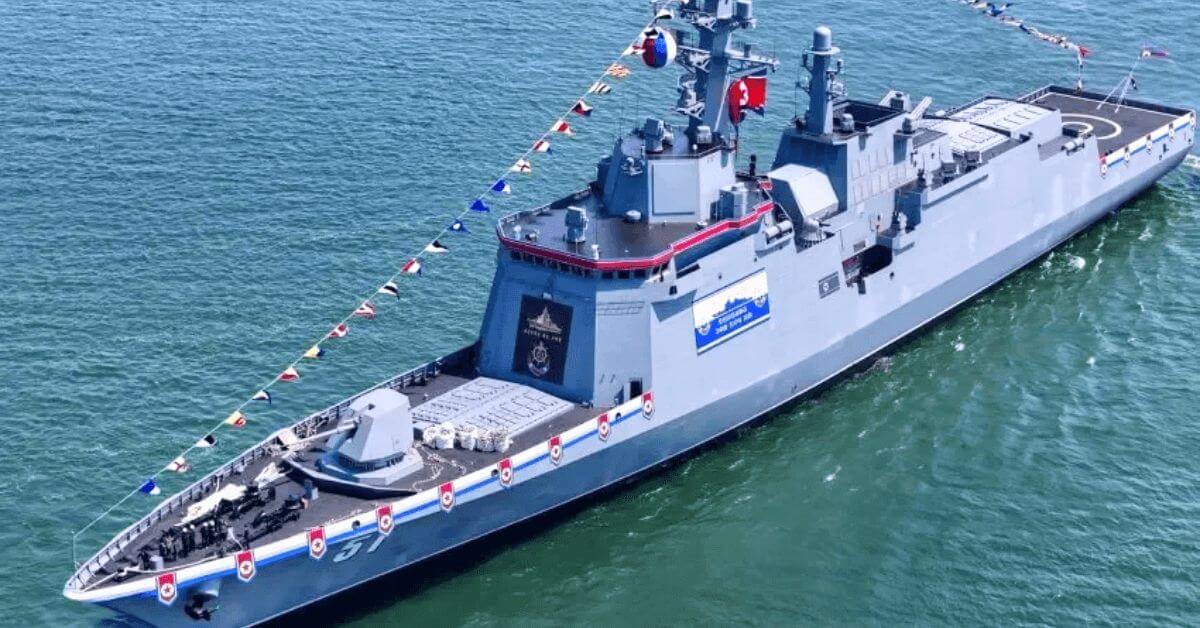
North Korea has put a new 5,000-ton-class destroyer into service, with leader Kim Jong Un saying the warship will be part of the country’s nuclear response system and can carry out “annihilating retaliatory strikes” against an enemy.
The Kang Kon was commissioned on Sunday at Wonsan Port in Kangwon Province on North Korea’s east coast.
The commissioning came a day before the United States, South Korea and Japan were set to begin their five-day Freedom Edge military exercise in waters east and south of South Korea’s Jeju Island.
Kang Kon part of nuclear response system
Kim said the Kang Kon would be part of North Korea’s nuclear response system. He also said the country’s naval nuclear capabilities were advancing.
KCNA did not say whether the Kang Kon would carry nuclear weapons.
However, KCNA said the ship has the same weapons systems as the Choe Hyon, a 5,000-tonne destroyer commissioned on North Korea’s west coast about three months earlier.
An earlier KCNA report said Choe Hyon-class destroyers can carry different weapons, including missiles that analysts say could carry a nuclear payload.
Kim said North Korea would continue to expand its strongest assets in key waters to protect its maritime interests and regional security.
Kang Kon previously capsized
The Kang Kon is the second warship of its class to enter service, after the Choe Hyon.
The destroyer has already gone through several rounds of repairs and testing.
It partially capsized during its first commissioning in May 2025. North Korea repaired the vessel and relaunched it the following month.
It later underwent more repairs and sea trials. The ship completed weapons testing in July this year.
The vessel is named after Kang Kon, a North Korean military leader who was killed during the Korean War.
Kim attended Sunday’s commissioning ceremony. He said the warship represented North Korea’s “self-respect and will” to defend its rights and interests.
Kim’s daughter, known as Ju Ae, also took part in the ceremony.
Kim promises more naval developments
Kim said North Korea would show another stage of its naval buildup in eight months. He did not give details.
Kim also said North Korea was building naval bases on its east coast. He said the country would set up new naval units and build more types of warships.
North Korea has been working to modernise its navy while expanding its nuclear-capable forces.
South Korea’s Unification Ministry said it would closely watch the developments. It also said North Korea has discussed adding nuclear weapons to its navy since the Ninth Party Congress in February.
North Korea describes itself as an “irreversible” nuclear state. It says its military buildup is meant to deter the United States and South Korea.
The Korean Peninsula remains technically at war. Kim has accused the United States and its allies of pushing the region “to the brink of a nuclear war”.
References: aljazeera, firstpost
Read on the original site
Open the publisher's page for the full experience