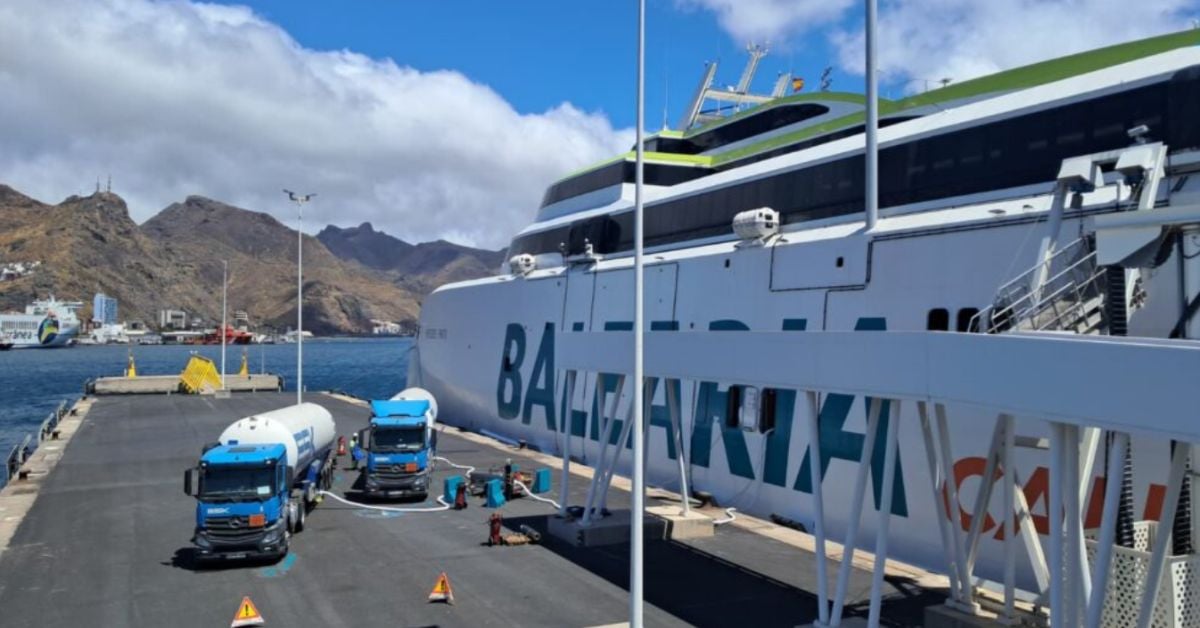
The port of Santa Cruz de Tenerife recently completed its first ship refueling using liquefied natural gas delivered by tanker trucks, a modest but measurable step in the maritime industry's transition away from heavy fuel oil. This operation does not solve shipping's decarbonization challenge on its own, but it demonstrates how existing infrastructure, trucks, a port, a supply chain, can be adapted to deliver a lower-emission fuel without waiting for a complete bunkering network to be built from scratch. For our readers tracking the gap between ambition and execution, this is the kind of empirical progress that matters.
The Tenerife event arrives alongside other concrete developments in the sector. Paradip Port Designated a Mega Port, Anchors Eastern India's Maritime Growth shows how port authorities are scaling capacity to handle larger vessels and higher cargo volumes, while Optimal LNG Carrier Design: Boosting Capacity, Reducing Costs explores how naval architecture is evolving to make LNG transport itself more efficient. Together, these stories point to a system where port capability, vessel design, and fuel supply logistics are being calibrated in parallel. Tenerife's truck-to-ship LNG operation is not a headline-grabbing innovation, it is an integrated, real-world test of whether the supply side can keep pace with demand.
What makes this development worth our attention is not the technology, which is well-understood, but the operational validation. The port authority and its partners had to coordinate delivery timing, safety protocols, and connection procedures that differ from conventional bunkering. Every successful operation like this one generates empirical data, flow rates, boil-off management, crew training requirements, that can be peer-reviewed and applied elsewhere. For researchers and policymakers, that data is more valuable than a press release. For port operators, it reduces the perceived risk of investing in LNG infrastructure, because someone else has already worked through the practical friction.
One clear takeaway our readers can quote: the maritime fuel transition will be won in ports, not in boardrooms. Tenerife's operation proves that incremental steps, trucks instead of pipelines, retrofits instead of new builds, can produce validated, measurable results today. The open question remains whether the supply chain for LNG, and eventually for zero-emission fuels like green ammonia or methanol, can scale fast enough to meet the climate indicators that scientists are monitoring in real time. The next operation to watch is not the one that makes headlines, but the one that replicates Tenerife's process at a port with ten times the traffic. That will tell us whether this approach is a prototype or a pattern.