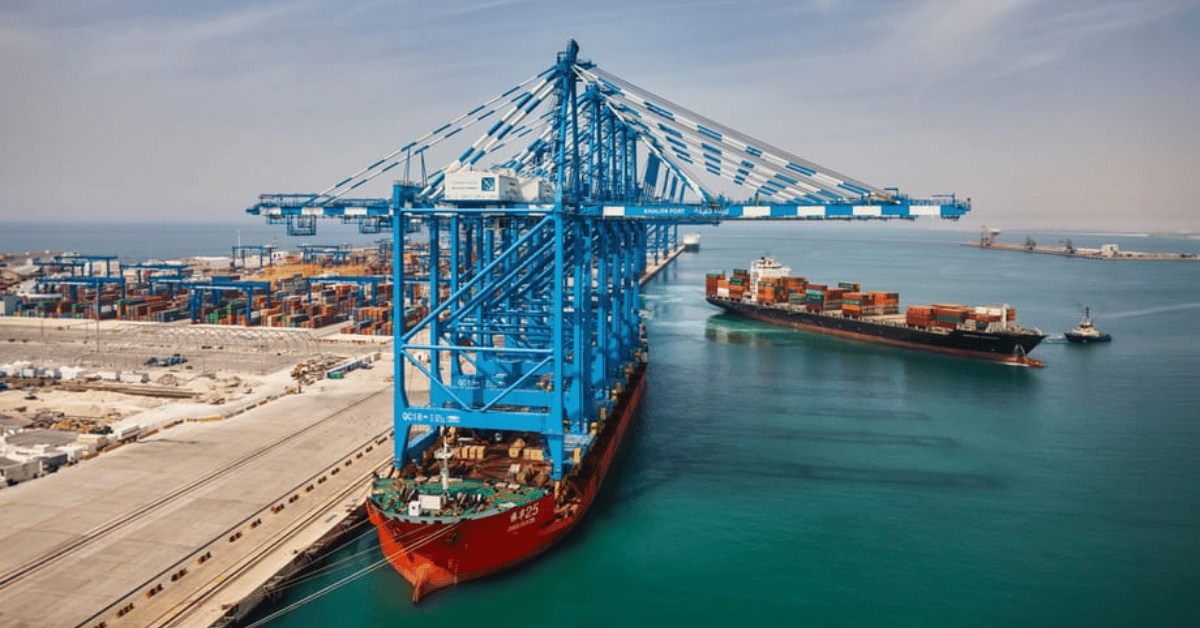
Khalifa Port's leap to 34th place in the Lloyd's List ranking is a measurable signal that infrastructure investment, when calibrated to real demand, produces empirical results. The 21.6% surge to 6.6 million TEUs is not just a number, it is a validated indicator of how integrated logistics ecosystems can scale without sacrificing efficiency. For our readers tracking the intersection of trade flow and climate strategy, this port's trajectory offers a concrete case study in what happens when capacity expansion aligns with operational precision.
The story here is not simply one of volume growth. Khalifa Port's rise, 61 positions since 2019, reflects a deliberate integration of three terminals operated by CMA CGM, COSCO, and MSC, each bringing distinct global networks into a single calibrated system. This mirrors a broader shift we have been monitoring: the Dual-Fuel Fleet Surpasses 500 Vessels in Measurable Shift Toward Lower-Emission Shipping demonstrates that the maritime industry is making measurable, not aspirational, progress on emissions. Similarly, Khalifa Port's expansion of CMA Terminals to 2.7 million TEU capacity represents a forward-looking commitment to handling larger, more efficient vessels, ships that increasingly run on dual-fuel systems. The port's planned total capacity of 10.5 million TEUs is not speculative; it is a direct response to the demand that validated decarbonization efforts, like those earning Validated Decarbonization Progress Earns Synergy Marine Global Recognition, are making possible.
What this means in practical terms: Khalifa Port is positioning itself as a node where trade volume and environmental responsibility can coexist. The port's integration of sea, road, and rail connectivity reduces dwell time and associated emissions, while its partnerships with major carriers ensure that the vessels calling there are part of a modern, lower-emission fleet. The 1.3 million TEUs handled by CMA Terminals in its first full year is early, empirical evidence that new capacity can be absorbed quickly when market demand and infrastructure are synchronized. For policymakers and logistics planners, the takeaway is direct: investment in capacity must be paired with investment in connectivity and technology to achieve both throughput growth and operational resilience.
The open question is whether other ports can replicate this model. Khalifa Port benefits from a centralized governance structure through AD Ports Group, which coordinates terminal operations, inland logistics, and industrial zones under one integrated data ecosystem. Most global ports operate with fragmented ownership and legacy infrastructure. As we watch Khalifa Port's ongoing expansion toward 10.5 million TEUs, the metric to watch is not just throughput but the port's ability to maintain its 21.6% growth rate without sacrificing turnaround times or environmental performance. That will determine whether this rise is an outlier or a replicable blueprint for the next generation of container ports.