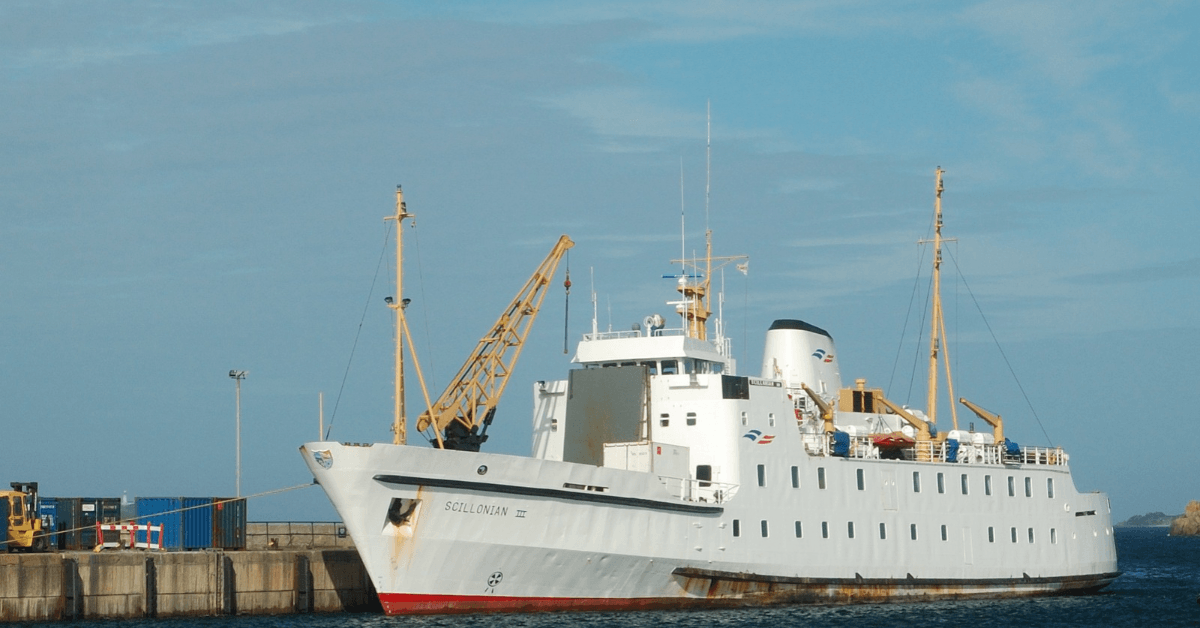
A ferry that has outlasted most of its passengers' careers is being retired, and that is a story about data as much as it is about sentiment. The Scillonian III's final voyage on November 8, 2026, with more than 480 passengers aboard, marks the end of a 49-year run connecting the Isles of Scilly to Cornwall. For the ocean intelligence community, this is not merely a nostalgic farewell. It is a reminder that the vessels we rely on for observation, transport, and lifeline service are aging assets whose operational data, maintenance logs, fuel consumption records, passenger counts, tidal performance metrics, represents a longitudinal dataset we rarely choose to preserve. The crew's mixed feelings are understandable; our own are more clinical. What happens to the empirical record of half a century of maritime service when the ship itself is decommissioned?
The contrast with recent developments in ocean transit is instructive. China Delivers Second Large Cruise Ship Ahead of Schedule, Expanding Ocean Transit demonstrates how rapidly new tonnage can be built and deployed when industrial capacity is aligned. Meanwhile, Residential cruise terminates voyage, stranding over 200 paid passengers in Cambodia shows what happens when operational continuity breaks down entirely. The Scillonian III sits between these extremes: a vessel that was launched by the Prince of Wales in 1977, carried islanders and holidaymakers for nearly five decades, and now hands off to a replacement that can carry 600 passengers. The question for our readers, who include researchers, policymakers, and maritime operators, is whether the transition includes a calibrated transfer of operational knowledge, or whether the time capsule sealed on board represents the only systematic archive of what the ship learned.
Ship master Joe Whetton called it "the honour of my career" to command the final voyage. That is a human truth we do not dismiss. But the practical takeaway for those who track climate indicators, coastal infrastructure, and integrated data ecosystems is this: every retired vessel represents a lost opportunity to validate models against real-world performance. The Scillonian III's fuel efficiency curves, its response to changing weather patterns over 49 years, its passenger load factors during peak and off-peak seasons, these are empirical measurements that could inform future ferry design, port planning, and emissions baselines. The Isles of Scilly Steamship Group has not said where the time capsule will be placed. We would suggest it be digitized first. The next generation of ocean intelligence depends on treating every voyage as a data point, not just a memory.