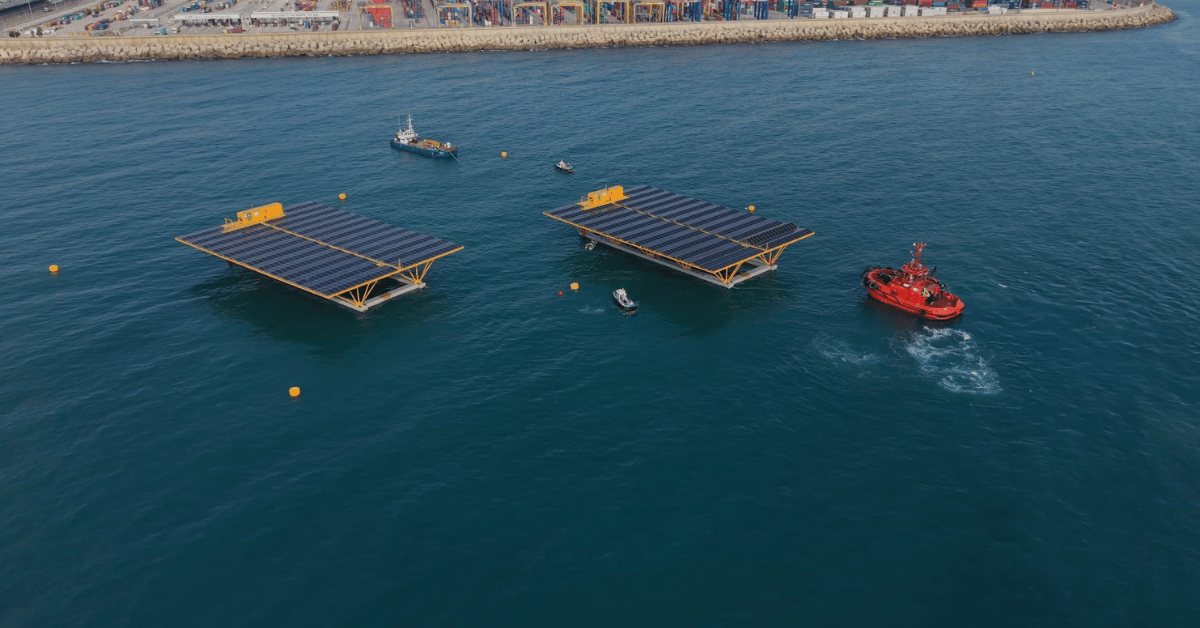
Floating solar has moved from concept to concrete in European waters, and that matters far more than a single megawatt suggests. The completion of BlueNewables' 1 MW demonstrator at the Port of València is not merely a technical milestone; it is a calibrated test of whether offshore solar can deliver measurable, real-world performance where land is scarce and demand is high. As we have observed in the Measured decline in solar costs tracks each doubling of global capacity, every doubling of installed solar capacity has historically driven a roughly 20 percent price reduction. Floating offshore arrays could accelerate that curve by opening up vast new surfaces for generation without competing for onshore space. The question is whether this technology can match the cost trajectory of its terrestrial counterpart under the corrosive, dynamic conditions of a marine environment.
This project is built to answer that question empirically. The two PV-bos platforms, named 'Paiporta' and 'Catarroja' in tribute to communities devastated by the 2024 floods, are now entering a structured testing and monitoring phase in the port's waters. The validation process will assess performance, operation, maintenance, and grid integration, precisely the kind of longitudinal data needed to move from demonstrator to industrial scale. The collaboration between BlueNewables and Naturgy over a two-year period to exchange technical, operational, and economic information is a model of the integrated data ecosystem the sector requires. Without peer-reviewed, real-world metrics on degradation rates, mooring loads, and biofouling, offshore solar remains a promising hypothesis. With them, it becomes a bankable option for ports, islands, and coastal infrastructure. The modular, scalable design of the platforms, built at the San Enrique shipyard in Vigo, signals an intent to manufacture rather than handcraft, which is essential for cost reduction.
What makes this installation strategically significant is its placement within a broader testing infrastructure. The Port Authority of València has developed a dedicated platform to connect marine renewable energy demonstrators to the power grid, a move that lowers the barrier for subsequent projects. This is not a one-off experiment; it is a replicable framework. The potential for floating solar to complement offshore wind, sharing transmission lines, balancing generation profiles, and utilising the same maritime space, could fundamentally reshape how we think about renewable energy zones. As the world grapples with the staggering scale of environmental pressure, from the Tracking 350 million tons of annual plastic waste to its ocean sink to rising climate indicators, every kilowatt-hour generated without land conflict or freshwater consumption is a direct contribution to resilience.
The specific detail to watch is whether the validated performance data from this 1 MW demonstrator can unlock financing for the first commercial-scale floating solar farms in European waters. The cost of capital for marine renewables remains higher than for onshore equivalents, precisely because the empirical track record is thin. If the Paiporta and Catarroja platforms demonstrate reliable performance and predictable maintenance costs over the coming months, they will provide the calibrated evidence that investors and insurers need. That is the concrete point: this test phase is not about proving that floating solar works, it is about proving it works at a known, replicable cost.