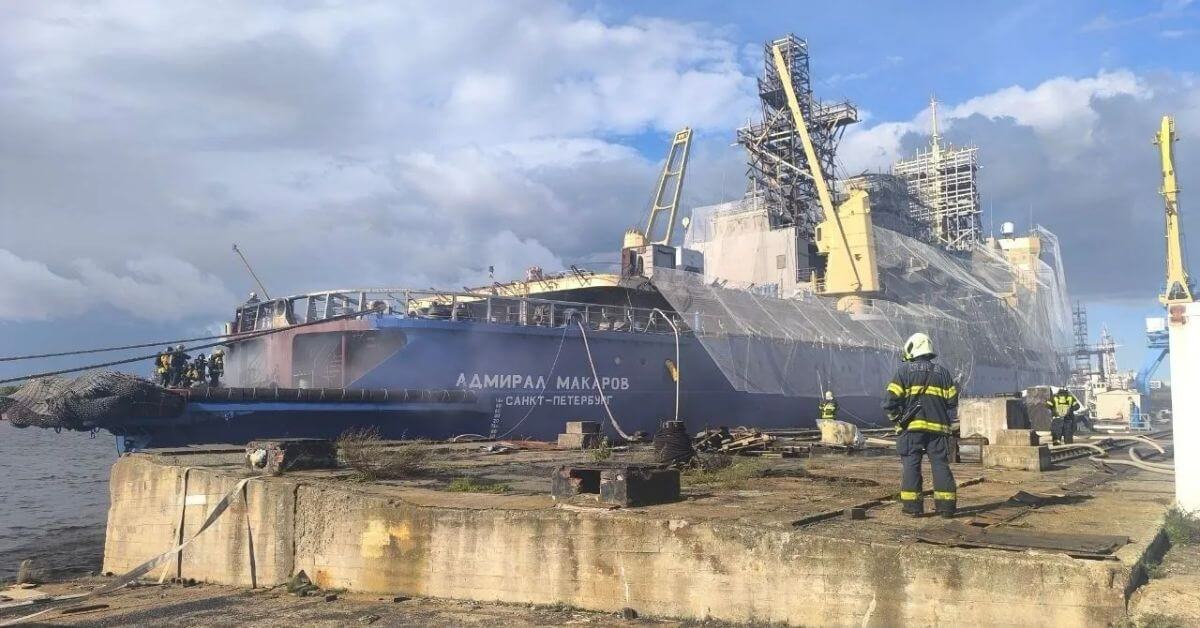
A fire aboard Russia's 20,000-ton icebreaker Admiral Makarov, reported on September 5 in the steering-gear compartment at the stern, is a reminder that maritime risk does not pause for geopolitical tension. The vessel was in repairs at the Kronstadt Shipyard, a facility with direct ties to Russia's Arctic ambitions. Damage assessment is now underway, but the incident is less about a single ship and more about what it reveals: the gap between a nation's stated maritime reach and the operational fragility of the assets meant to deliver it.
This event sits alongside a pattern of Russian maritime activity that deserves calibrated attention. We recently noted how Moscow is calibrating export revenue for the Northern Sea Route icebreaker fleet, a plan to extract more than 200 billion roubles from exporters to fund two new icebreakers. That is a statement of intent. But intent does not equal readiness. A fire in a steering-gear compartment, a space critical for maneuverability, is not a trivial systems glitch. It is the kind of event that forces a hard look at maintenance cycles, crew training, and the difference between a flagship and a fleet. Meanwhile, the CIA warning about suspected Russian drone operations from commercial ships in the Mediterranean reminds us that Russian vessels are not passive instruments. They are active, distributed tools of pressure. When one of those tools suffers a fire during a routine repair, the question is not just about Kronstadt. It is about the broader operational tempo.
For our readers, the practical takeaway is straightforward: track incidents, not just announcements. The Admiral Makarov fire is one data point in a longitudinal record of Russian maritime incidents, from the Mediterranean to the Baltic. The cargo ship fire near Mykonos on September 25, which forced all 29 aboard to evacuate, is another. Neither event is necessarily a strategic turning point. But together, they form a picture of systemic risk that analysts and policymakers should integrate into their own assessments. The ocean is a harsh operating environment, and fires do not respect flag states.
The specific detail to watch is the damage assessment itself. Steering-gear compartments are not modular. If the fire compromised hydraulics, rudder controls, or the surrounding hull structure, the Admiral Makarov could face weeks or months in dry dock. For a vessel class that Russia has positioned as essential to its Northern Sea Route ambitions, that is not a minor inconvenience. It is a measurable delay in operational capacity, and it comes at a time when Russia is asking exporters to fund a larger icebreaker fleet. The gap between that funding request and the performance of existing assets is the story worth monitoring. One fire does not sink a program, but it does test the integrity of a system. The next few weeks will tell us how deep the damage runs, and how much of the Admiral Makarov's reputation was built on tonnage rather than true readiness.