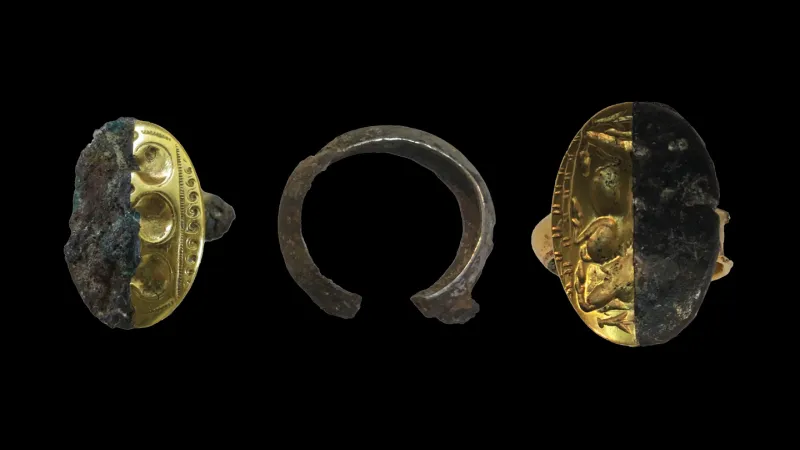
The discovery that Bronze Age Greek nobles wore signet rings forged from meteoritic iron reframes how we think about ancient technology and the value systems of early metallurgy. Chemical analysis has now confirmed what once sat at the edge of myth: that the sky was not just a source of wonder, but of material wealth. For a publication built on ocean intelligence, there is a quiet resonance here. Both the deep sea and deep time demand the same patience, the same willingness to let empirical evidence correct assumption. We are used to reading the seafloor for climate indicators; these rings ask us to read ancient metal for cultural signals.
What makes this finding significant is not the novelty of the material alone, but the implication that these objects were not utilitarian. They were status markers, worn by people who understood that iron from a meteorite carried a different kind of authority than iron smelted from ore. That distinction, between terrestrial and celestial, is one we still recognize today, though we often frame it in terms of supply chains and provenance rather than divine favor. The practical takeaway for our readers is straightforward: provenance is not a modern obsession. It has always shaped value, whether in a signet ring or a shipwreck's cargo. Consider the Lost Ship Reveals Clues to Caribbean Trade and Smuggling History, where recovered amphorae and ballast stones tell a story of commerce and evasion. The same analytical rigor that identifies a meteorite's nickel content can trace a smuggling route or verify a hull's origin. The tools differ; the principle does not.
This also speaks to the value of interdisciplinary inquiry, a lesson we carry into marine archaeology. The Charting a Course: Exploring Marine Archaeology and Future Careers piece touches on a student's uncertainty about entering the field. What this meteoritic iron study shows is that the field rewards curiosity that crosses boundaries: chemistry, history, geology, and material science all converge on a single artifact. For anyone hesitating at the edge of a career in archaeology, this is the answer: the questions are expanding, not narrowing. And the Unearthing Viking History: New Insights from a 1,000-Year-Old Burial demonstrates how reopening a site, or reexamining a collection, can yield new truths with better instruments. The same is true here. What else have we misclassified because we assumed a material's origin?
Our honest take is that this discovery should temper any tendency toward technological exceptionalism. We like to think of advanced materials as a modern advantage, but these rings suggest that ancient societies were already making calibrated choices about material properties and cultural meaning. The open question is whether other iron objects from the period, currently sitting in museum drawers, will yield similar results when reexamined. That is the detail to watch: not the rings themselves, but the broader sample. If even a fraction of Bronze Age iron carries a cosmic signature, our understanding of trade networks and resource access will need revision. For now, the rings stand as a reminder that the empirical method, applied with patience, can turn a small artifact into a large insight. That is a lesson worth carrying into any ocean, ancient or otherwise.