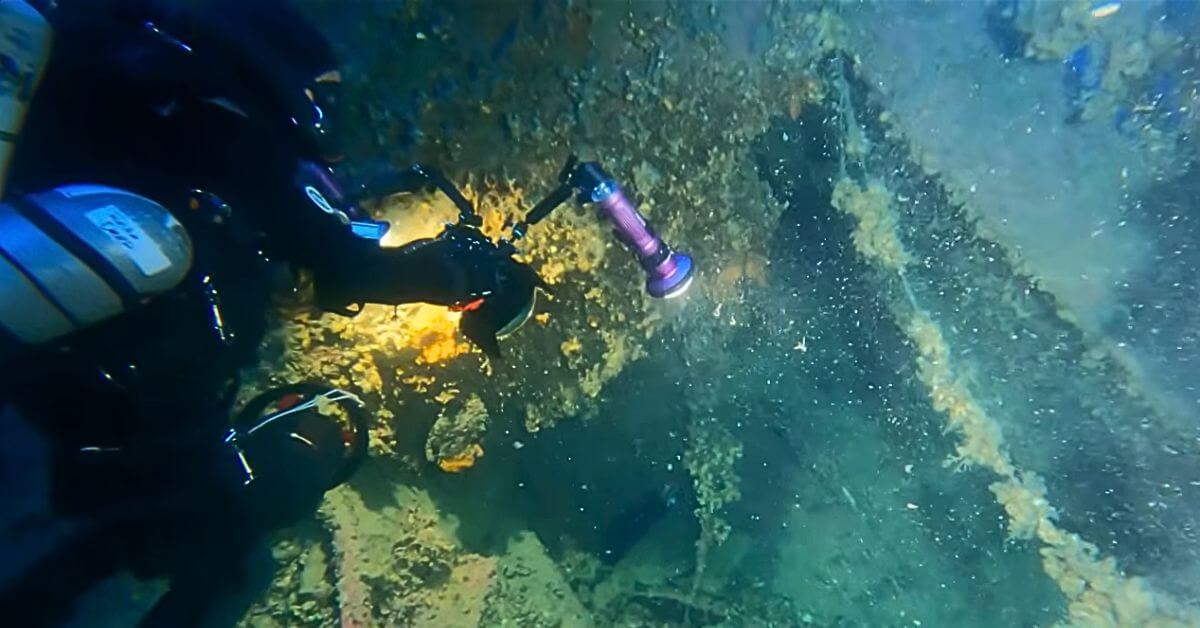
The recovery of the bell, navigation light, and binoculars from HMHS Britannic is not a salvage story; it is a data acquisition event. For over a century, the wreckage of Titanic's sister ship has rested 120 metres down in the Aegean, serving as an unintended time capsule. Now, with authorisation from Greece's Ministry of Culture and the careful work of an 11-member dive team using closed-circuit equipment, a small set of artefacts has been brought into the light. We see this as a calibrated step in building what we call ocean intelligence: not the romantic retrieval of relics, but the measured collection of physical evidence that connects historical events to present-day marine conditions.
The practical value here is twofold, and it extends beyond the museum display planned for the National Museum of Underwater Antiquities in Piraeus. First, the objects themselves are empirical records. The porcelain washbasin, silver-plated trays, and Turkish bath tiles spent 109 years underwater, and their condition tells us something measurable about how materials degrade in that specific marine environment. That is longitudinal data, gathered without an instrument deployment, simply by observing what survives and what does not. Second, the recovery operation itself is a demonstration of how to work in a fragile, deep, high-current site. The divers left some objects behind because of their condition or position, which is exactly the right call. Retrieving everything would have compromised the wreck's integrity and the safety of the team. This is the difference between exploration and exploitation, and we should note it.
For our readers, the takeaway is direct: this is not a one-off curiosity but a template. The methods used here, closed-circuit rebreathers, specially designed lift bags, supervised conservation protocols, are the same principles that apply to modern ocean observation. When we report on a 4,700-year-old shipwreck extending Mediterranean voyage records, we are looking at the same underlying idea: the seabed holds information, and the question is how we extract it without destroying the context. Likewise, our coverage of retrofitting the fleet for decarbonisation and the acoustic data from offshore platforms all points to a shared need: we must treat the ocean as an integrated data ecosystem, where historical wrecks, living infrastructure, and natural soundscapes are all part of one system. Britannic is not an isolated artefact; it is a node in that system.
The objects are still being conserved in Athens, and the public will not see them until the museum opens. That delay is appropriate, and we should watch for what the conservation process reveals. The bell and the navigation light are not just display pieces; they are physical witnesses to a sinking that killed 30 people, some pulled into the ship's still-turning propellers. The question we should keep in mind is not whether the museum will be impressive, but what further analysis of these materials will tell us about the wreck's structural collapse over a century. That is the specific consequence to track: the conservation reports, not the exhibition catalogue, will be the real contribution to ocean science.