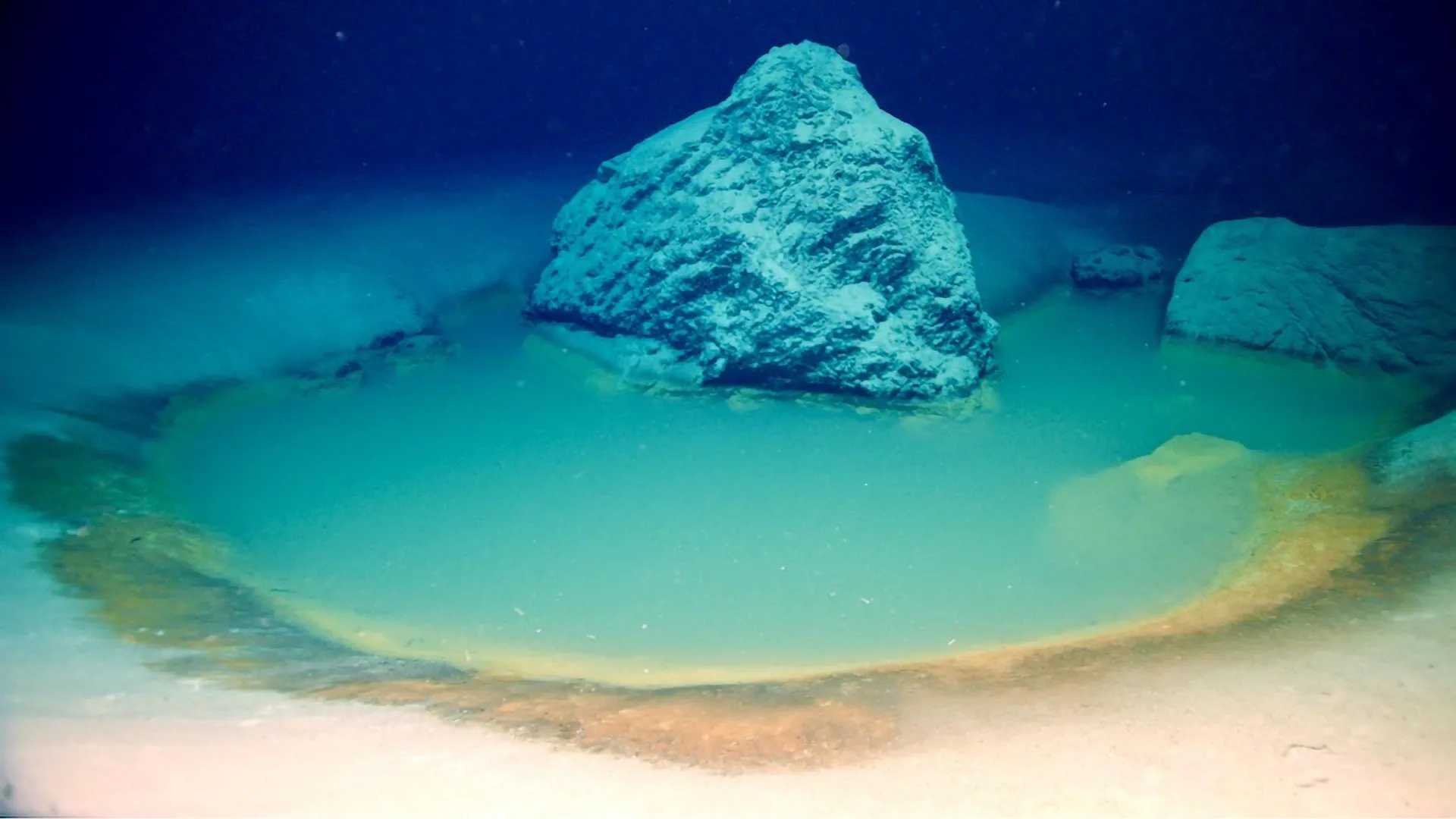
The brine pools discovered more than a mile beneath the Red Sea are not just a geological curiosity, they are a direct, measurable window into Earth's ancient oceans and a testbed for where life can persist. These underwater lakes, devoid of oxygen and saturated with salt, should be sterile by conventional logic. Instead, they are teeming with microbial life. That empirical finding reshapes our understanding of habitability, both on this planet and beyond.
For researchers and policymakers tracking climate indicators, these pools offer a rare longitudinal record. The still, stratified waters preserve sediments that capture past climate events with a fidelity unmatched by most marine environments. They are, in effect, natural archives of ocean chemistry from epochs when Earth's atmosphere looked very different. This is not abstract science. The same microbial metabolisms that thrive in brine pools may inform how marine ecosystems respond to expanding oxygen-minimum zones in a warming world. The practical question is whether we can calibrate our models using these deep-sea laboratories before the conditions they mimic become more common at the surface. Meanwhile, the search for life elsewhere in the solar system, on icy moons like Europa or Enceladus, gains a concrete analogue. If life can organize in these extreme, salty, anoxic Red Sea lakes, the probability that similar environments elsewhere harbor organisms rises measurably.
This discovery also underscores a broader truth about our region: the Red Sea is a corridor of both geopolitical tension and scientific opportunity. The same waters that saw Coalition Strikes Hodeidah Port Following Civilian Evacuation Order in Yemen and where Egyptian Crew Maneuver and Armed Guard Fire Repel Three Speedboat Attacks off the coast also hold these pristine, undisturbed brine pools. It is a reminder that integrated data ecosystems must account for human activity as much as natural processes. The same ocean intelligence that maps brine pools can monitor shipping lanes and security threats, but only if we invest in the collaborative, peer-reviewed frameworks that make such data usable across disciplines.
The takeaway is direct: brine pools are not a footnote to oceanography. They are a calibrated, real-time experiment in survival that forces us to revise what we mean by "habitable." The next step is to sample these lakes systematically, before deep-sea mining or other industrial pressures reach these depths. The question is not whether we can learn from them, but whether we will act on what they tell us before the window closes.