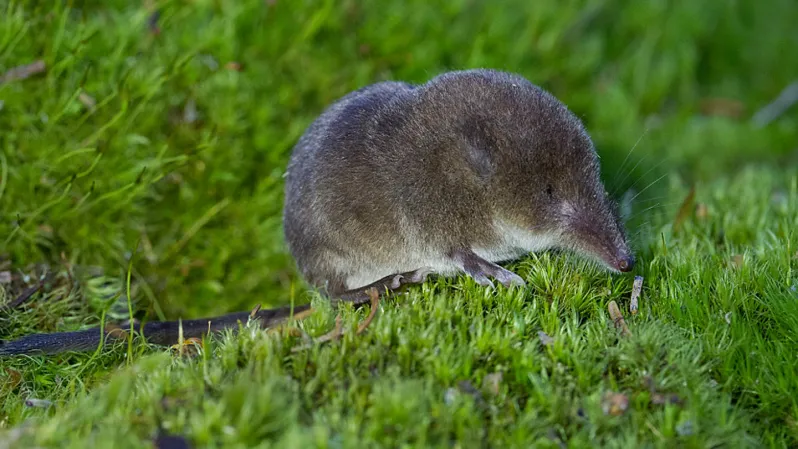
Nature has a quiet way of revising its own rulebook. The long-clawed shrew, a small mammal already built for a life of frantic foraging, appears to undergo a striking seasonal transformation: its snout grows larger in winter while its brain shrinks. This is not a fantasy of evolutionary storytelling. It is a documented, empirical observation of skull reshaping under cold stress. And it deserves more than a passing glance, because it challenges how we understand survival itself. We tend to think of adaptation as a slow, generational grind. Here, we see a flexible, reversible change within an individual's lifetime. That is a different kind of intelligence, one written in bone and tissue rather than genes alone.
The finding also speaks to a broader truth about trade-offs. When winter tightens its grip, resources become scarce, and every calorie counts. A larger snout may improve foraging efficiency, while a reduced brain, an energetically expensive organ, may free up vital energy for warmth and metabolism. This is not a sign of weakness. It is a calibrated response to an immediate environmental demand. We would tell any reader who asks: do not mistake this for a failure of evolution. This is evolution's practical side, operating in real time. It also echoes themes we have explored in related coverage, such as how Fossilized Poop Reveals Feathered Dinosaur Traits Linked to Survival, where survival traits are often tied to specific, sometimes subtle, physical differences. And just as fish may not experience cold as we do, as discussed in Do Fish Experience Cold, or Simply Temperature Change?, our understanding of thermal perception and adaptation remains incomplete.
What excites us here is the precision. The shrew is not vaguely adapting. It is measurably reshaping its skull, likely in response to seasonal metabolic pressure. This is the kind of longitudinal, validated observation that moves the field forward. It reminds us that climate indicators are not always about melting ice or shifting ranges. Sometimes, they are written in the very anatomy of a small mammal, a living signal of environmental stress. For researchers, this opens a practical question: what other species are quietly changing their own bodies in response to seasonal extremes? And for the rest of us, it is a lesson in humility. We are not the only ones adjusting to winter. Some of us just do it with better insulation. The shrew does it with a sharper snout and a lighter mind.
Our take is straightforward. This is not an anomaly to file away. It is a prompt to look closer at the mechanisms of resilience, especially as climate variability intensifies. The specific consequence to watch is whether these reversible changes become permanent over generations, and what that means for species facing rapid environmental shifts. As we consider the limits of adaptation, we might also recall the Extreme Thermophile Amoeba Expands Limits of Complex Life's Heat Tolerance, a reminder that life's boundaries are often more flexible than we assume. The shrew's winter nose is not a quirk. It is a measurable signal of life's ongoing negotiation with the world. And that is worth watching, one season at a time.