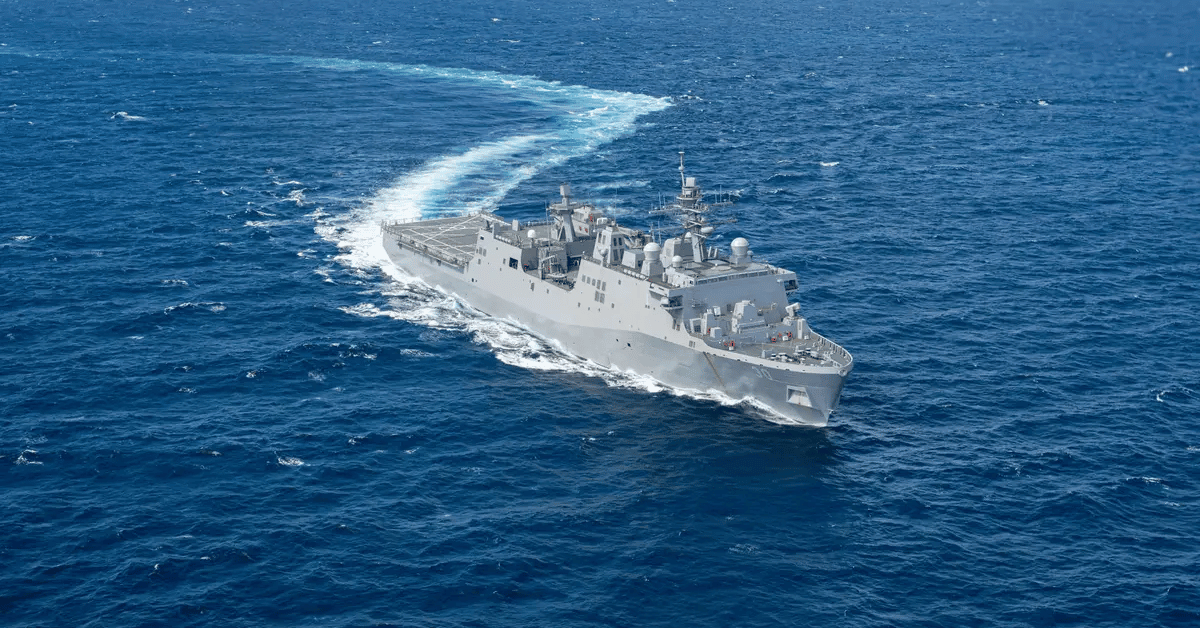
The USS Harrisburg's successful completion of builder's sea trials is not just a routine shipyard milestone; it is a validated, measurable step toward a more capable and integrated naval fleet. For a community that tracks the intersection of maritime power and technological evolution, this event signals something concrete: the Flight II design of the San Antonio-class is ready for real-world validation. The real news here is not that a ship passed a test, but that the Navy is systematically calibrating its amphibious fleet for a future where sensor integration and mission flexibility are paramount.
The Harrisburg represents more than 200 modifications from its Flight I predecessors, and two of those changes deserve close attention. The installation of Raytheon's AN/SPY-6(V)2 Enterprise Air Surveillance Radar replaces the earlier composite mast with a steel structure, a design choice that prioritizes empirical performance over aesthetic novelty. This radar is the smallest member of the SPY-6 family, but its inclusion on an amphibious warship points to a broader trend: the Navy is pushing sensor capability down to platforms that traditionally carried less sophisticated air-search systems. That shift mirrors the kind of modular, precision-focused thinking we recently examined in the Modular power meets precision defense in the SCX 26 naval concept, where future warship designs lean heavily on adaptable mission systems. Similarly, the successful integration of advanced radar on a Flight II amphibian suggests that the Navy is treating its LPD fleet not merely as troop transports, but as nodes in a layered, integrated data ecosystem.
From a practical standpoint, what does this mean for the fleet? The Harrisburg, along with its sister ships Pittsburgh and Philadelphia now under construction at Ingalls, will replace aging amphibious classes that have been in service since the Vietnam era. The well deck can launch two large landing craft; the flight deck can handle two CH-53E heavy-lift helicopters or two V-22 tiltrotors. Those capabilities are well-established, but the Flight II's updated combat systems and radar give commanders a clearer real-time picture of the battlespace. This is not a revolution in naval architecture, it is a deliberate, calibrated evolution. The ship's builder's trials validated propulsion, steering, communications, and mission system integration, and the next step is Navy acceptance trials. The timeline is tight: launched in October 2024, christened in January 2025, and expected to deliver later this year. That pace is worth watching, because it reflects a shipyard that has delivered LPDs 17 through 29 and knows the production rhythm.
One specific detail to track as the Harrisburg moves toward commissioning: how the AN/SPY-6(V)2 performs in the amphibious operating environment. The radar's smaller size means it trades some range for affordability and fit, but if it proves reliable on a 25,000-ton hull operating near contested shores, it could validate a cost-effective path for upgrading other amphibious platforms. That is the kind of empirical data, not a press release, but years of at-sea performance, that will determine whether Flight II becomes a template or an exception. The Harrisburg has cleared its first measured hurdle; the real test begins when it joins the fleet.