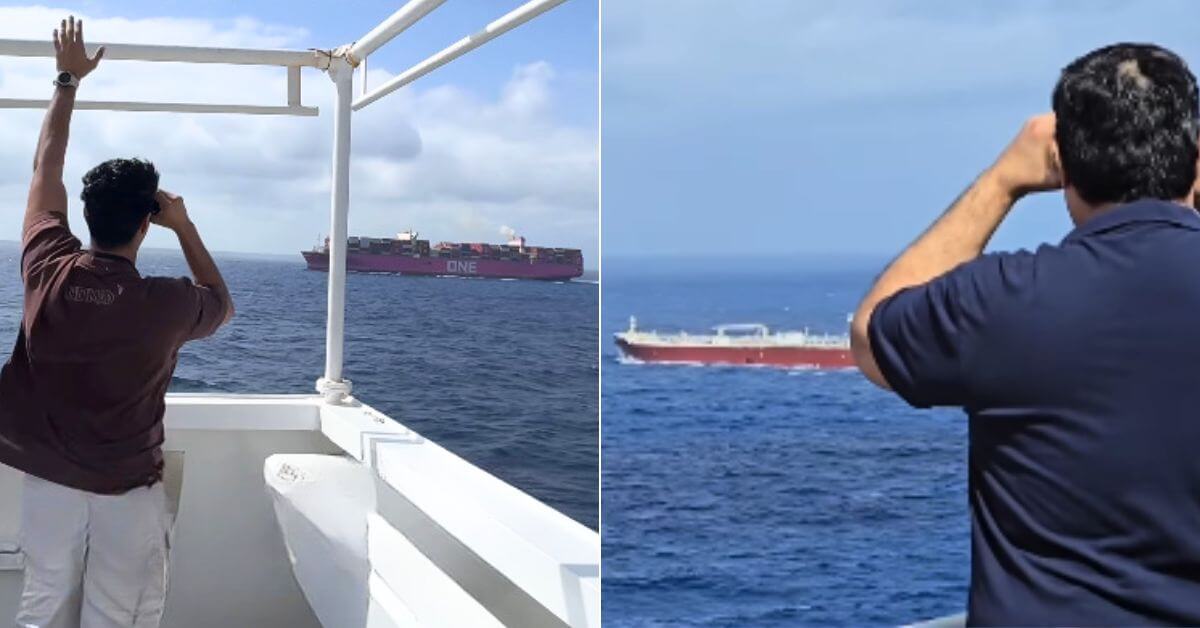
The open Atlantic is a place of deliberate solitude, a vast expanse where schedules are dictated by currents and cargo manifests. So when a young Indian sailor aboard his vessel spotted another ship in the North Atlantic and recognized the face on the bridge as his father's, the usual protocol of maritime distance dissolved. The moment, captured in a video that has since circulated, shows a reunion that was equal parts shock and joy. Raviraj's expression, as one observer noted, carried a happiness and pride that needed no translation. It is a human moment, but it is also a professional one, a reminder that the men and women who move our global economy across the water are not merely cogs in a logistics machine. They are individuals carrying personal histories, and sometimes, those histories surface in the most unexpected coordinates.
For our readers, this story is more than a feel-good pause in the daily feed of shipping news. It is a live demonstration of the emotional architecture that underpins the industry's hard data. We often discuss the ocean in terms of integrated data ecosystems and climate indicators, measuring salinity, temperature, and traffic density. But this reunion grounds those metrics in lived experience. It connects directly to the work of those building Bridging Data Gaps: Integrating Citizen Science for Ocean Intelligence, where human observation fills the gaps left by buoys and satellites. Here, the human element is not a data point, but the very vessel of connection. Similarly, the Integrated Subsea Cables Enhance Data Transmission Across the Indian Ocean remind us that 99% of intercontinental data flows under the sea, yet it is the people on the surface who carry the emotional weight of that connectivity. The sailor's story is a reminder that while our infrastructure is becoming more automated, the human factor remains the most unpredictable, and often the most meaningful, variable.
Our take is straightforward: we should resist the urge to romanticize this as fate. Instead, view it as a matter of probability. The world's merchant fleet is a small community; the North Atlantic is a busy highway. Reunions like this are rare, but they are a feature of a system that moves people in predictable patterns. We would tell a reader who asked us about this that the real takeaway is not the serendipity, but the scale of the unseen human network that makes global trade possible. It is a reminder that every ship that passes another is staffed by people with families, and that the Puntland Forces Intercept Hijacked, US-Sanctioned Oil Tanker After 48 Hours incident underscores how quickly that human network can turn from routine to risk. The ocean does not care about sentiment, but it does create the conditions for these fleeting, powerful moments.
The specific detail to watch here is the reaction of the crews on both vessels. In an era where mental health at sea is a growing concern, a moment of genuine, unscripted joy is a powerful counterweight to the isolation of the job. We would tell our readers to watch for how shipping companies respond to this viral moment. Will they use it to advocate for better crew welfare, or will they let it fade as a novelty? The answer will tell us more about the industry's stated values than any mission statement. For now, we can appreciate the image of a father and son, separated by salt water and contractual schedules, finding each other in the blue. That is the real ocean intelligence: knowing that the data is only as resilient as the people who interpret it.