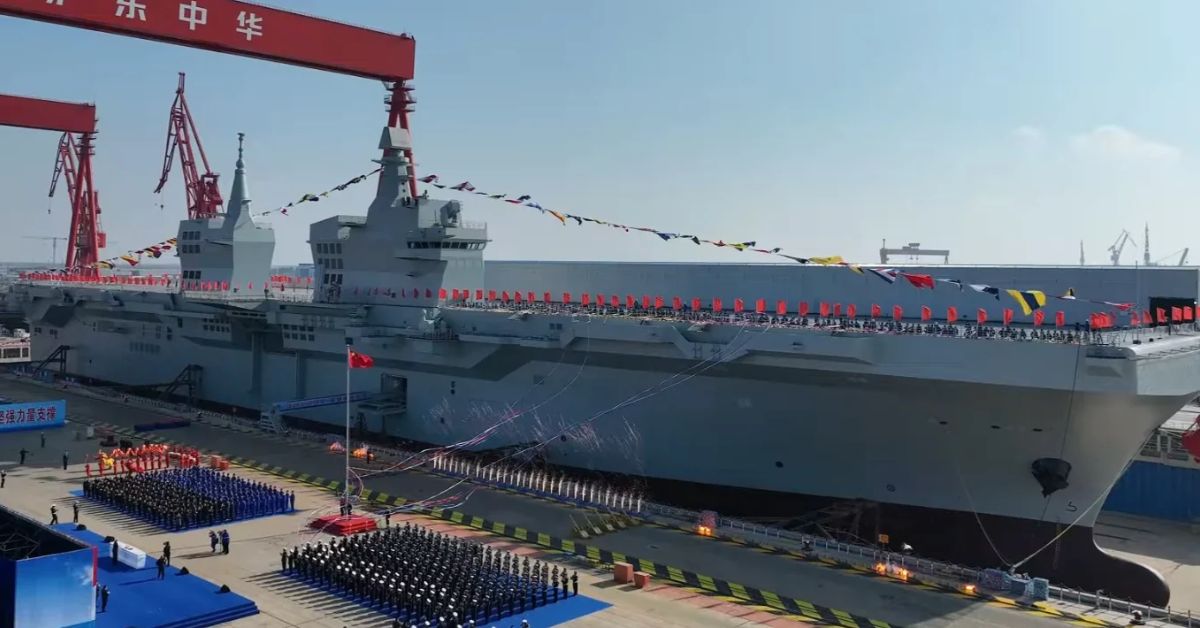
The Type 076 drone carrier's first at-sea launch and recovery of a stealth unmanned aircraft is a calibrated step forward in naval warfare, and it demands our attention not for the hardware alone but for what it signals about the operational future of ocean intelligence. The People's Liberation Army Navy has confirmed that the 40,000-ton Sichuan, pennant 51, successfully flew the GJ-21 stealth reconnaissance and strike drone, integrating an electromagnetic catapult system into a hull evolved from a landing helicopter dock. This is not speculative hype; it is a validated milestone in China's effort to normalize unmanned aviation at sea. For our readers, whether researchers tracking force posture, policymakers assessing regional stability, or analysts mapping naval modernization, the practical takeaway is clear: the era of drone carrier operations has moved from concept to empirical reality, and the data ecosystem of maritime surveillance just expanded.
This development sits alongside related shifts in naval strategy that our publication has covered. India's $5.6 billion corvette order, for instance, reflects a parallel commitment to modernizing fleet capabilities and strengthening ocean intelligence through conventional platforms. India's $5.6B corvette order modernises naval fleet to strengthen ocean intelligence That investment in surface combatants contrasts with China's bet on unmanned systems, but both acknowledge the same reality: integrated, real-time maritime awareness is no longer optional. Meanwhile, the recent drone strike that sank a container ship in the Black Sea illustrates the vulnerability of commercial vessels to unmanned aerial threats, a dynamic the Type 076 could extend into the Indo-Pacific. Drone strike sinks Black Sea container ship, 14 Filipino crew rescued at sea And with naval deployments now stretching to 11 months, the operational timeline for crewed vessels is being reshaped, making unmanned platforms like the GJ-21 increasingly valuable for sustained presence without exhausting personnel. Naval deployments extend to 11 months, reshaping operational timelines at sea
What matters most is the deliberate integration of these systems into a broader force structure. The Type 076 is not an isolated experiment. China has already tested containerized missile and drone launch systems aboard a commercial cargo ship at the same yard where Sichuan was built, and the PLA Air Force is developing Collaborative Combat Aircraft to operate alongside twin-seat J-20 stealth fighters. The GJ-21 itself combines low-observable intelligence-gathering with strike capability, meaning it can collect peer-reviewed-quality surveillance data and act on it in the same sortie. How China plans to task these drones, whether in support of Marine Corps amphibious operations or as part of carrier strike group air wings, remains an open question, but the infrastructure is now being validated at sea.
The specific detail to watch is the electromagnetic catapult. It is the same technology that enables the launch of heavier, more capable unmanned aircraft than the WZ-6 reconnaissance drones already operating across the Western Pacific. If China can reliably launch and recover stealth UCAVs from a 40,000-ton deck, the range and persistence of its ocean surveillance, particularly near Taiwan, Japan, and the South China Sea, will increase measurably. That is not an alarmist projection; it is a direct consequence of a system that has now been tested. The question for our community is whether existing monitoring frameworks can track and attribute these operations with the same precision.