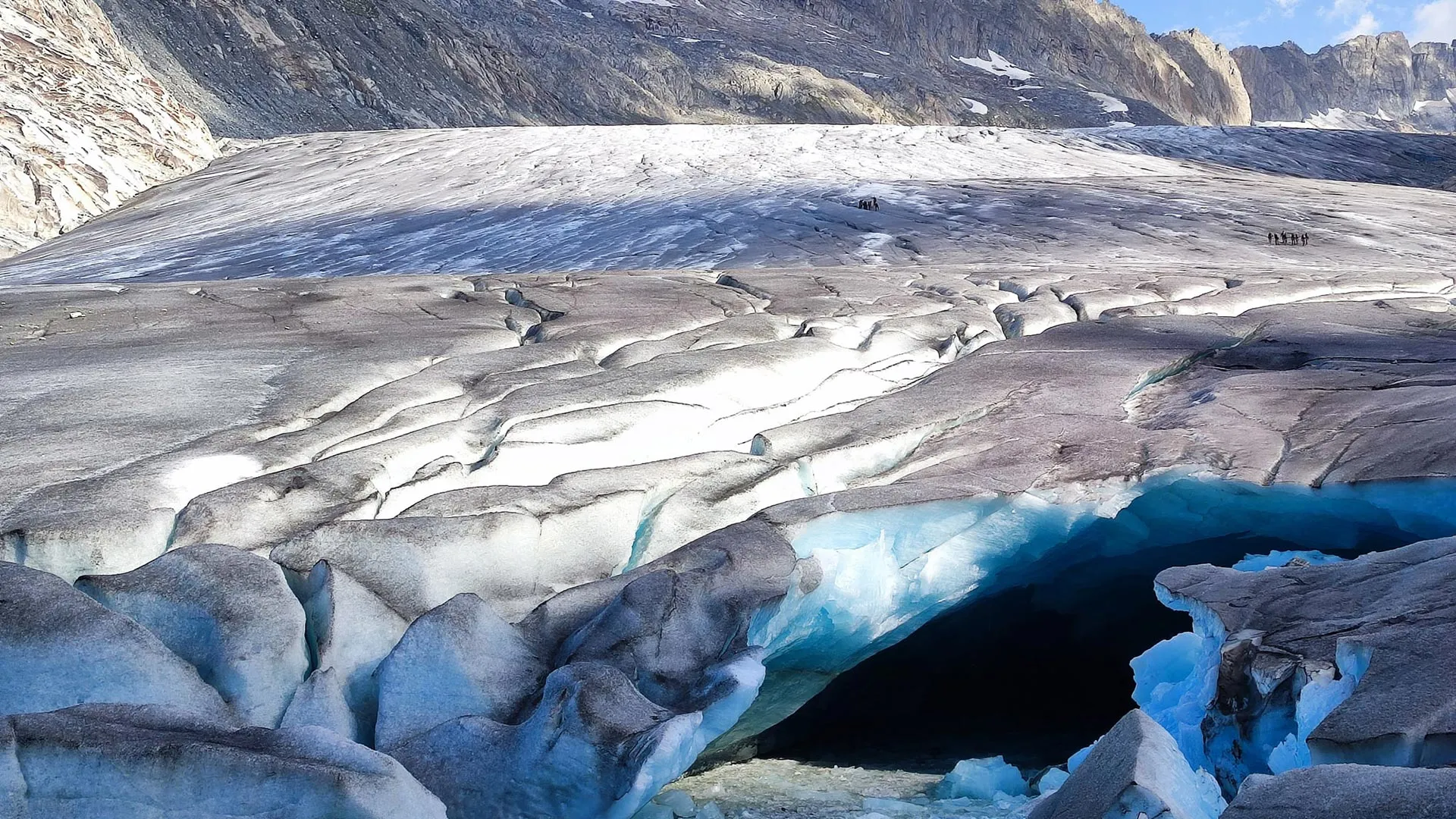
The loss of nearly 20% of Switzerland's glacier ice in just five years is not a distant warning; it is a measured, empirical signal that the cryosphere is responding to climate forcing faster than many models projected. For our readers, researchers, policymakers, and ocean advocates, this data demands a recalibration of how we interpret risk and allocate resources. These are not abstract figures: the 5% volume loss recorded in 2026 alone represents a year of extreme summer heat and snowless winters that erased glaciers that have persisted for millennia. When smaller glaciers vanish completely, the hydrological systems they feed, rivers that sustain agriculture, hydropower, and freshwater supplies across Europe, lose a calibrated buffer against seasonal drought.
This acceleration aligns with patterns we have documented across other Earth systems. The New Atlantic Current Data Signals Weakening and Imminent Tipping Point shows that ocean circulation is approaching a threshold with similarly nonlinear consequences. Both stories share a troubling commonality: the pace of change outruns institutional response times. The glacier data from Switzerland is not an isolated alpine story; it is a real-time climate indicator that feeds into the same integrated data ecosystem that tracks ocean currents, sea-level rise, and freshwater flux. When ice volume declines this sharply, the freshening of polar and subpolar waters accelerates, which in turn weakens the density-driven engine of the Atlantic Meridional Overturning Circulation. These systems are coupled, and the measurements confirm they are moving in concert.
The 27 meters of ice loss measured across 50 years in reference glaciers provides the longitudinal context that makes the Swiss data so stark. A half-century of steady retreat has now compressed into a five-year collapse. That is not a linear trend; it is an inflection point. For policymakers, the practical takeaway is that adaptation plans built on historical baselines are already obsolete. Infrastructure designed for a given meltwater regime, dams, irrigation schedules, cooling systems for nuclear plants, will face conditions outside their design envelope within this decade. For researchers, the priority must shift from documenting retreat to deploying integrated monitoring networks that capture the cascading effects in real time, linking glacier mass balance to downstream ocean salinity and temperature.
The question that remains open is whether the international community will treat this as a discrete alpine tragedy or as the validation of a broader systemic threshold. Data-driven insights unlock measurable pathways to ocean restoration demonstrate that when we integrate observations across domains, actionable pathways emerge. The Swiss glacier data is one such observation. We know what drives the melt: persistent atmospheric warming and reduced albedo from dust and darkening ice. The harder question is whether the loss of these ice masses will trigger a political response commensurate with the speed of the physical change. Watch the 2027 melt season: if another snowless winter follows, the remaining ice may cross a threshold from which recovery is no longer possible within any human timescale.