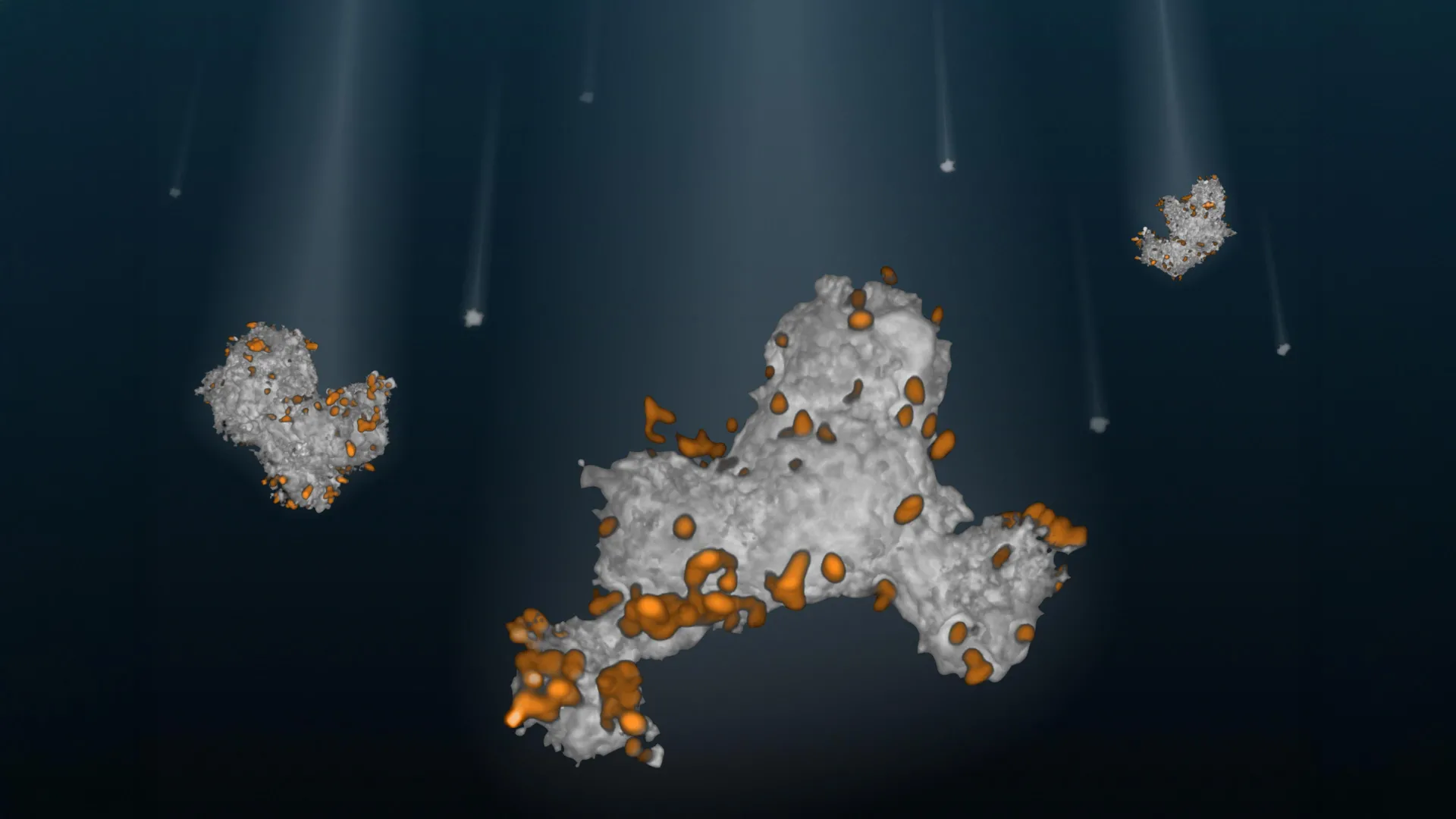
Stickiness is not the first property we think of when we consider the ocean's capacity to regulate climate. Yet this is exactly where the latest empirical work points: gooier marine snow particles resist bacterial breakdown and carry more than six times as much carbon to the deep ocean. That is not a marginal adjustment. It is a measurable, integrated factor in the planet's carbon budget, and it reframes how we read the biological pump. We should treat this as a calibration event, not a curiosity.
For researchers and policymakers alike, the practical consequence is immediate. Carbon flux models that omit particle stickiness are likely underestimating the deep ocean's storage capacity, and by a wide margin. The finding also reinforces a broader lesson we have been tracking across our coverage: the ocean's behavior is best understood through longitudinal, calibrated observation. When we look at how Iceland's warming seas signal a measurable shift in temperate marine species distribution, we see the same principle at work. Species movement is not a vague trend; it is a distributional change we can measure. Marine snow stickiness is no different. It is a physical property with a quantified outcome, and it belongs in our shared data ecosystem alongside temperature, salinity, and current velocity.
The connection to Tidal and current data can clarify ocean dispersal patterns is equally direct. Dispersal models depend on how particles move and degrade, and stickiness governs both. If we are serious about predicting where carbon goes, or where larvae drift, or how nutrients cycle, we need to integrate this variable into real-time observational frameworks. The work also speaks to our ongoing call for Calibrating ocean data: standards for a shared, measurable future. A property like stickiness will only be useful if it is measured consistently across platforms and regions. Otherwise, we risk collecting numbers that cannot be compared.
What we find most compelling is the implied reversal of intuition. We tend to assume that fragile, easily degraded material is less important to deep-ocean storage. Instead, the slime is the shield. The resistance to bacterial breakdown is not an accident; it is a mechanism. That raises a specific question we want answered: how does stickiness vary with warming seas, acidification, or changes in phytoplankton composition? If warming alters the stickiness of marine snow, then the carbon storage capacity we rely on may shift in ways our current models do not capture. That is the detail to watch. The next step is to push for stickiness as a standard variable in ocean observing systems, measured with the same rigor we apply to temperature and salinity. Understanding drives protection, and this finding gives us a clearer, more precise target.