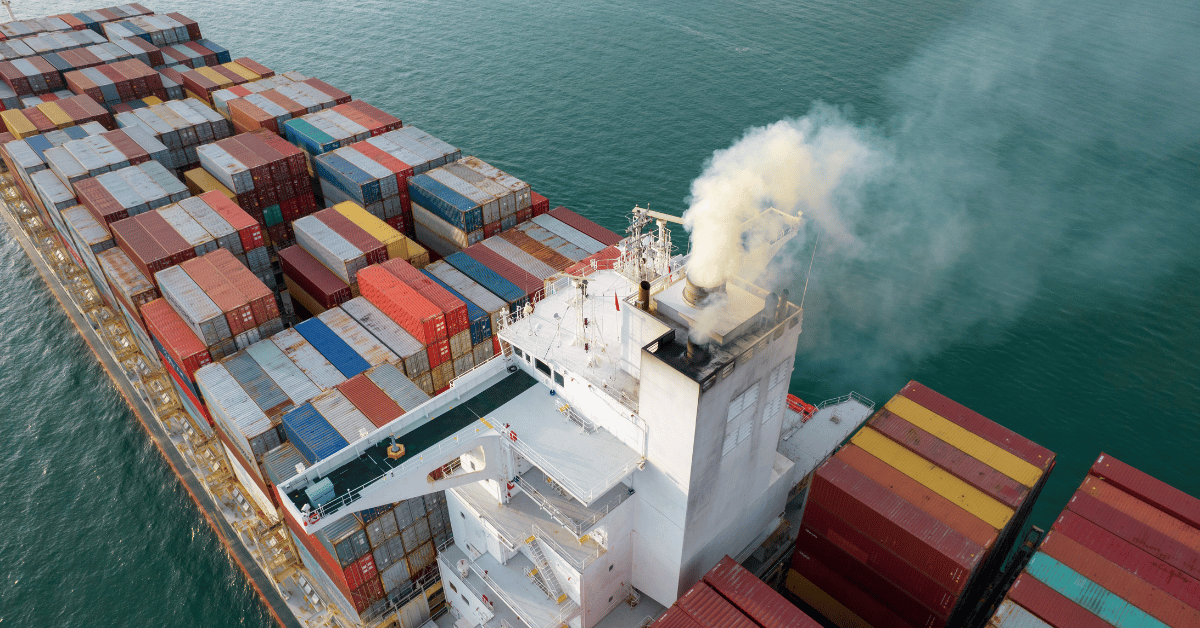
The USD 963 billion price tag attached to three decades of shipping emissions is not a future cost, it is a debt already incurred. A new analysis from Zero Carbon Analytics makes the arithmetic plain: the economic damage from international shipping between 1990 and 2020 exceeds what it would likely cost to decarbonise the sector. This finding reframes the debate at the International Maritime Organization, where talks on the Net-Zero Framework resume this week. Opponents of the policy, including the US and Middle Eastern oil-producing states, cite implementation costs. Yet those same economies are absorbing the largest absolute damages, USD 280.7 billion for the US, USD 113.5 billion for China, USD 66.8 billion for Japan. The true accounting, it seems, has been upside down.
The damage is not evenly distributed. While wealthy nations bear the highest absolute losses, the relative burden falls hardest on lower-income countries and the Middle East. The UAE lost 0.35% of its 2020 GDP; Saudi Arabia lost 0.34%; Mali and Burkina Faso each lost more than 0.3%. These are not abstract figures. They represent forgone healthcare, infrastructure, and resilience in places least responsible for the emissions. This pattern mirrors what we have observed in other domains where environmental change exacts a hidden toll. Consider how Industrial shifts and a cooling climate converged to weaken bone health in historic Europe, a reminder that the interplay between industrial activity and climate does not announce its effects evenly across populations. Similarly, shipping emissions have been a silent line item on national ledgers, unaccounted for in regulatory cost-benefit calculations.
The Net-Zero Framework offers a concrete alternative. According to the analysis, implementing it could avoid approximately 14.2 billion tonnes of CO₂-equivalent emissions between 2026 and 2050, compared to business as usual. It could also prevent an estimated 1.5 million heat-related deaths by 2100. These are not speculative benefits; they are the measurable outcomes of a policy that connects emissions to temperature rise and temperature rise to economic and human impact. As Victoria Kalyvas of Zero Carbon Analytics notes, improved methods now allow us to reveal the hidden costs countries are already paying. The IMO's technical group resumes work on 23 November, with political negotiations to follow. The question is whether member states will continue to treat decarbonisation as a burden or begin to see it as the avoided cost it actually represents. We already know that climate change alters every ocean layer, from surface to abyss. The debate in London this month will determine whether the shipping sector helps slow that alteration, or continues writing checks the global economy must cash.