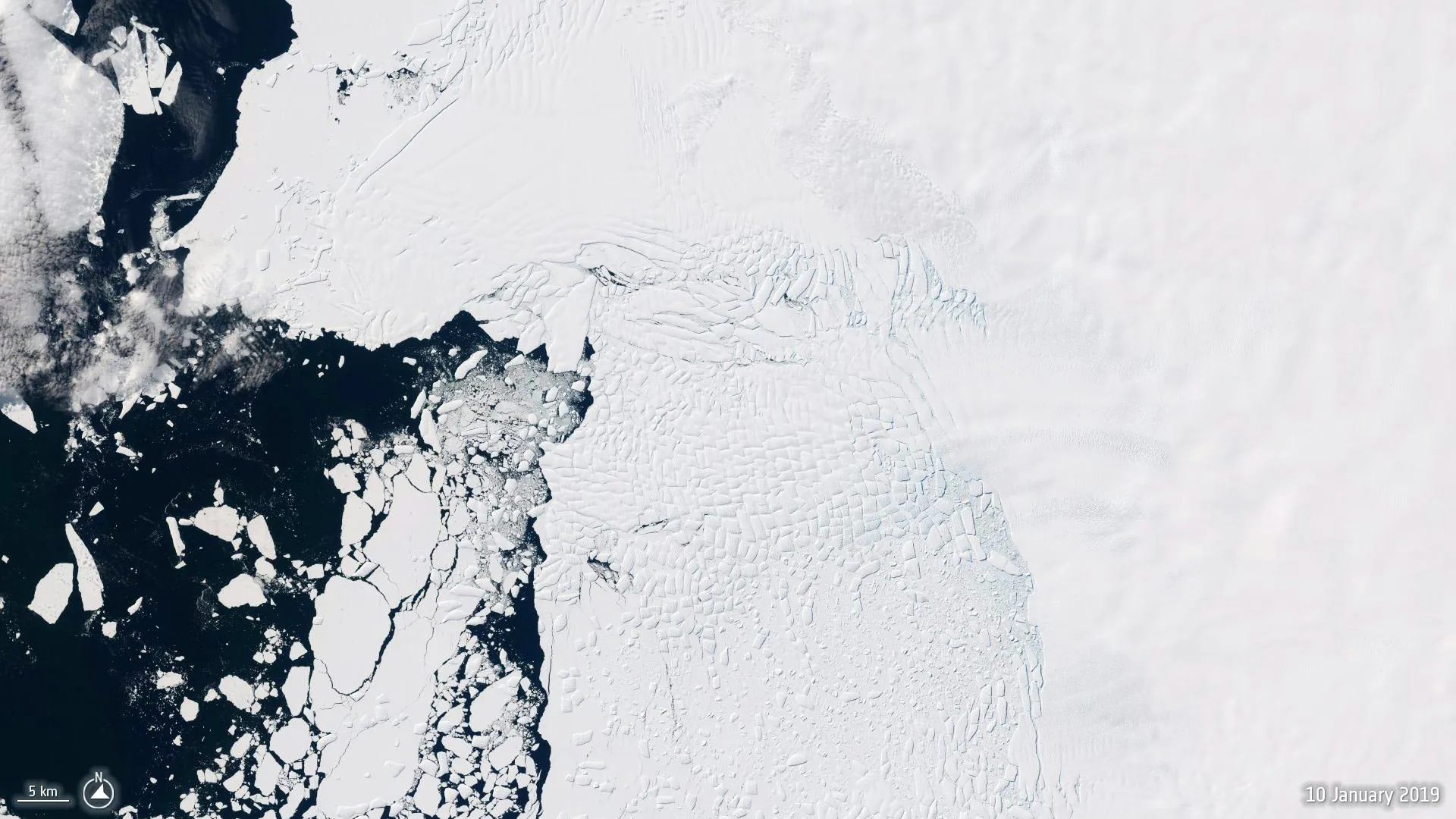
The ground beneath Thwaites Glacier is speaking more loudly than we have listened for before. Hundreds of previously overlooked seismic events have been detected under the Antarctic ice, including 245 near the glacier's marine edge. Many of these signals are glacial earthquakes, triggered when massive icebergs calve, capsize, and slam back into the ice front. The surge in activity lines up with a period when Thwaites was flowing faster toward the ocean, which points toward a direct, physical connection between changing ocean conditions and the glacier's stability. This is not a distant tremor on a seismograph; it is a measurable signal of stress in one of the most consequential ice systems on Earth.
What stands out here is not just the scale of the events, but what they reveal about the mechanics of ice loss. We have long known that warm water intrudes beneath these floating shelves, but these seismic signals give us a real-time, empirical record of the breakup process itself. That is a step change in how we can monitor change. The events are not random noise; they are the acoustic signature of structural failure, and they are occurring in a pattern tied to ice flow acceleration. This connects directly to the kind of integrated, real-time observation we have championed in our own work, such as Real-Time Ocean Simulations Advance Understanding Through Integrated Modeling, where simulated and observational data are being stitched together to read these systems more clearly. The same logic applies here: single measurements are interesting, but calibrated, longitudinal seismic records can turn isolated events into a coherent picture of how the glacier is responding to its surroundings.
There is a practical consequence for how we should think about monitoring and prediction. If we can track these seismic swarms in near real time, we may be able to detect when the glacier is becoming more unstable before a major calving event makes the news. That is not alarmism; it is simply the value of better indicators. The same principle applies to other marine ecosystems under pressure, as seen in research on Antarctic Krill Reproduction Linked to Deep-Sea Hydrothermal Vent Activity, where biological responses are also tied to physical oceanographic conditions. In both cases, the ocean is not a passive backdrop; it is an active driver of change. The more we treat these seismic records as climate indicators, the closer we get to forecasting, not just explaining, ice behavior.
Our take is straightforward: this is the kind of evidence that should sharpen the focus of the research community and the agencies that fund polar observation. The next step is to build this seismic data into the broader integrated data ecosystem alongside ocean temperature, ice velocity, and bathymetric surveys. The open question is whether the current monitoring network is dense enough to capture the next surge with the same clarity. That is the detail to watch. Because if these events are indeed precursors to faster flow, then a quiet seismic record may be the most misleading thing we can rely on. We would tell any reader who asks: do not wait for the next big iceberg to make headlines. The signal is already in the data, and it is growing louder.