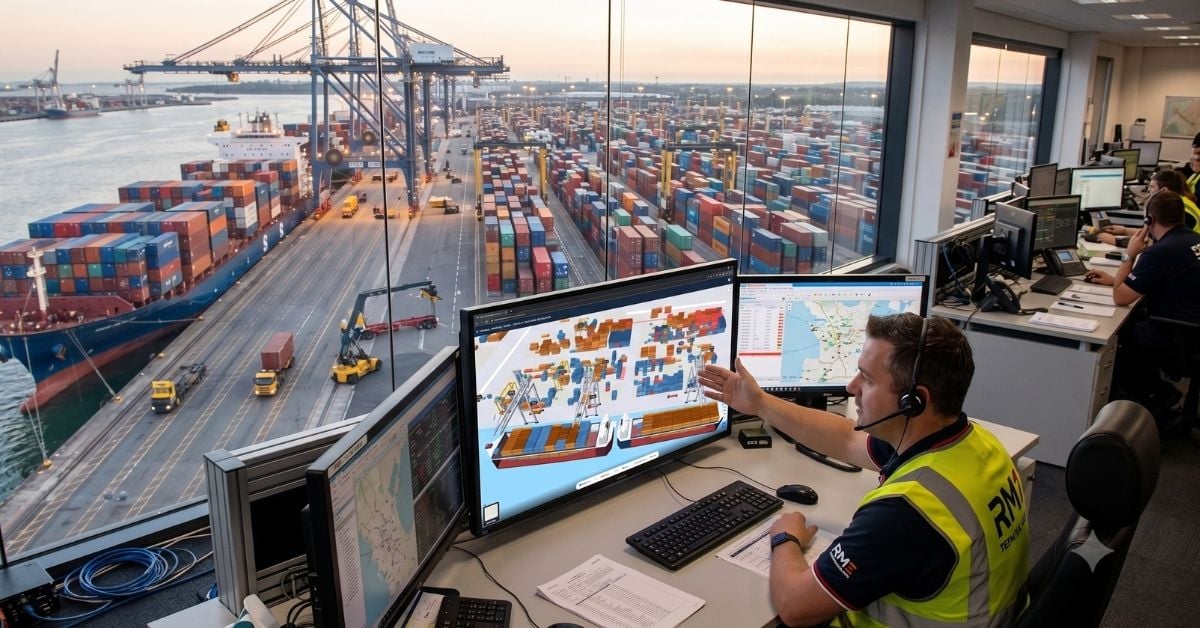
A terminal yard that flows freely in the morning can become a bottleneck by midday, and the difference between a productive shift and a costly delay often comes down to what managers cannot see. A digital twin that gives terminal staff a live view of operations and, more importantly, a forecast of what is coming next is described for real-time yard visibility. This is not a luxury feature; it is a practical response to a fundamental operational problem. For port operators, shipping lines, and logistics planners who have long relied on periodic reports that arrive too late, this tool represents a shift from reactive management to informed anticipation. We would tell any reader asking about it: the value is not in the dashboard itself but in the decisions it enables before congestion sets in. For a deeper look at how digital tools are reshaping port operations, see our coverage of AI in Port Logistics and Real-Time Cargo Tracking.
Our take is that this technology addresses a persistent blind spot in terminal management. A yard with ample space in the morning can become crowded within hours, and that reality is familiar to anyone who has watched a single vessel delay cascade into gridlock. A digital twin that integrates real-time sensor data, equipment status, and vessel schedules gives operators a calibrated view of the yard as it is, not as it was when the last report was generated. More importantly, it offers predictive capability, the ability to simulate what will happen if a crane goes down or a truck arrives early. This is measurable operational intelligence, not speculative hype. For the reader who manages a terminal or plans cargo flows, the practical consequence is straightforward: fewer idle assets, faster turnaround, and a yard that absorbs variability without breaking.
We see two implications worth watching. First, the success of such a system depends on data integration across silos. A digital twin is only as good as the empirical inputs it receives, if equipment sensors are not calibrated or vessel schedules are not shared in real time, the model becomes a pretty picture with limited utility. Second, the technology raises the question of who owns the data. When a terminal operator gains this level of visibility, it can improve coordination with shipping lines and trucking companies, but it also creates an asymmetry of information. The open question is whether the industry will adopt shared standards for data exchange or whether each terminal will build its own walled garden.
The specific takeaway our readers should quote: a digital twin does not solve the problem of yard congestion by itself, it solves the problem of not knowing where the congestion is forming. That distinction matters because it forces terminal operators to invest in the sensors, integrations, and training that make the model actionable. The detail to watch is how quickly the industry moves from pilot projects to operational standards. If the data becomes interoperable, we could see a step change in port efficiency. If not, the tool will remain a competitive advantage for the few rather than a shared benefit for the many.