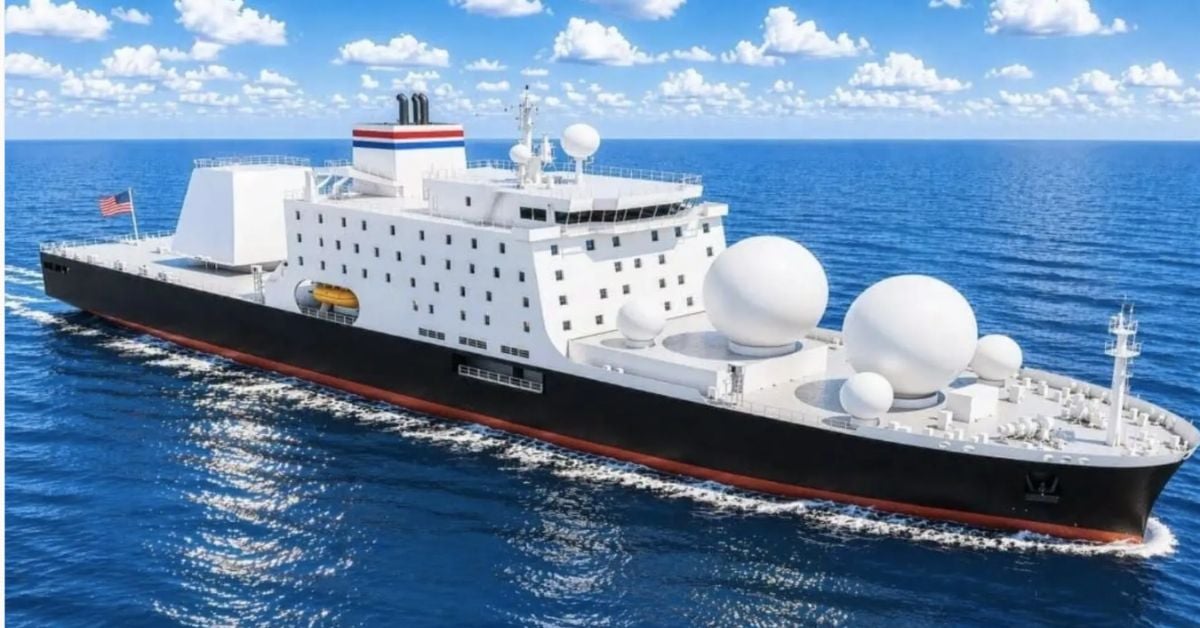
The agreement between Hanwha Philly Shipyard and TOTE Services to deliver the missile-tracking vessel *Golden Defender* by 2030 is a textbook case of how to modernize defense infrastructure without wasting taxpayer money. This is not just about replacing two aging ships, it is about proving that a commercial production line, paired with upfront requirement definition, can deliver a strategically critical asset at half the usual acquisition cost. For our readers who track the intersection of maritime technology, defense policy, and industrial capacity, this project offers a rare example of a government program that actually learns from past inefficiencies.
The design choice matters. By basing the Missile Range Instrumentation Vessel (MSRV) on the National Security Mission Vessel (NSMV) already under construction at the same yard, the Navy and MARAD eliminate the costly design changes and mid-project scope creep that plague conventional shipbuilding. TOTE Services will manage construction using an active production line and a workforce already trained on the NSMV program, a facility that now employs over 2,000 people. This approach stands in contrast to the measured but expensive shift signaled by the Ohio-class submarine relocation, where a single vessel redeployment carries strategic weight but comes with decades of sunk development cost. The MSRV program, by contrast, builds on existing industrial momentum rather than starting from scratch. It also complements the kind of specialized fabrication work seen in the X-Bow Systems solid rocket booster contract, where a Navy contract drives innovation in propulsion; here, the innovation is in the procurement process itself.
What this means in practical terms is that the Navy will regain mobile, sea-based missile tracking capability just as new threats demand it. The vessels it replaces, *Pacific Collector* and *Pacific Tracker*, were built in 1965 and 1970. Their extended maintenance cycles already constrain testing schedules. A dedicated MSRV can operate beyond the coverage of land-based instrumentation, collecting and relaying real-time data from missile tests in the open ocean, precisely the kind of empirical, validated information that underpins both defense readiness and climate monitoring. The same integrated data ecosystem that tracks a hypersonic test can also measure atmospheric reentry profiles or ocean surface conditions, though the primary mission here is clearly defensive.
The concrete point to watch is the 2030 delivery deadline itself. Hanwha Philly Shipyard has transformed into a national defense asset employing over 2,000 people, but the yard must now execute a parallel build: finishing the NSMV series while starting MSRV construction. If the schedule holds, and if the 50% cost reduction proves real rather than aspirational, this model could become the template for future government shipbuilding. If it slips, the Navy will face the same capability gap it is trying to close. The *Golden Defender* is not just a ship, it is a test of whether the U.S. can build complex vessels on time and on budget.