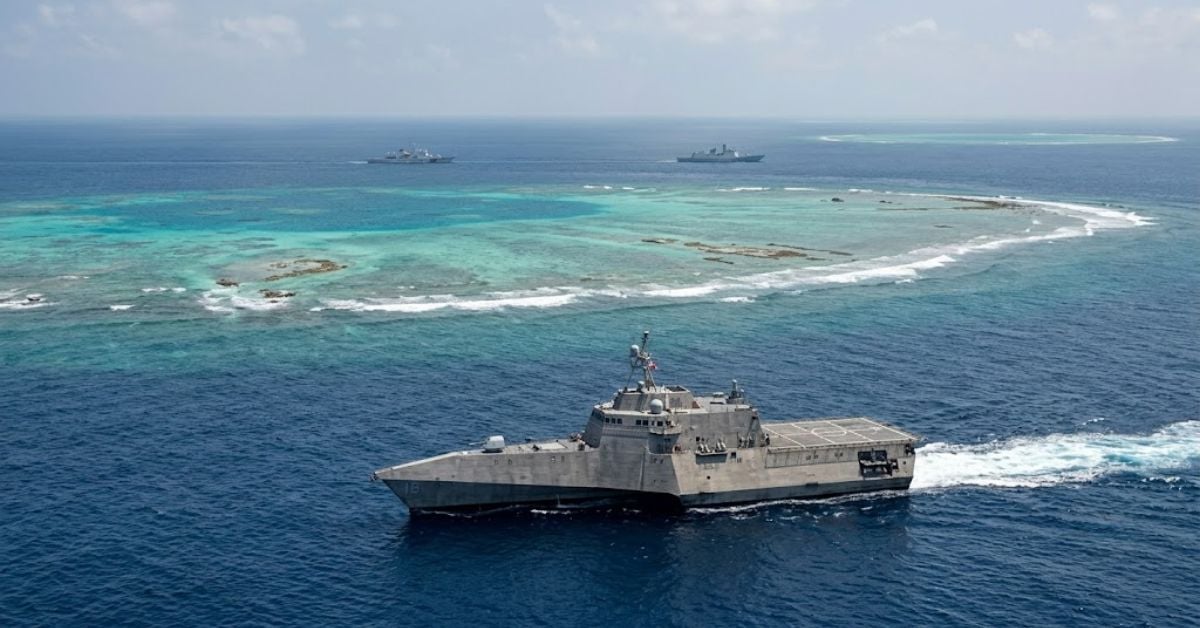
The USS Charleston incident near Sabina Shoal is not a new crisis, but it is a revealing one, and it shows that the region's most persistent dispute will not be resolved by warship presence alone. What is needed is a framework of empirical, legally calibrated ocean intelligence that can separate navigational fact from territorial fiction. Without it, every transit risks escalation, and every claim remains a political statement rather than a measurable data point.
This standoff follows a familiar script: China invokes its Law on the Territorial Sea to demand prior permission for foreign naval vessels, while the United States insists on the right to freedom of navigation under international law, citing the 2016 Arbitral Tribunal ruling. Both positions are legally coherent within their own frameworks, but they are mutually exclusive. That is the core problem. As we have noted before in our analysis of Navigating the Legal Boundary Between Police and Military Force in the South China Sea, the line between law enforcement and military action in these waters is dangerously thin. What the Charleston incident adds is a practical test: when a vessel operates where one party claims territorial seas and another claims international waters, who decides? The answer today is political posturing, not calibrated, peer-reviewed maritime evidence.
The practical consequence for our readers, researchers, policymakers, and ocean analysts, is a clear gap. No integrated data ecosystem exists that can independently validate whether a transit like the USS Charleston's falls inside or outside a state's territorial sea under the 1982 UN Convention on the Law of the Sea. The Sabina Shoal sits approximately 75 nautical miles west of Palawan, within the Philippines' claimed Exclusive Economic Zone, but China's nine-dash line extends claims far beyond that. These overlapping assertions are not new, but they remain unmeasured by any shared, real-time ocean intelligence platform. As we discussed in Validating ocean prediction: the operational legacy of Global NCOM, validated models and empirical data have long been used to track ocean behavior for naval operations. The same rigor should be applied to the legal geography of disputed features, mapping reefs, shoals, and low-tide elevations with calibrated, peer-reviewed bathymetry rather than political maps.
China's insistence that the South China Sea does not contain international waters is a claim without empirical support in the UNCLOS framework. The United States' insistence that it may operate anywhere international law permits is equally unsupported by any shared, verifiable data on feature status. Both positions rely on legal interpretation, not on measurable ocean intelligence. That is unsustainable. The specific detail to watch is whether any party begins to submit calibrated, longitudinal evidence of feature status, such as whether Xianbin Reef is a low-tide elevation or a rock capable of generating an EEZ, to an independent body. Until that happens, every naval transit is a gamble, and every response is a risk. The ocean deserves better than competing assertions; it deserves validated clarity.