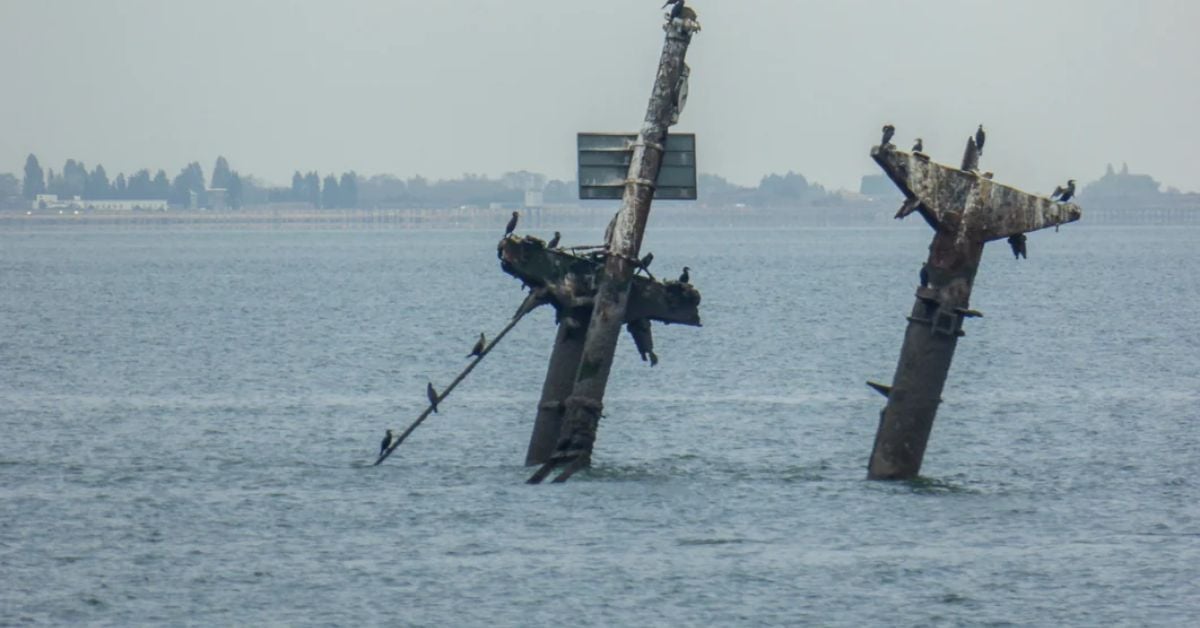
The removal of the three masts from the SS Richard Montgomery is not a solution to the wreck's danger, it is a calibrated, necessary reduction of risk. British authorities made the right call: the masts were becoming a structural liability, and their collapse could have triggered a catastrophic blast from the 1,400 tonnes of ammunition still onboard. For the communities along the Thames Estuary, this operation buys time and reduces a tangible threat, but it does not eliminate the underlying problem.
The wreck, known locally as "Monty," has been a known hazard since it sank in 1944 with roughly 7,000 tonnes of ordnance bound for Britain. Despite unloading nearly half the cargo, the ship still holds over 2,000 cluster bombs, 300 blockbuster bombs weighing 900 kilograms each, and white phosphorus artillery. A 2004 report projected that an explosion could send a small tsunami into Sheerness, shattering windows and destroying the town. Yet, as University College London's David Alexander noted in 2019, the precise impact remains uncertain, a reminder that even the best models cannot fully predict a blast of this scale. The decision to remove the masts, rather than attempt full salvage, reflects a pragmatic assessment: the wreck's steel has become "paper-thin," and any aggressive intervention could be more dangerous than leaving the ammunition in place. This mirrors the careful, data-driven approach seen in Autonomous Systems Chart Safer Course for Undersea Explosive Clearance, where the U.S. Navy is deploying robotic systems to handle underwater explosives without putting divers in harm's way. Similarly, the Resolve Marine team used radar, sonar, and magnetometers to survey the site, then employed specialized equipment to minimize vibrations during the mast-cutting operation, a textbook case of empirical risk management.
What does this mean for policymakers and the public? The masts' removal is a stopgap, not a cure. The shipping exclusion zone and the no-fly zone imposed since 2025 are necessary, but they are passive measures. The wreck remains a time bomb, and the question of full remediation is still open. The operation's success in reducing the load on the hull is validated, but it also highlights the limits of our ability to address legacy hazards from past conflicts. This is not a problem unique to the Thames: as Mitigating a Wartime Legacy: Masts Removed From Munitions Wreck in Thames documents, similar wrecks dot coastlines worldwide, each requiring site-specific, empirically grounded interventions. The SS Richard Montgomery's masts now sit at Dockyard Chatham, preserved as historical artifacts, but the real story is what remains underwater, and what we still do not know about how to safely remove it. The concrete takeaway is this: the risk has been measurably reduced, but the core hazard persists, and the next step requires a decision on whether to attempt full removal or accept a perpetual exclusion zone.