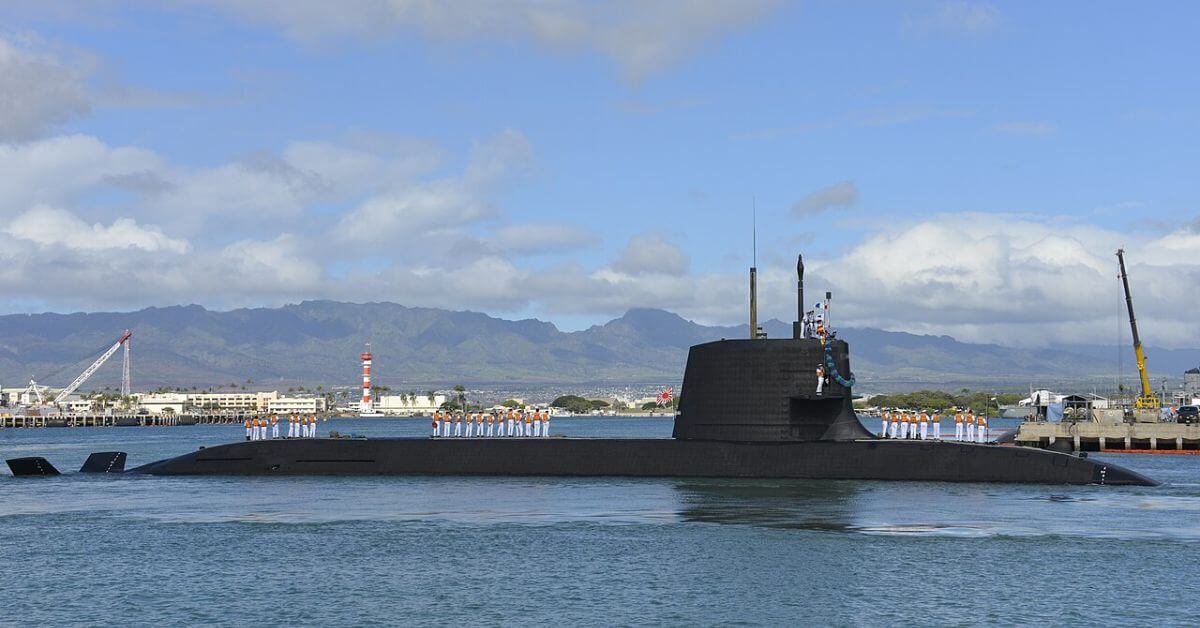
Japan's decision to fold a submarine-launched hypersonic missile into its FY2027 budget request is not a headline to file under defense trivia. It is a calibrated signal, issued from a position of long-term strategic thinking. The Ministry of Defense's plan, reported at the end of August 2026, tells us that Tokyo is no longer treating maritime deterrence as a matter of fleet size alone, but as a question of reach and response time. For those of us who track ocean intelligence, this is the kind of development that redraws assumptions about who can project power across which water. It is not alarmist to note that the Indo-Pacific is becoming a denser, faster, and more contested environment. It is simply empirical.
What makes this move noteworthy is not the technology in isolation, but how it interacts with the maritime logistics and data ecosystems we already monitor. Consider the related pressures we have covered: Gulf of Oman STS Transfers Max Out Amid Rising Saudi Oil Exports and Record Port Activity Reflects Rising Chinese Exports Amid Trade Uncertainty. These are not separate stories. They are the same story of a region where chokepoints, commercial flows, and military capabilities are tightening in lockstep. Japan's hypersonic program is a response to that integrated reality, not a standalone weapons project. When a nation with Japan's maritime history decides to arm its submarines with Mach 5 strike capability, it is acknowledging that the ocean is no longer a passive highway but a contested domain where speed decides leverage.
Our read is practical. For shipping operators, insurers, and logistics planners, this budget line item is a leading indicator of operational risk. Hypersonic missiles do not change the physics of a voyage; they change the calculus of escalation. A submarine that can strike from beyond conventional torpedo ranges alters transit planning near strategic straits. The Integrated Subsea Infrastructure Shifts to Enhance Indian Ocean Connectivity piece we published points to a parallel truth: the Indian Ocean is being rewired, both physically and now militarily. If data cables and energy routes are being re-routed for resilience, it would be naive to assume naval posture is not being re-routed for the same reason.
Here is what we would tell a reader who asks what this means for them. Watch the procurement timeline, not the press release. Hypersonic systems are notoriously difficult to validate, and Japan's engineering culture prioritizes reliability over speed to deployment. The FY2027 request is a budget document, not a fielded capability. The open question is whether this accelerates the regional arms dynamic or whether it simply raises the threshold for conflict because no one wants to be the second mover. The concrete point to track is how this affects submarine patrol patterns in the Philippine Sea over the next 24 months. That is where the intent will show, in the quiet data of submerged movements, long before any missile is fired.