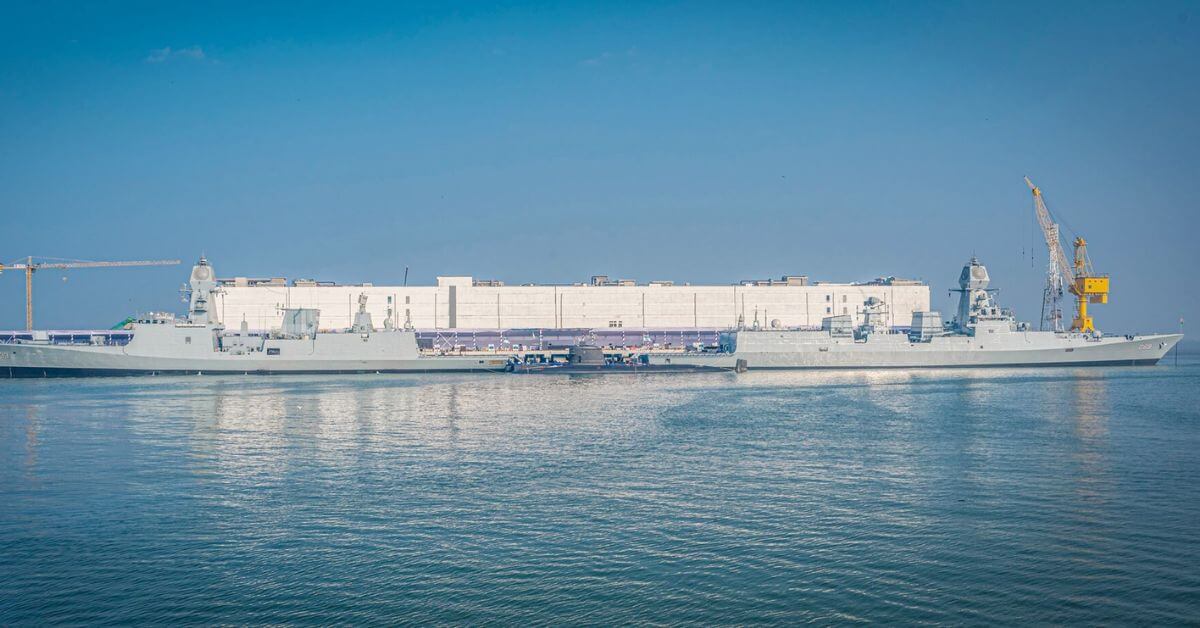
India's decision to greenlight a ₹27,000 crore greenfield shipbuilding cluster at Mazagon Dock, with the Maharashtra government projecting 90,000 new jobs, is a serious commitment to a sector that rarely makes headlines beyond naval strategy or cargo routes. This is not a minor expansion; it is an industrial bet placed squarely on the ocean as an economic engine. For our readers, the number that matters is not the crore figure but the 90,000 jobs, a workforce pipeline that will demand skills ranging from welding to systems integration. The ripple effect on ancillary industries, from marine electronics to logistics, will be felt far beyond the dockyard gates. This is the kind of tangible, measurable progress that aligns with the integrated data ecosystem we often discuss, where investment in physical infrastructure must be matched by investment in human capital and operational transparency.
The timing is instructive when we place this alongside Cochin Shipyard Expands Design Capabilities with Conoship Equity Stake. India is not just building hulls; it is acquiring design intelligence. A greenfield cluster without design ownership would be a low-margin assembly line. By coupling Mazagon's scale with Cochin's equity-driven design acquisition, the subcontinent is signalling a move up the value chain. Similarly, the security dimension cannot be ignored. As we have seen with Maritime Interdictions Yield 25,000 Pounds of Cocaine, Supporting Ocean Security, maritime domain awareness is a defensive necessity. A robust commercial shipbuilding base is a force multiplier for that awareness, because a nation that builds its own fleet can also deploy it for monitoring and response. This cluster is not just an economic story; it is a sovereign capability story.
Our take is straightforward: this is a validation of long-cycle industrial policy, but the proof will be in the execution. The 90,000 jobs are a projection, not a promise. What we would tell a reader asking about this is to watch for the employment mix. Will these be skilled fabrication roles or will they include the design and systems engineering jobs that anchor wealth creation? The Mazagon cluster will succeed or fail on its ability to integrate with existing defence production and commercial shipping demand. We are not talking about a speculative venture; we are talking about a calibrated expansion of physical capacity that must be matched by digital readiness. A shipyard that cannot manage its own supply chain in real time will struggle to compete.
The specific consequence to watch is whether this cluster catalyses a broader ecosystem for ship recycling and retrofitting, particularly for environmentally compliant vessels. If the design phase incorporates dual-fuel or electric propulsion from day one, this becomes a global benchmark. If it does not, it risks locking in outdated assets for decades. As we look at the Alaska’s Base Kodiak to Gain Enhanced Arctic Capabilities with New Pier investment in the Arctic, the parallel is clear: infrastructure is only as forward-looking as its specifications. The question for Mazagon is whether this cluster is built for the vessels of 2040 or merely the ships of today. That answer will determine if this is a one-off boom or a durable industrial shift.