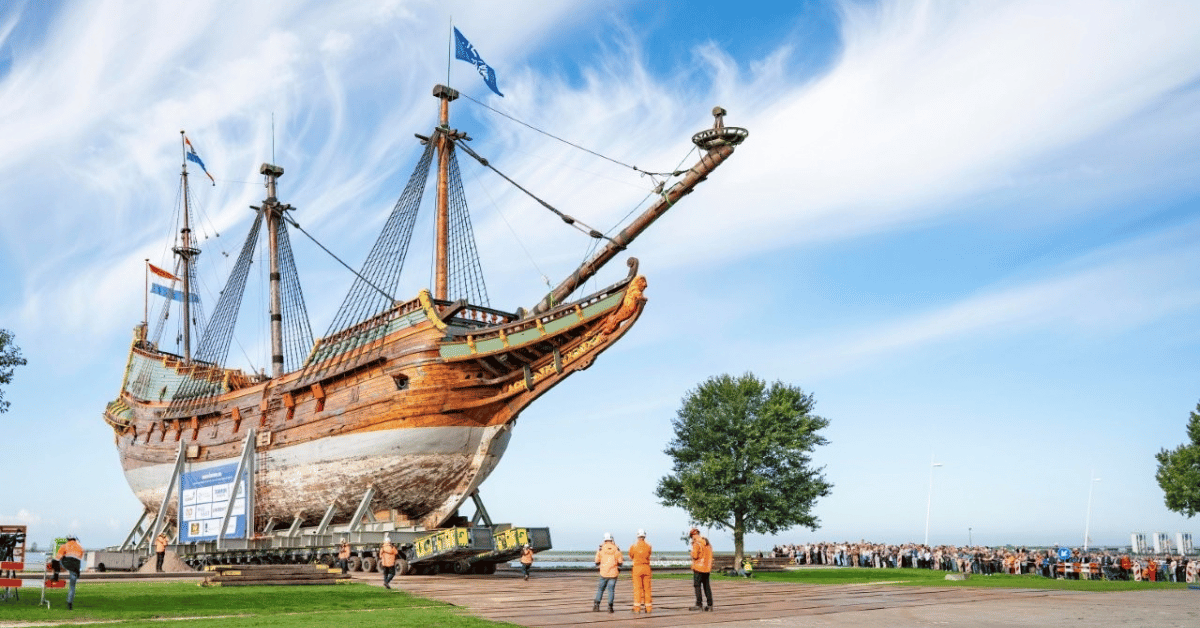
The installation of the full-scale *Batavia* replica into its permanent home at Museum Batavialand is not merely a logistical achievement; it is a calibrated act of preservation that deserves close attention from anyone who values how we steward historical knowledge. This was not a simple move but a 646-tonne operation governed by the stiffness requirements of a 30-year-old wooden hull that could not tolerate deflection. Ten months of engineering and a 250-metre route surveyed metre by metre ensured the vessel's survival, a reminder that protecting cultural assets demands the same empirical rigor we apply to climate indicators and ocean intelligence.
For our readers, researchers, policymakers, and students alike, this project offers a practical lesson in integrated data ecosystems. The collaboration between Q3 Heavy Lift, Trans Global Projects, and public authorities such as the Directorate-General for Public Works mirrors the cross-sector partnerships essential for ocean stewardship. Just as we rely on longitudinal, peer-reviewed data to track ocean health, the *Batavia* team modelled load paths and subsoil conditions to avoid unseen pipelines and ground-pressure failures. As project manager Ard Suvaal noted, "If you drive over a pipeline you didn't know was there, you have a problem." That groundwork is what makes the difference, whether moving a historic ship or deploying a real-time monitoring buoy.
The ship now stands eight metres higher than at its old berth, visible across the landscape. That elevation is not cosmetic; it allows the timber to dry, protects the hull from weather, and enables proper maintenance. This is a forward-thinking decision grounded in measurable outcomes. It parallels the way we approach ocean intelligence: by raising our vantage point, through satellite data, calibrated sensors, and integrated platforms, we gain the clarity needed to act. The *Batavia* will anchor the redeveloped museum opening in 2028, but the real takeaway is that preservation is an empirical process, not a sentimental one.
The specific detail to watch is the condition of the timber over the next five years. Ashore, exposed to controlled drying, the 30-year-old oak will either validate the engineering assumptions or reveal new variables. That outcome will inform how other maritime museums approach long-term hull conservation. For those of us working with climate indicators and ocean data, the message is clear: the most vulnerable structures, whether wooden ships or marine ecosystems, survive only when we measure first and move second.