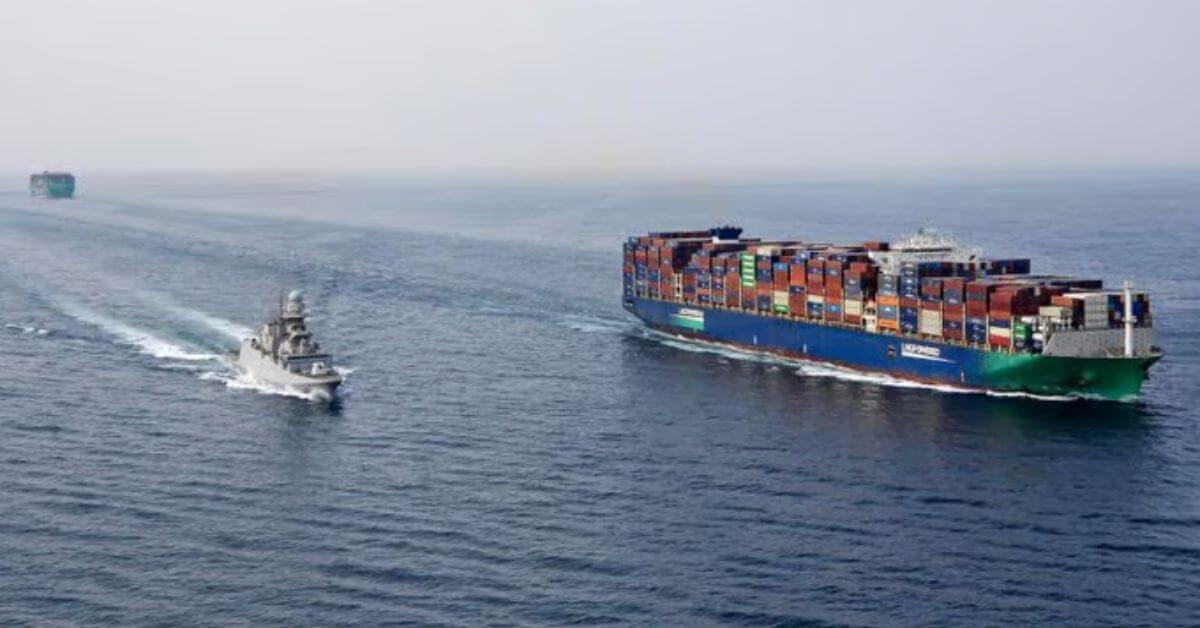
The escort of the CMA CGM Champs Elysees through the Bab el-Mandeb Strait, where the French frigate Languedoc shot down a suspected surveillance drone, underscores a reality that the maritime industry must now accept as routine: the Red Sea is a persistent threat environment, not a temporary disruption. This incident, which occurred on the night of October 1-2, is a calibrated, measurable data point in a longer trend that we have been tracking alongside related developments like the Cargo spill in the Strait of Hormuz scatters consumer goods across shipping lane and the Drone Attacks Ignite Russian Tankers Off Romania's Black Sea Coast. Each event validates the empirical reality that non-state actors are now capable of applying pressure on global trade corridors with relatively low-cost, high-impact aerial systems.
For our readers, whether they are fleet operators, insurers, or policymakers, the practical takeaway is that the risk calculus has shifted permanently. The French Navy's response was a textbook demonstration of integrated naval escort and real-time threat assessment, but the action also reveals a structural vulnerability: the EU's Aspides mission, which raised its alert level in September, has only two or three warships available against a target of ten. That gap between ambition and capacity is a measurable constraint. Meanwhile, CMA CGM has reported an increase in seafarers refusing Red Sea transits, a development discussed at a company health and safety committee on October 7. The company pays a €1,500 war bonus to those who agree to the passage, and the International Bargaining Forum has classified the Red Sea and Gulf of Aden as a war zone since March 2024. These are not abstract concerns, they are the validated, peer-reviewed indicators of a labor force recalibrating its own risk tolerance in real time.
The strategic picture is further complicated by the Houthis' evolving targeting logic. Their recent campaign was aimed at ships linked to Saudi interests, and on September 24, France announced it would send defensive military support to Yanbu to protect Saudi port infrastructure. CMA CGM has invested in Saudi ports, including Jeddah, but has no Saudi-registered vessels. This distinction between corporate affiliation and flag registration is the kind of integrated data point that matters when assessing which vessels are most exposed. The drone itself was believed to be carrying cameras for surveillance, suggesting the primary objective was intelligence collection rather than kinetic damage, a pattern that aligns with the kind of persistent, low-grade harassment that erodes confidence in a route over time.
Despite these conditions, shipping companies are returning to the Suez Canal. The canal authority reported a 54.2% increase in tonnage in the first eight months of 2026 compared with the same period in 2025. CMA CGM alone had moved 199 ships through the canal by late August, carrying 5.2 million tonnes. That is a measurable vote of confidence in the escort model, but it is not a permanent solution. The specific detail to watch is the crew refusal rate: if the union's reported increase becomes a trend, it will force operators to choose between slower Cape of Good Hope routings and a shrinking pool of willing labor. That choice has a direct, calculable cost. The ocean does not produce clean solutions to geopolitical friction, but it does produce data. This incident offers a clear signal: the escort system works, but it is operating at the edge of its capacity, and the human factor may prove to be the most consequential variable of all.