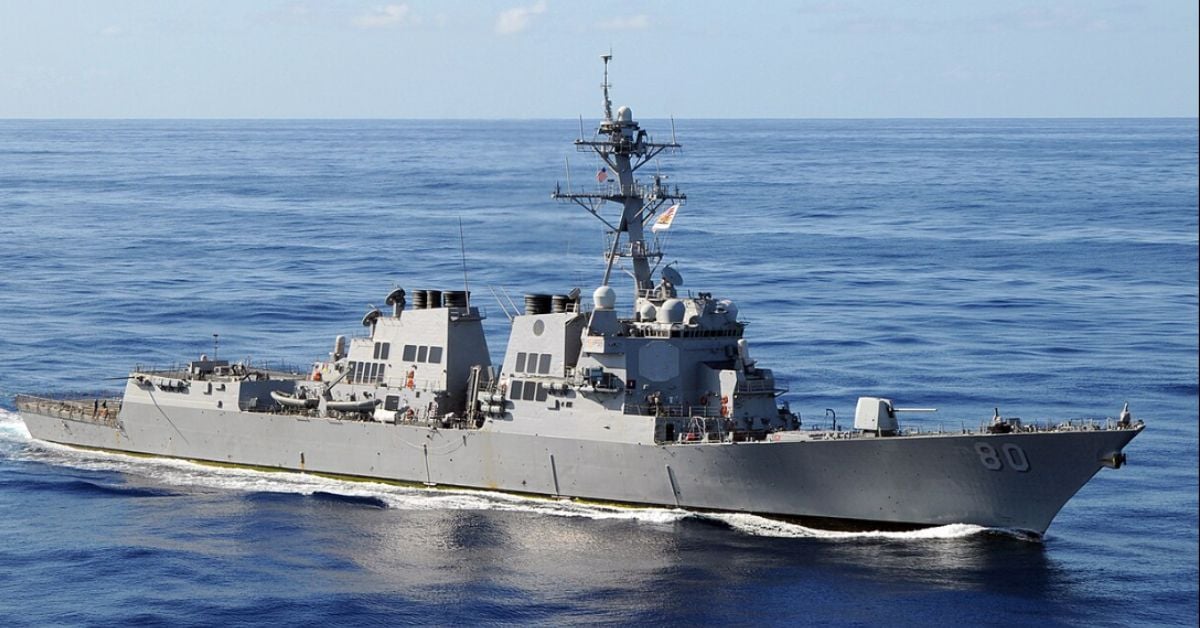
The U.S. Navy's decision to deploy an AI-driven sensor-fusion system across five Arleigh Burke-class destroyers is a practical validation of a principle we have long championed: that integrated, real-time data ecosystems reduce human error and strengthen maritime security. This $25 million contract moves the Intelligent Perception System from testing into active fleet operations, and that matters for every stakeholder who depends on safe, transparent sea lanes.
The system's core function, converging infrared sensors, navigation feeds, and cameras into a single software overlay that alerts crews to collision risks, directly addresses the kind of catastrophic human failures seen in the 2017 collisions of the USS Fitzgerald and USS John S. McCain. By automating vessel tracking and trajectory prediction, IPS shifts the burden from fatigued sailors manually cross-checking radar and camera feeds to a calibrated, real-time digital picture. This is not about replacing human judgment; it is about giving crews the validated data they need to act before instinct or exhaustion fails. The same logic applies ashore, where Validated digital identity strengthens maritime security against fraud by closing gaps in paper-based credentialing. Both systems replace disconnected records with integrated, peer-reviewed information streams that reduce ambiguity at critical moments.
What makes this deployment particularly significant is the data pipeline feeding it. The Navy's Data Edge Collection Kit trial gathered thousands of hours of ship video to train the computer vision models now running on IPS. That training loop continues: an onboard data engine manages satellite bandwidth to transfer sensor data to shore stations, where new machine-learning models are refined and pushed back to warships via software updates. This creates a closed feedback cycle that allows the fleet to adapt to emerging threats without requiring structural overhauls to aging destroyers. It is a measurable step toward the kind of adaptive, forward-thinking maritime posture that the At-Sea Missile Replenishment Test Validates Faster Naval Resupply System also aims to achieve, faster response loops that keep vessels operational in contested environments.
The open question is how this system scales across the Navy's mixed fleet of manned and unmanned ships. IPS is designed for easy integration on older destroyers, but scaling software across platforms with different sensor suites and bandwidth constraints will test the architecture's flexibility. The specific detail to watch is the onboard data engine's ability to prioritize which data gets transmitted to shore under bandwidth limits. If the Navy can refine that filtering process, IPS becomes a template for how any large vessel, commercial or military, can turn raw sensor noise into actionable ocean intelligence. That is the concrete consequence of this contract: not a futuristic promise, but a working feedback loop that will either prove its worth in real collisions or reveal gaps that require new empirical data to close.