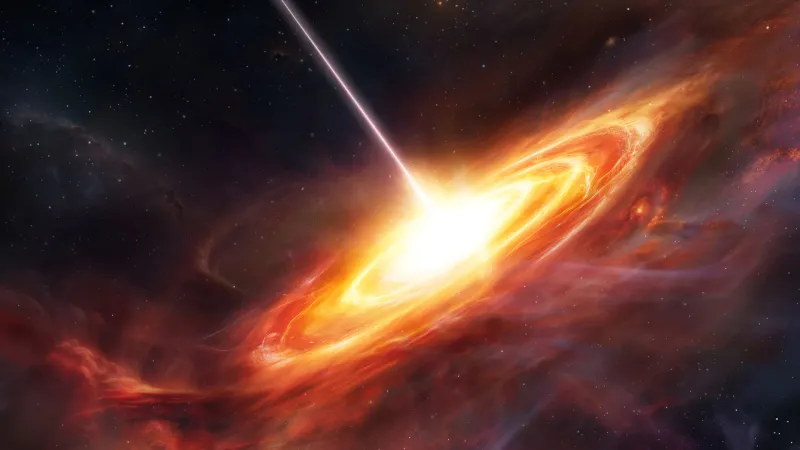
The Euclid space telescope has handed us a question that feels almost impertinent in its simplicity: how did black holes get so big, so fast, so early? The discovery of a distant quasar, observed as it was when the universe was a fraction of its current age, suggests that the growth of these gravitational behemoths was not a slow, steady grind but a rapid, almost violent process. For researchers, this is not just another data point; it is a constraint on every model of cosmic evolution we hold. We are watching the machinery of the early universe operate on a timescale that defies our usual sense of patience.
Our take is that this finding does more than confirm the existence of massive black holes in the early universe; it challenges the timeline of their assembly. The quasar's brightness and mass, as captured by Euclid, imply an accretion rate that borders on the extreme. We would tell a reader who asks, "Why does this matter?" that this is the difference between understanding the universe as a static archive and seeing it as a dynamic, evolving system. Practically, this discovery refines the parameters for future observatories like the James Webb Space Telescope, which will now have a specific target to probe. It turns a theoretical problem into a measurable one. The Euclid space telescope discovery is a reminder that our instruments are not just taking pictures; they are taking depositions from the past.
But here is where we push back on the usual narrative of "mystery solved." This is not a solved problem; it is a sharper definition of the mystery. The quasar's existence forces us to consider that the seed black holes from which it grew were themselves anomalies. We are not just asking how it ate so much, but how it was born with such an appetite. The early universe black hole growth we observe here suggests a feedback loop between accretion and galaxy formation that our current simulations struggle to replicate. For our audience of researchers and students, the takeaway is not a new fact but a new question: what physical mechanism allowed this object to bypass the standard Eddington limit without tearing itself apart? That is the open detail to watch.
The practical consequence for those of us tracking climate indicators and integrated data ecosystems is that this discovery reinforces the value of persistent, calibrated observation. Just as we monitor ocean currents to understand energy transfer, Euclid is monitoring the sky for these rare, violent events. The specific detail to watch is whether follow-up spectroscopy reveals the quasar's host galaxy is merging with a companion. If it is, that would provide a natural explanation for the sudden influx of gas. If it is not, we have a bigger problem with our models. We would tell a reader that this is not about the quasar itself, but about the limits of our own predictive power. The takeaway is direct: the early universe was not a slower version of today; it was a different beast, and we are only now learning its feeding habits.