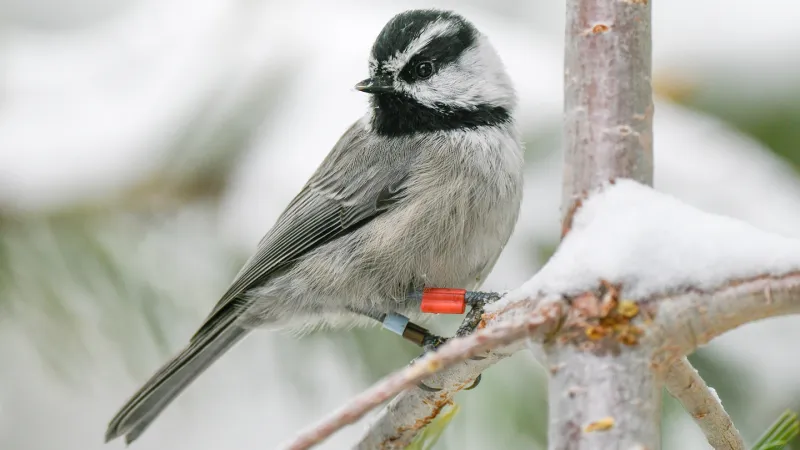
Cognitive resilience in a species that weighs less than a sugar packet is not what most people expect to find when they think about aging and intelligence. Yet the study of chickadee cognition in the wild has delivered exactly that: evidence that smarter birds maintain their mental sharpness into old age, produce more offspring, and carry healthier gut bacteria. This is not a charming nature note. It is a piece of empirical data with implications that reach far beyond the bird feeder. The work connects directly to two other stories we have covered recently. A study of Fossilized Poop Reveals Feathered Dinosaur Traits Linked to Survival showed that plumage differences may have determined which Cretaceous birds survived an asteroid impact. And evidence from Cascadia and San Andreas: Evidence Suggests Sequential Earthquake Risk demonstrates how complex systems, geological or biological, reveal their vulnerabilities only when we measure them properly over time. Together, these findings reinforce a principle our readers already know: longitudinal, calibrated observation is the only way to separate signal from noise.
What makes the chickadee study stand out is the specificity of its measurement. The researchers did not rely on lab-based intelligence tests that might not translate to real survival. They tracked cognition in the wild, correlating problem-solving ability with actual reproductive success and age-related decline. The result is a validated data point: cognitive performance in older birds is not a random variable. It is a measurable trait that correlates with fitness. For researchers working on human aging, gut microbiome science, or even conservation biology, this is a direct line of inquiry. If a chickadee's gut bacteria can be linked to its cognitive health, then the integrated data ecosystem of an organism, its brain, its microbiome, its environment, must be studied as a single system, not in isolated compartments.
Our take is straightforward: this study provides a measurable, repeatable framework for asking better questions about resilience. The takeaway a reader could quote is this: *cognitive decline is not inevitable with age, even in a wild bird; it is correlated with measurable biological factors that we can now track*. That is not a sentimental observation. It is an empirical challenge to the assumption that aging brains must deteriorate. For policymakers and funders who allocate resources toward aging research or microbiome science, the chickadee offers a low-cost, high-resolution model system. For ocean scientists who study how marine species adapt to warming waters, the methodological approach, tracking individual cognition over time in a natural setting, is directly transferable.
The open question is whether the same relationship holds across species and environments. Does a smarter fish, for example, show the same resilience to thermal stress? Does a smarter seabird maintain foraging success as its prey shifts distribution? The chickadee data gives us a hypothesis worth testing. We would tell any reader who asks: pay attention to the methodology here, not just the cute result. The real news is that we now have a calibrated, longitudinal measure of cognitive resilience in a wild population. That is a tool, not a headline. And tools are what we need to understand how intelligence, whether in a bird, a fish, or a human, fares under pressure.