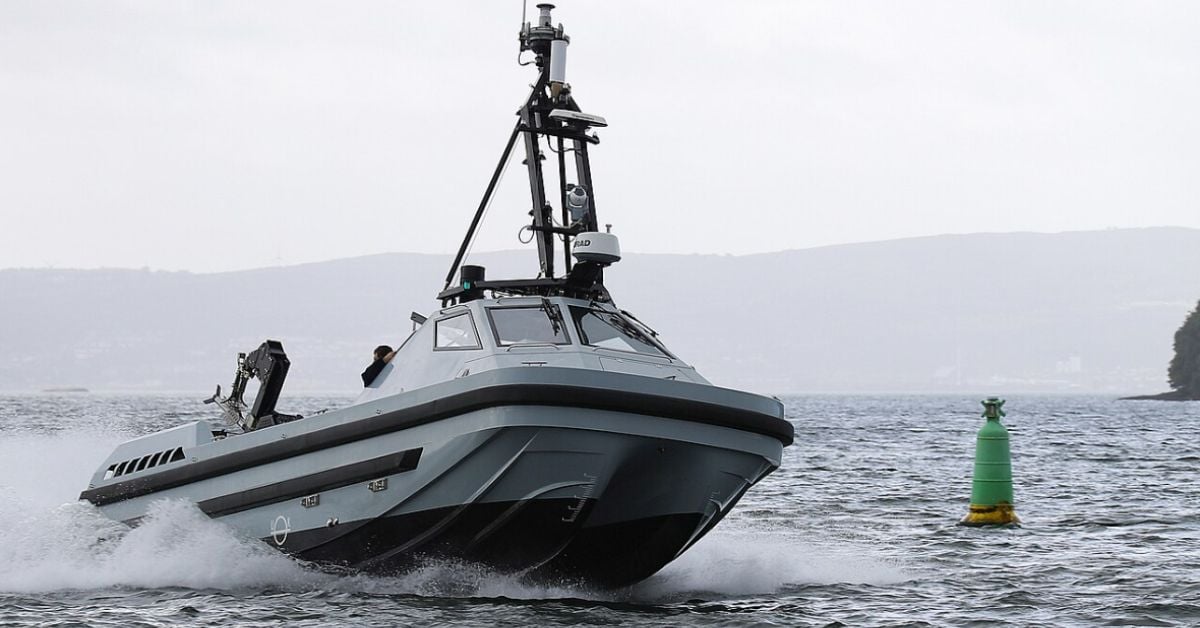
The Black Sea has become a live-fire laboratory for naval drones, and the latest engagement, featuring an unmanned surface vessel armed with a 12.7 mm machine gun and a protected remote weapon station, confirms that maritime warfare has entered a new, precise phase. This is not speculation about future capability; it is a calibrated, real-time demonstration of how remote platforms can project force in contested waters. For our readers, this is the empirical evidence that the integration of autonomous systems into naval doctrine is no longer experimental. It is operational, and it demands a reassessment of how we track, deter, and counter such assets.
This development does not exist in isolation. It sits alongside a broader pattern of Russian maritime strategy that we have been tracking, from the Russia Calibrates Export Revenue for Northern Sea Route Icebreaker Fleet to the Russian Maritime Activity Raises Concerns of Drone Operations in Mediterranean. These are not separate stories; they are data points in an integrated ecosystem of naval power. The icebreaker fleet is about economic leverage and access, while the Mediterranean concern highlights the potential for drones to be launched from commercial hulls far from the Black Sea. The machine gun on this drone is a blunt instrument, but its deployment is a sophisticated signal: Russia is validating the utility of unmanned systems across multiple theatres simultaneously.
Our take is straightforward: the strategic implications extend beyond the hull of any single vessel. When a drone carries a remote weapon station, it changes the calculus of engagement. It lowers the threshold for lethal action because there is no crew at immediate risk, and it complicates escalation dynamics for any adversary. For policymakers and naval planners, the question is not whether these systems work, but how to integrate them into a defensive framework that presumes their presence. The Vostok project's start of Arctic oil exports amid sanctions, as covered in the Vostok Project Launches Arctic Oil Exports Amid Geopolitical Shifts, shows that Moscow is willing to operate in high-risk, high-reward environments. The Black Sea drone is another expression of that same risk tolerance, but in a kinetic form.
What we would tell a reader who asks about this is simple: watch the remote weapon station, not just the drone. The capability to fire a 12.7 mm round with precision from a small, uncrewed hull is a force multiplier that can be mass-produced and deployed in swarms. The immediate consequence is that every commercial vessel, port, and naval base in the region now operates under a new threat profile. The open question is how quickly other navies will adapt their own counter-drone protocols, and whether the next iteration of these vessels will be armed with something heavier than a machine gun. That is the detail to watch, because the escalation ladder has just been shortened.