Our Take: Unraveling Oceanic Resilience in the Ancient Arabian Sea
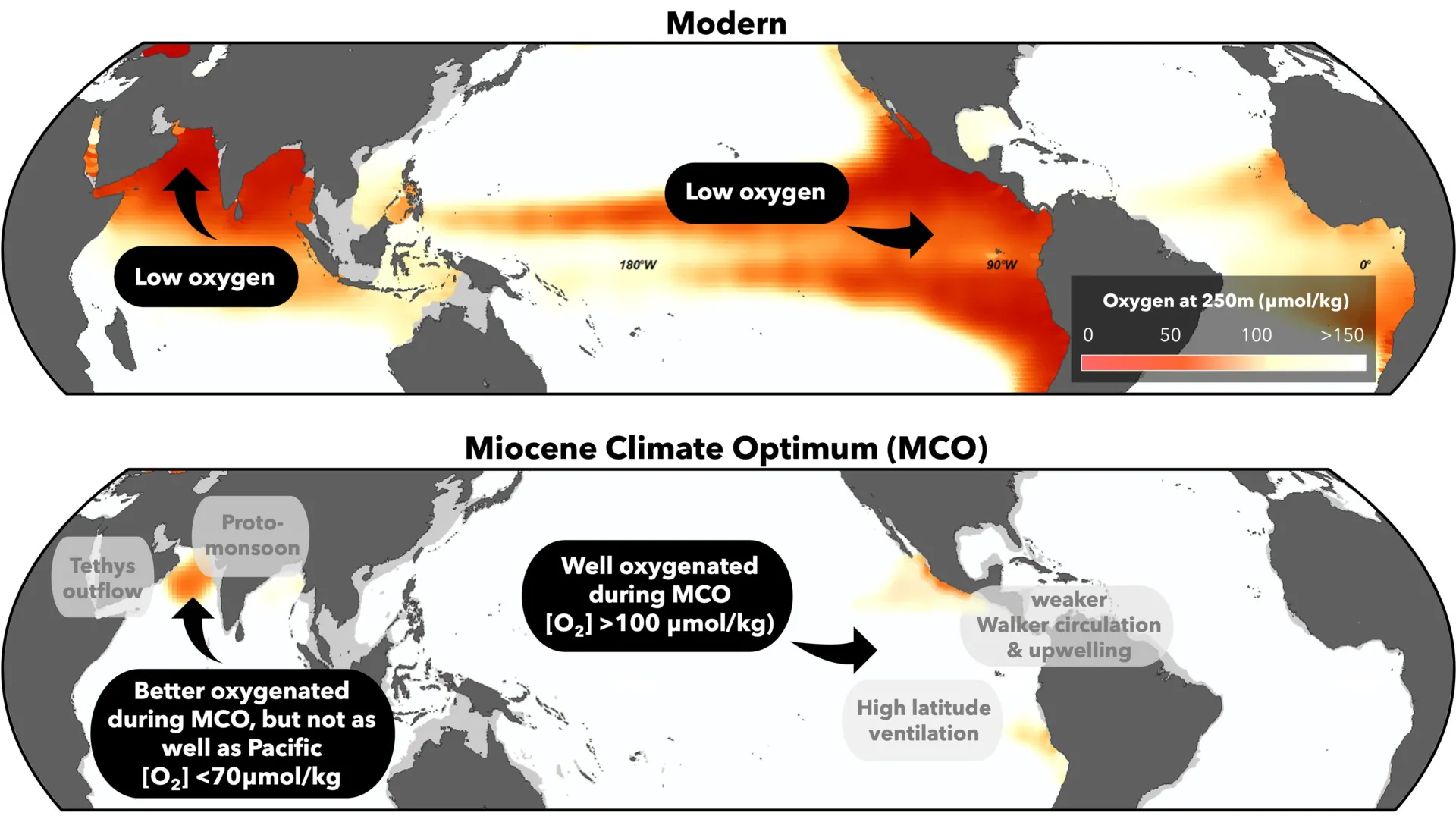
The recent findings regarding the ancient Arabian Sea offer a compelling testament to the intricate dynamics of Earth's climate and ocean systems. For decades, a widely held tenet has been that rising global temperatures invariably lead to ocean deoxygenation. This new research, however, challenges that straightforward correlation by revealing that 16 million years ago, during a period warmer than the present, the Arabian Sea maintained significantly higher oxygen levels. This observation, derived from rigorous analysis of ancient ocean fossils, underscores that the relationship between climate and oxygenation is far more nuanced than previously assumed, particularly when considering regional oceanic processes. The delay in oxygen depletion, occurring millions of years after the peak warming and only following a subsequent cooling phase, points to a complex interplay of factors that can buffer or even counteract the direct impacts of temperature increase on ocean oxygen.
The key to this unexpected resilience appears to lie in the powerful monsoon systems and robust ocean circulation patterns characteristic of the Arabian Sea during that ancient epoch. Unlike the Pacific Ocean, which experienced earlier oxygen loss, the vigorous mixing driven by these monsoons and currents likely facilitated the replenishment of oxygen at deeper ocean levels. This suggests that regional oceanographic features can play a crucial role in modulating the global climate's influence on marine oxygen budgets. Such insights are invaluable as we strive to understand and predict future ocean health. They highlight the necessity of moving beyond generalized models to incorporate region-specific hydrodynamics and climatic drivers, particularly in a world facing ongoing climate change.
This discovery has profound implications for our understanding of ocean stewardship. It emphasizes that while warming is a significant stressor, it is not the sole determinant of deoxygenation. The capacity of ocean systems to maintain oxygenation is influenced by a complex web of physical and biological processes. For World Data Ocean, this research reinforces our commitment to developing integrated data ecosystems that capture these intricate relationships. By leveraging advanced technologies and fostering global collaboration, we can build a more comprehensive, validated understanding of ocean intelligence. This knowledge is not merely academic; it is essential for informing effective conservation strategies and policy decisions that safeguard marine life and the vital services our oceans provide. The ancient Arabian Sea’s story reminds us that resilience can exist, but it is often a product of specific environmental conditions and complex oceanic processes that we must diligently study and protect.