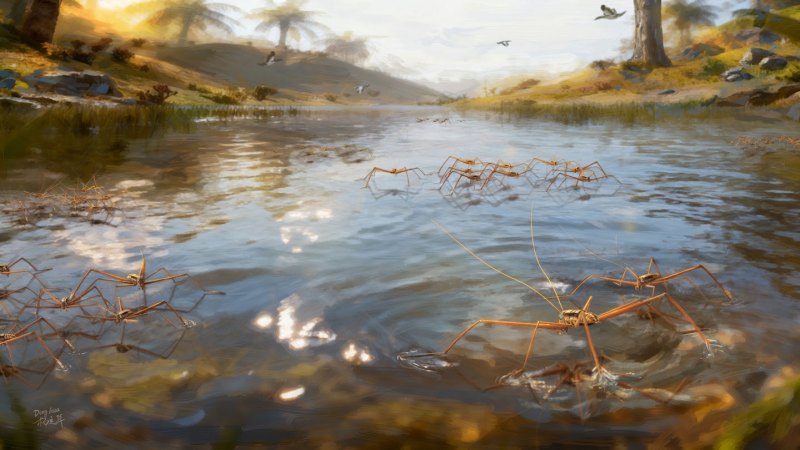
Understanding drives protection. The recent discovery of a 99-million-year-old grasshopper preserved in amber does more than refine our understanding of insect evolution, it offers a measurable, empirical data point for how life adapted to ancient aquatic environments. We are looking at a species that could walk on water long before modern pond skaters evolved their own surface-tension tricks, and that tells us something practical about resilience and adaptation under changing planetary conditions.
The fossilized specimen, locked in Burmese amber, reveals specialized leg structures that allowed this ancient insect to distribute its weight and paddle across still water. This is not a curiosity from a lost world; it is a calibrated piece of evidence in the larger puzzle of how organisms respond to environmental pressure. Consider what we already know from related research: Fossilized Poop Reveals Feathered Dinosaur Traits Linked to Survival showed that subtle differences in plumage gave some Cretaceous birds a survival edge after the asteroid impact. Similarly, Post-dinosaur forests claimed by a towering half-meter fungus demonstrated how life can pivot dramatically when ecosystems collapse. Each of these findings, including the water-walking grasshopper, reinforces a single point: adaptation is not a vague concept but a measurable, longitudinal process encoded in fossil evidence.
What matters for our readers, researchers, policymakers, and ocean enthusiasts alike, is the methodological takeaway. This amber discovery was made possible by integrated observation: paleontologists combining CT scanning with surface-morphology analysis to reconstruct behavior from static remains. That same approach applies directly to modern ocean intelligence. When we track climate indicators or map real-time shifts in marine habitats, we are doing the same work, extracting behavioral and ecological signals from static data points. The grasshopper's legs are, in effect, a 99-million-year-old sensor reading. The principle is identical: validate the mechanism, calibrate the observation, and integrate the finding into a broader understanding of how life persists through change.
We should watch for what this implies about extinction thresholds. If a Cretaceous insect could evolve specialized water-walking adaptations during a period of significant environmental flux, it raises an open question about how many species today possess latent adaptive capacity that we have not yet measured. The fossil record offers no guarantees, only data. Our responsibility is to treat each discovery, whether a grasshopper in amber or a fossilized ear bone identified through citizen science, as a peer-reviewed data point in an integrated data ecosystem. The past does not repeat itself, but it does calibrate our expectations for the future.