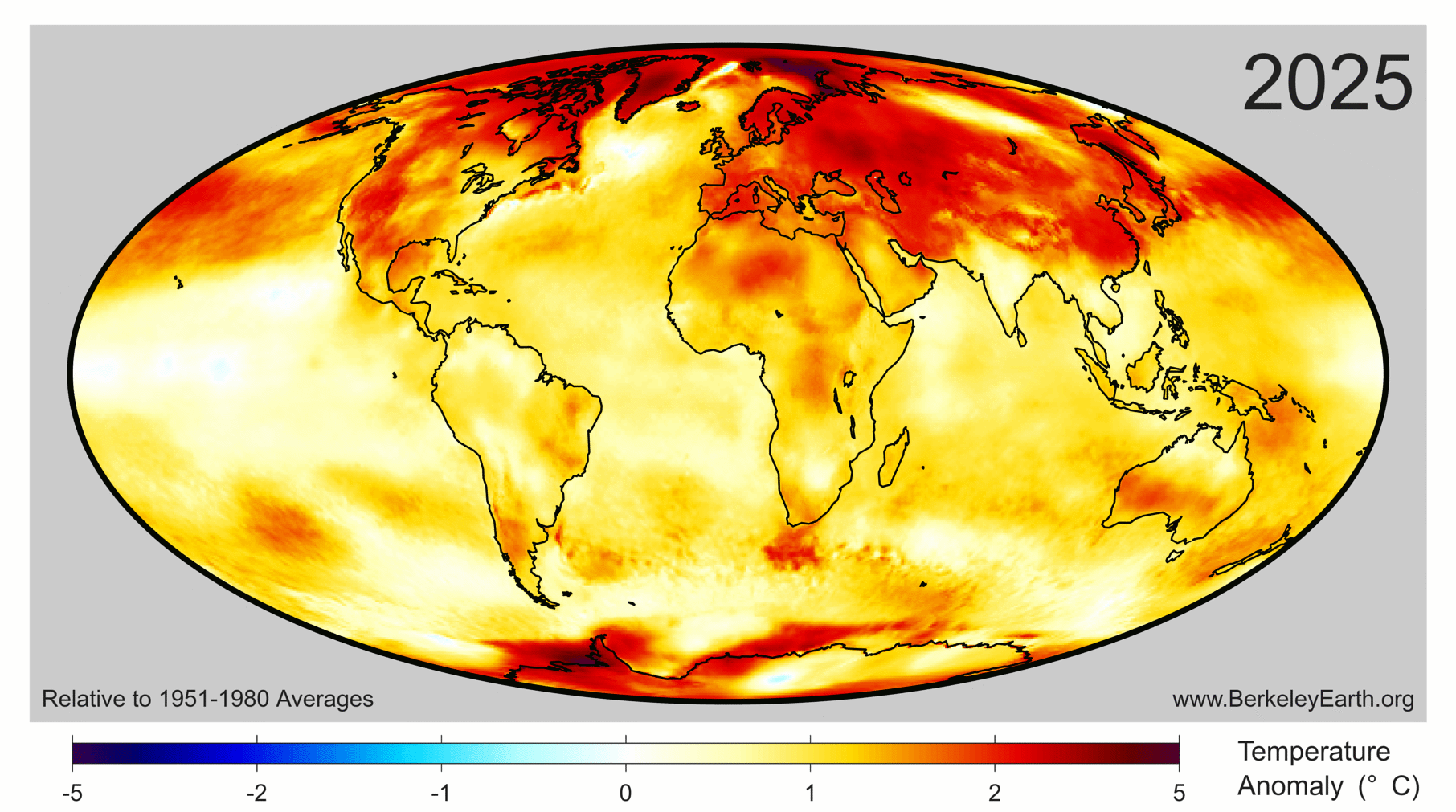
The numbers are in, and they demand a clear-eyed response: 2025 was the third warmest year on Earth since direct thermometer measurements began in 1850, with a global mean temperature 1.44 °C above the pre-industrial baseline. This is not a headline to file away. It is a signal that the linear warming trend we relied on for decades may no longer hold. The data from Berkeley Earth, which integrates 23 million land-based measurements and 500 million ocean observations, confirms that the past eleven years are the eleven warmest on record. The real story, however, is the spike. The warming observed from 2023 to 2025 has deviated from the previous 50-year trend with a probability of less than 1-in-100 from natural variability alone. This is not a blip; it is a shift that demands we update our models and our expectations.
This finding connects directly to the tools we use to understand our planet. As we reported in AI Illuminates the Ocean's Hidden Data, From Surface to Seafloor, artificial intelligence is now essential for parsing the vast, complex datasets that underpin climate science. Berkeley Earth's own analysis, which relies on integrating disparate data streams from ships, buoys, and weather stations, is exactly the kind of integrated data ecosystem that benefits from such computational power. Furthermore, the same imperative to measure precisely applies to other planetary boundaries. Our coverage of plastic pollution, from From waste to wave: measuring ocean plastic's true share to From two million to over 450 million tonnes: measuring the rise of plastic production, underscores that rigorous, longitudinal measurement is the foundation for any credible action. Whether tracking temperature anomalies or plastic tonnage, we cannot manage what we do not measure.
What does this mean in practical terms? Berkeley Earth's conclusion that reductions in low cloud cover and man-made sulfur aerosol pollution are likely amplifying greenhouse gas warming is a specific, testable hypothesis. It moves the conversation from a general call for emissions cuts to a targeted investigation of aerosol and cloud feedbacks. This is the kind of empirical, peer-reviewed question that ocean intelligence can help answer. For the 770 million people, 8.5% of Earth's population, who experienced a locally record warm annual average in 2025, largely concentrated in Asia, this is not an abstract debate. It is a lived reality. The fact that 2025, a La Niña year typically associated with modest cooling, still ranked third warmest, tells us that the background warming has overwhelmed a natural cooling pattern. The most likely outcome for 2026 is that it will be roughly the fourth warmest year, but the authors note that a warmer outcome cannot be ruled out.
The concrete point to watch is this: the warming rate has accelerated, and the causes are no longer purely a function of greenhouse gas accumulation. If the cloud and aerosol feedbacks identified by Berkeley Earth are validated, they represent a previously underappreciated multiplier on human-driven warming. That is the open question we should be tracking with the same rigor Berkeley Earth applied to 2025's temperature.