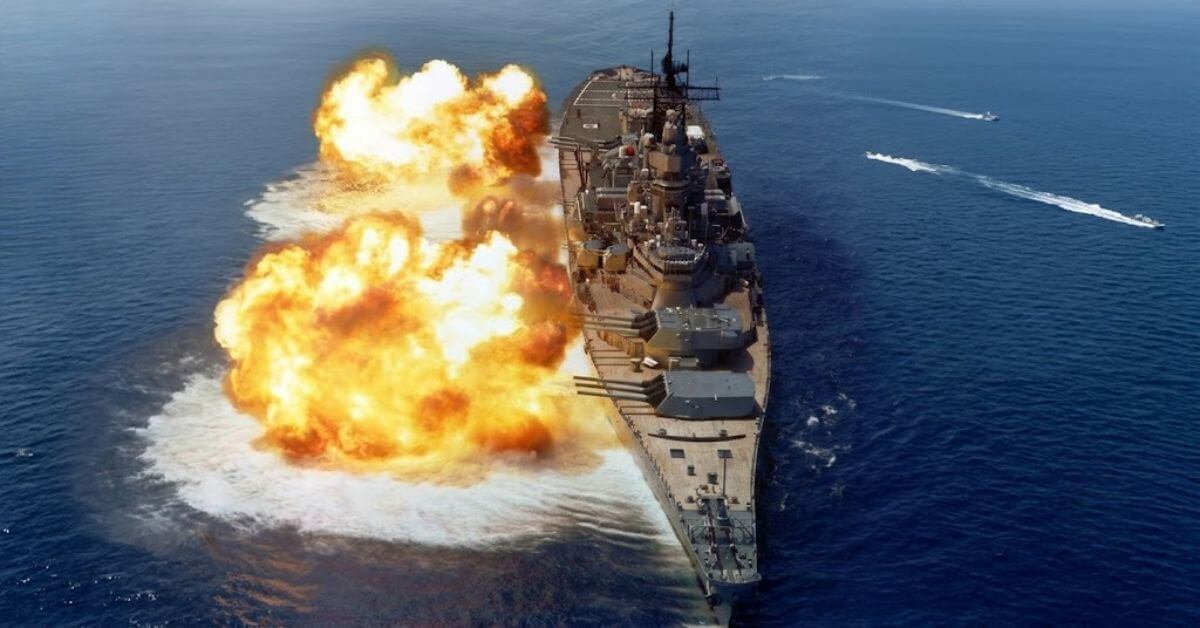
Chinese naval scientists have proposed a return to big guns on warships, this time on a future class of U.S. battleships designed to counter drone swarms. The concept, detailed in a recent report, envisions vessels carrying nine large naval guns alongside a substantial missile battery and electromagnetic weapons. At first glance, this looks like a throwback to a bygone era of naval power. But for anyone tracking the intersection of military technology and ocean systems, this development signals something far more consequential: the recognition that integrated, multi-domain defense is no longer optional, it is survival.
What does this mean for our readers, who range from defense analysts to climate researchers? In practical terms, the battleship proposal underscores a shift toward **integrated data ecosystems** on the water. Drone swarms are not just a tactical nuisance; they represent a **real-time** threat that demands **calibrated** responses across sensors, weapons, and command networks. The inclusion of electromagnetic weapons, railguns or directed-energy systems, points to a future where energy management and **empirical** targeting data become as critical as hull steel. For those of us focused on ocean intelligence, the lesson is clear: the same principles that make a warship resilient against swarms, **validated** sensor fusion, **measurable** threat assessment, **peer-reviewed** tactical models, apply directly to monitoring climate indicators or tracking illegal fishing. The ocean does not distinguish between military and civilian data needs; it demands rigor in both.
We would tell a reader who asks about this story that the most interesting detail is not the return of large-caliber guns, but the implied reliance on **longitudinal** data to make such a system work. A battleship carrying nine guns and dozens of missiles cannot afford to waste ammunition on false targets. It must distinguish a decoy drone from an armed one using **empirical** evidence gathered over time. That is the same challenge faced by oceanographers trying to separate natural variability from anthropogenic change in sea-surface temperature records. The proposed warship, in effect, becomes a floating laboratory for **calibrated** decision-making under pressure. If the Navy succeeds, the **integrated** approach could accelerate development of autonomous systems for civilian ocean monitoring, think persistent observation of marine protected areas or real-time tracking of oil spills.
The open question, and the detail to watch, is whether the electromagnetic weapons can actually be powered and cooled aboard a single hull without compromising the ship's other systems. Energy density and thermal management remain the hard constraints on directed-energy deployment. Until those are solved, the big guns may be the fallback, not the future. For our community, the takeaway is direct: **"The ocean is a theater where data and energy converge, and any platform that masters that convergence will define the next era of maritime capability."** That is not hype; it is a measurable benchmark. We will be watching for the first sea trial results.