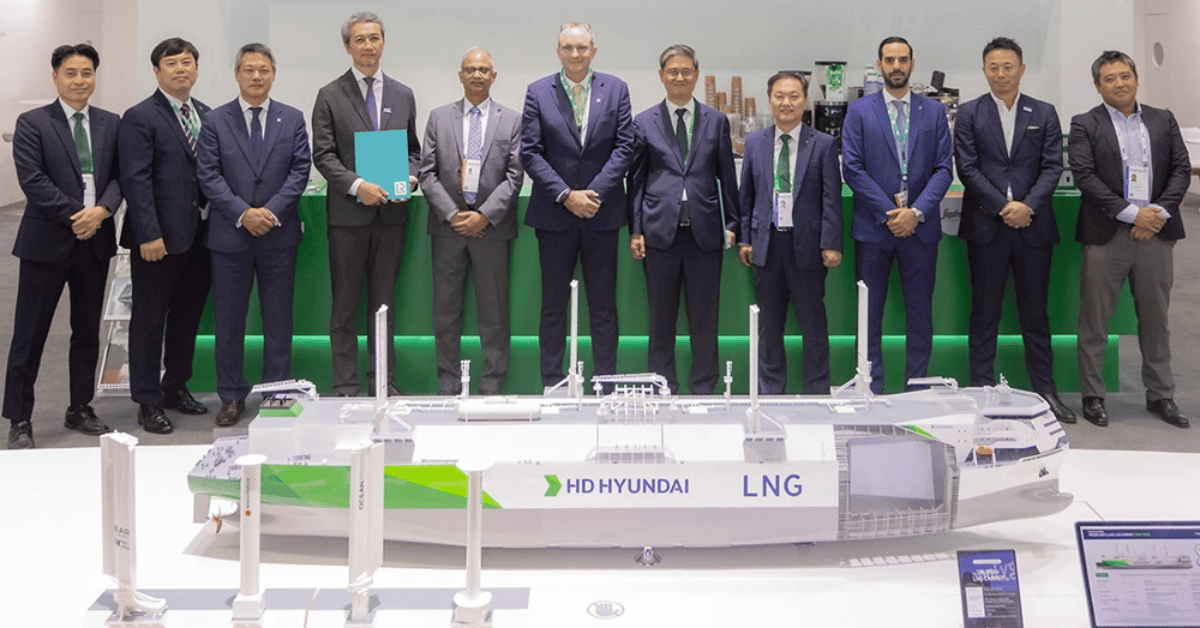
The announcement that Lloyd's Register has granted Design Appraisal to HD Hyundai Heavy Industries for an LNG carrier concept with MOL's Wind Challenger hard-sail system is not a small step. It is a validation of integrated design thinking. For readers who track maritime decarbonization, this is the kind of news that matters less for the hardware itself and more for what it signals: that wind-assisted propulsion is no longer a retrofit experiment or a niche demonstration. It is being engineered into newbuilds as a core system, not an afterthought. That distinction carries real weight. The LNG carrier design appraisal means the classification society has reviewed the integration of the hard sails with the vessel's structure, stability, and operational profile and found it sound. That is a form of empirical validation that cannot be faked.
Our take is straightforward: this is where the industry stops talking about potential and starts accounting for performance. Wind Challenger is not a soft-focus nod to sail nostalgia. It is a mechanical, retractable hard sail that converts wind into thrust with measurable effect. For LNG carriers, which burn significant fuel on long voyages, the practical benefit is a reduction in fuel consumption and, by extension, emissions. But the deeper point is the word "integrated." HD Hyundai Heavy Industries did not bolt sails onto an existing hull. They designed the ship around the sails, optimizing accommodation placement and hull form to work with the wind system. That is the difference between adding a feature and building a solution. For a reader asking what this means for them, the answer is about procurement and risk. If you are a shipowner or operator, this appraisal tells you that wind-assisted LNG carriers are a bankable option, not a science project. The classification society has done the due diligence. The question is no longer "does it work?" but "how quickly can the fleet adopt it?"
We would also caution against reading this as a silver bullet. Wind-assisted propulsion is one tool in an integrated data ecosystem that includes route optimization, weather routing, and engine tuning. The real gains come from combining wind with operational intelligence, not from the sail alone. What we want readers to watch is the next phase: how this design performs in sea trials, what the measured fuel savings actually are, and whether the fore-accommodation layout becomes a standard template for other LNG carriers. The MOL Wind Challenger has already proven itself on bulk carriers. This appraisal extends that proof to a more complex vessel type. The classification approval process is not a rubber stamp; it involves rigorous review of structural loads, sail dynamics, and emergency procedures. That LR has signed off on this concept means the design has passed a high bar.
The specific takeaway to quote: "Wind-assisted propulsion is moving from auxiliary concept to integrated design standard, and the LNG carrier segment is now positioned to lead that shift." For a reader, the concrete point to watch is the timeline of the first vessel in this design entering service. When that ship posts its operational data, we will finally have peer-reviewed numbers on how much wind can contribute to LNG shipping. That is the moment that matters, and it is closer than many expect.