•1 min read•from @worlddataocean
Imagine a team of scientists that never sleeps, doesn't get seasick, and explores the deepest corners of our blue planet...
Our take
Imagine a team of scientists that operates tirelessly, exploring the deepest corners of our blue planet without the constraints of seasickness or fatigue. This is the reality of autonomous marine science today, where surface vessels act as mobile hubs, deploying fleets of underwater gliders and aerial drones in a synchronized effort to map our oceans. At World Data Ocean, we transform the data collected from these advanced technologies into validated ocean intelligence, enhancing our understanding and stewardship of marine environments like never before.
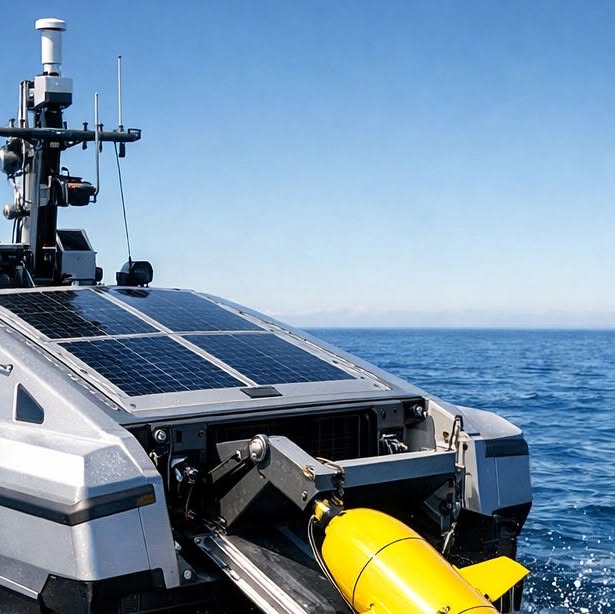
Imagine a team of scientists that never sleeps, doesn't get seasick, and explores the deepest corners of our blue planet simultaneously. That’s the reality of autonomous teams in marine science today.
We’re moving beyond single-drone missions to a multi-layered future. Imagine a sleek surface vessel (USV) acting as a mobile hub, launching a fleet of underwater gliders to map the seafloor while aerial drones scan from above. It’s like a synchronized orchestra of ocean technology.
At World Data Ocean, our job is to make sense of this "symphony." Processing data from multiple sources: motherships, gliders, and sub-surface sensors: requires high-tech integration to turn raw signals into validated ocean intelligence.
By using these autonomous teams, we’re getting a higher resolution of our oceans than ever before, in real-time. It’s not just about the robots; it’s about the integrated data ecosystem that drives better stewardship of our waters.
The ocean is vast, but with a team like this, it’s starting to feel a lot more connected.
#OceanTech #AutonomousSystems #MarineScience #WorldDataOcean
Read on the original site
Open the publisher's page for the full experience
Related Articles
- From solo ships to robotic swarms: the way we explore the ocean is fundamentally changing. Decades of ocean science reli...From solo ships to robotic swarms: the way we explore the ocean is fundamentally changing. Decades of ocean science relied on a single research vessel at a single point in time. Today, through our Ocean Infinity Operations, we’re witnessing a transition to autonomous robotic fleets. These swarms work in unison, providing a coordinated, real-time data integration that was previously impossible. This shift means we can now map larger areas faster and monitor environmental indicators with validated, empirical accuracy. Instead of a single snapshot, we get a living data ecosystem, allowing researchers and scientists to make more informed decisions for our planet’s future. Whether it's tracking climate indicators or mapping uncharted seafloors, the future is collaborative, autonomous, and data-driven. This is part of our Weekly Ocean Data & Innovation Highlights. Stay tuned as we continue to explore the technologies protecting our blue planet. #OceanData #Robotics #OceanExploration #MarineScience
- Ever wondered how long it takes to map a mountain range under the sea? Traditionally, it takes months of painstaking man...Ever wondered how long it takes to map a mountain range under the sea? Traditionally, it takes months of painstaking manual data processing. But at World Data Ocean, we're seeing a shift from months to mere days. For our 'Weekly Ocean Data & Innovation Highlights,' we're diving into the AI vs. Human speed gap. While a team of experts can spend weeks cleaning acoustic data, modern AI neural networks can process that same information up to 25x faster. This isn’t just about being quick: it’s about ocean intelligence in real-time. For our partners in conservation and the maritime industry, this speed is a game-changer. Faster mapping means faster protection for vulnerable ecosystems and smarter decisions for offshore operations. We're turning validated scientific data into immediate action. Science is moving fast, and we’re here to make sure you’re at the forefront of it. #OceanData #AIInnovation #MarineScience #DeepSeaMapping
- Ever wonder what’s actually swimming in those deep blue waters without having to catch a single fish? Welcome to the era...Ever wonder what’s actually swimming in those deep blue waters without having to catch a single fish? Welcome to the era of 'Ocean CSI.' At World Data Ocean, we’re geeking out over how environmental DNA (eDNA) is changing the game. By using autonomous underwater vehicles (AUVs) to scoop up water samples, we can detect traces of DNA left behind by marine life. It’s like forensic science for the sea: allowing us to identify rare species and track biodiversity trends in real-time. Our data portals and SDKs are built to handle this kind of complex, high-tech info, making it easier for researchers and teams to turn a jar of seawater into a clear picture of ocean health. Want to see how we’re turning water samples into validated scientific insights? Head over to our site to explore our latest data portals. #OceanCSI #MarineTech #eDNA #WorldDataOcean
- Imagine a living, breathing model of our ocean that predicts changes before they happen. This is the 'Digital Twin' of t...Imagine a living, breathing model of our ocean that predicts changes before they happen. This is the 'Digital Twin' of the ocean: a cornerstone of the UN Ocean Decade and the future of marine stewardship. At World Data Ocean, we’re bridging the gap between raw data and actionable intelligence. By integrating validated scientific datasets with real-time sensors, we are helping build this digital mirror. From tracking deep-sea temperature fluctuations to monitoring cyclone paths, our platform provides the high-fidelity data needed to simulate and understand complex marine ecosystems. This isn’t just a map; it’s an interactive, predictive tool for researchers, policymakers, and industry leaders to test solutions in a virtual environment before applying them to the real world. Together, we are creating a more transparent and sustainable ocean for everyone. Explore how we’re making ocean intelligence accessible at worlddataocean.com. #OceanDecade #DigitalTwin #OceanData #Sustainability