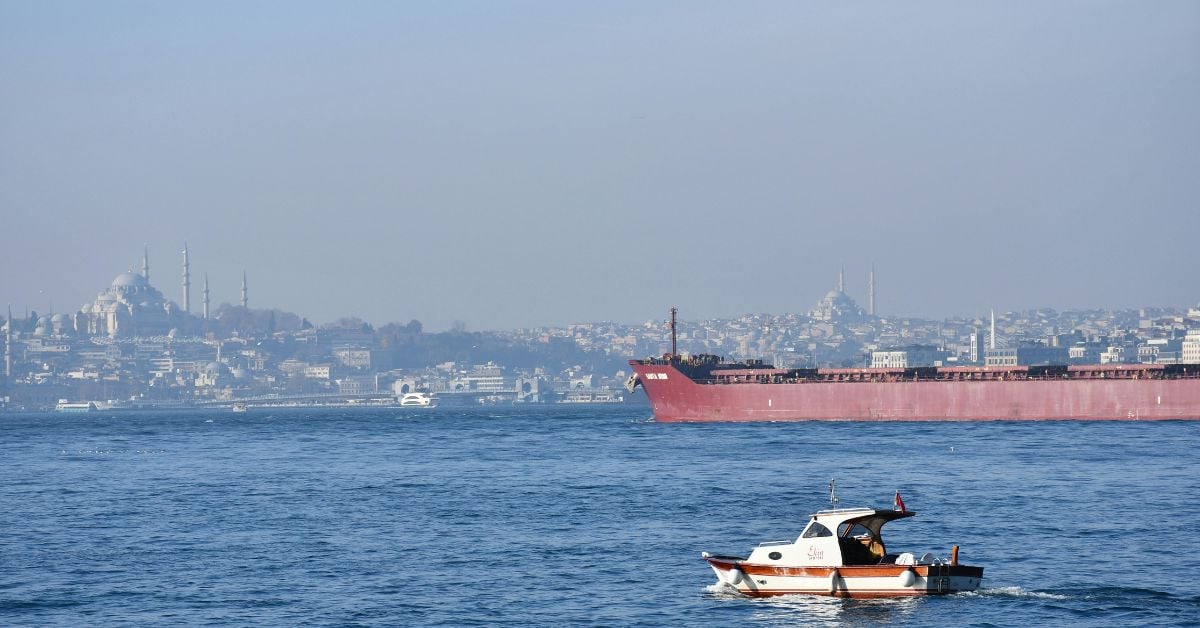
A Tanzanian-flagged cargo ship, bound for a Ukrainian port, was struck by a Russian drone in the Black Sea. That is the event. But the meaning of that event extends far beyond a single vessel or a single route. For our readers, who track the intersection of maritime commerce and geopolitical instability, this is not an isolated incident; it is a calibrated signal. The Black Sea has become a live-fire laboratory where the rules of navigation are being rewritten in real time, and a flag of convenience offers no protection from a drone's trajectory. We should say plainly: this is what escalation looks like when it is measured in hull damage rather than headlines.
The attack underscores a practical reality for every operator, insurer, and logistics planner watching these waters. A ship flying a Tanzanian flag suggests a deliberate attempt to signal neutrality or distance from direct conflict, yet the drone did not pause to check the registry. This tells us that the targeting logic has shifted. It is no longer about the nationality of the crew or the cargo manifest; it is about the destination. Any vessel heading to a Ukrainian port is now a legitimate target in the eyes of Moscow. For our readers, the takeaway is not to ask "will we be hit?" but "what is our rerouting protocol, and how fast can we execute it?" The cost of hesitation is no longer measured in delays, but in total loss. We would tell a reader who asked: do not assume that a flag, a crew, or a cargo type offers any buffer. Assume the risk is uniform, and plan accordingly.
This is where the disconnect between official statements and on-water reality becomes dangerous. The attack happened while the ship was transiting to Ukraine, and the drone was Russian, though the details are thin. That is enough to infer a pattern of deliberate interdiction. We do not need to speculate about the drone's launch point or the ship's speed. The point is that the Black Sea is no longer a maritime corridor; it is a contested zone where commercial traffic moves at the sufferance of a belligerent. For our audience, this means the risk calculus has changed permanently. Insurance premiums will spike, but more importantly, the legal framework for who is responsible when a civilian ship is hit is being tested without precedent. We would advise our readers to watch how the flag state responds, because that response will set a precedent for every other non-combatant nation whose ships transit these waters.
The concrete point to watch is not the next attack, but the response to this one. Will Tanzania file a formal protest? Will the crew's home countries demand compensation? Or will this be absorbed into the growing catalogue of unpunished incidents? For our readers, the practical consequence is simple: do not wait for a formal declaration of war to change your routing. The signal has been sent, and it is measurable in the wreckage of a ship that thought a flag was a shield. The question is not whether more ships will be targeted; it is which flag they will be flying when the next drone launches. That is the detail to track, because it will tell us whether the international community still believes the sea is open, or whether we have already accepted that it is not.