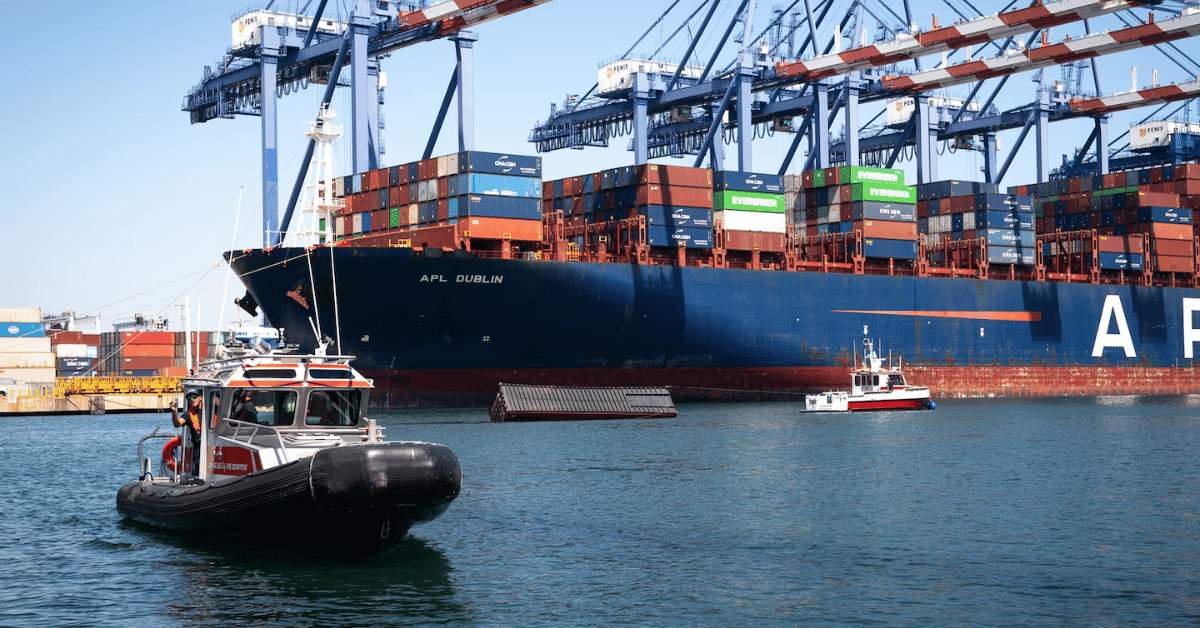
Three containers lost overboard at the Port of Los Angeles during routine cargo operations. The Coast Guard response was immediate, and the incident is contained in the reporting. But the brevity of the Coast Guard's summary should not be mistaken for insignificance. This is not a failure of a single crane operator or a momentary lapse in a busy port. It is a measurable data point in a much larger system, one that we have spent years working to integrate and understand.
For our readers, the distinction between a headline and a hazard is critical. The immediate risk is navigational: a 40-foot container floating just below the surface is a collision threat to any vessel leaving or entering one of the busiest harbors in the Western Hemisphere. The Coast Guard's response is the correct, calibrated action. But the more pressing question is not what happens to these three containers, but what their loss represents for the integrity of the entire maritime supply chain. Every lost box is a small failure of the integrated data ecosystem we advocate for. It is a signal that our current tracking, lashing, and verification protocols have a gap, and that gap is real-time. We would tell a reader who asked that the takeaway is not alarm, but audit. This incident is a prompt to review your own operational data, to ask whether your port call processes are feeding accurate, validated information back into the system, or whether you are relying on the assumption that a routine operation is a safe one.
This is where our voice must be direct. We do not need sensationalism to understand the stakes. A container overboard is not a climate catastrophe, and we will not frame it as one. But it is a climate indicator in the sense that it measures the strain on a system that is being pushed harder and faster every year. The Port of Los Angeles handles millions of TEUs annually. When three go into the water, the event is statistically minor. But the response, the investigation, and the subsequent report are anything but minor. They are peer-reviewed lessons in operational risk. The practical consequence for our readers, whether you are a shipping line, a port authority, or a researcher modeling supply chain resilience, is that this incident will generate longitudinal data. That data will be used to calibrate future safety standards. We should be watching that process closely. The open question is whether the industry will treat this as a one-off, or as a measurable input into a more robust, integrated approach to container security. We would advise our readers to track the Coast Guard's casualty report when it is released. The specific detail to watch is whether the report identifies a failure in lashing gear, a software error in weight calculation, or a procedural miss. That distinction will tell us more about the health of the system than any single headline. Because understanding drives protection, and protection requires that we know exactly where the chain broke.