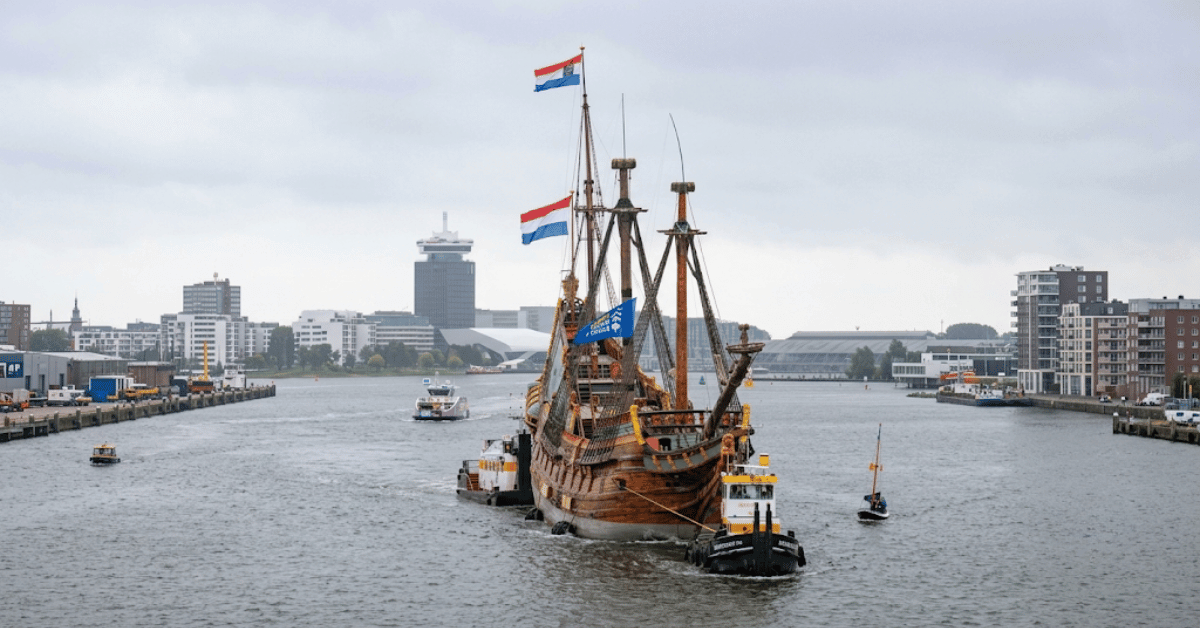
The Batavia's arrival at Damen Shiprepair Amsterdam is not a news cycle moment; it is a logistical statement about how we treat the objects that carry our shared history. A replica of the 17th-century Dutch East India Company vessel, she has spent decades afloat, and now she is being prepared for a permanent berth ashore at Museum Batavialand. The dry-docking operation is the delicate part. You do not lift a wooden hull out of the water on a whim, and you do not move it across a city without calibrating every step. The fact that the team is choosing the careful route, rather than the expedient one, tells you everything about the standards at play.
Our take is straightforward: this is what integrated preservation looks like. The Batavia is not just a ship; she is a floating dataset of shipbuilding techniques, maritime labor, and the geopolitical reach of a small European nation. Moving her ashore is not a surrender to the limitations of water. It is an upgrade in how we manage her long-term stability. For readers who work in heritage, logistics, or coastal infrastructure, the practical lesson is direct: the same discipline you apply to climate indicators or real-time monitoring applies here. You measure. You validate. You move when the conditions are right. The Batavia's relocation is a case study in applying empirical methods to a problem that is often treated as sentimental. We would tell a reader who asked: watch how the dry-docking is executed, because the tolerances involved are tighter than most people assume.
This is also a moment to reconsider what we mean by preservation. Too often, we treat museum objects as static artifacts, frozen behind glass or roped off from interaction. The Batavia is different. She is a working vessel that has been sailed, maintained, and now relocated with the same care you would give a research platform. That is a point worth repeating: the ship is not being retired from the world; she is being repositioned within it. The move to Museum Batavialand places her in a context where visitors can see her not as a relic but as a continuous experiment in keeping knowledge alive. This aligns with our broader view that stewardship is not about locking things away. It is about integrating them into a larger ecosystem, whether that is an ocean data network or a museum floor.
The specific outcome to watch is the condition of the hull after the dry-docking. A ship that has been afloat for decades will reveal her true state only when the water is gone. That is the moment when the measured, peer-reviewed approach pays off. If the team finds rot or structural fatigue, the relocation becomes a repair story. If the hull is sound, the move validates the maintenance regime that kept her afloat for this long. Either way, the Batavia's next chapter is being written in the dry dock, not in the museum hall. That is where the proof will be. That is the detail to follow.