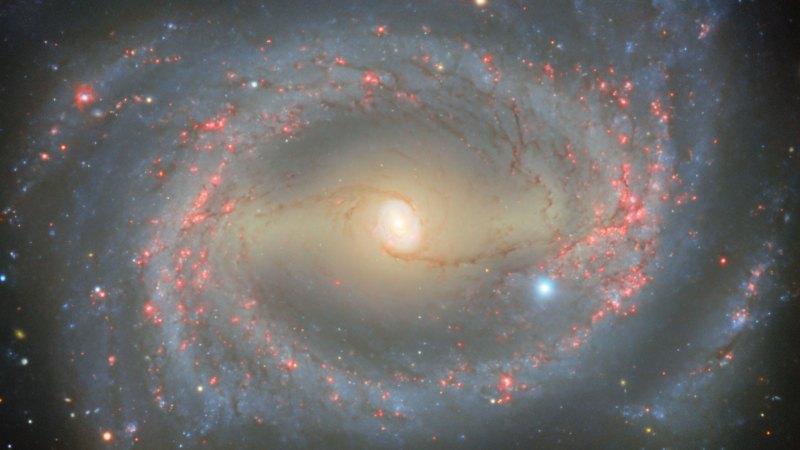
A supernova flared in early November, and astronomers mobilized with a speed that should be familiar to anyone who studies dynamic systems. This was no ordinary stellar death. The proximity of the event, unusually close by cosmic standards, turned a routine alert into a scientific scramble. Our view is clear: this is precisely the kind of opportunistic, coordinated response that defines modern discovery. The race to capture every wavelength of light, every neutrino signature, and every moment of the explosion's evolution is not just a triumph of logistics; it is a validation of the integrated data ecosystem we advocate for across disciplines. When the universe offers a signal, the question is whether our networks are calibrated to receive it. Here, they were.
The parallels to other frontiers of observation are instructive. At the SETI Institute, researchers are applying machine learning to decipher cosmic signals for undiscovered phenomena, training algorithms to recognize patterns that human eyes might miss. The supernova response relies on a similar premise: that the most valuable data comes not from a single instrument but from an orchestrated, real-time collaboration of telescopes and computational models. Meanwhile, the recent observation of a stellar merger in Andromeda offered clues to why binary stars sometimes combine rather than orbit separately. That finding, like the supernova, depends on longitudinal monitoring, watching the same patch of sky long enough to catch rare, violent events. Both stories underscore a practical truth: empirical science at this scale demands patience and an infrastructure that can pivot instantly from routine survey to emergency campaign.
What does this mean for our readers, whether they study ocean currents or gamma-ray bursts? It means that the methods we champion, integrated sensor networks, open data protocols, peer-reviewed alert systems, are not abstract ideals. They are the operational backbone of discovery. The astronomers who caught this supernova did not invent a new theory that night. They leaned on decades of calibrated hardware, shared databases, and a culture that values rapid, transparent communication. That same architecture is what allows oceanographers to track a warming anomaly across basins or marine biologists to flag an unidentified specimen like the one recently submitted to our integrated species database. The challenge is the same: can we recognize the unusual fast enough to study it before the moment passes?
The specific consequence to watch is how the data from this supernova will feed into models that predict future stellar behavior. Every calibrated measurement, from the initial flash to the decaying light curve, becomes a boundary condition for simulations that attempt to map the life cycles of massive stars. Those models, in turn, inform our understanding of element formation, gravitational wave sources, and the rate of cosmic explosions that could one day threaten Earth. That is not alarmist; it is empirical. The supernova's secrets are not idle curiosities. They are measurable inputs to our understanding of a volatile universe. The question left open is whether the global observing network can sustain this level of coordination for the next event, and the one after that. The answer will depend on the same principle that drove the scramble in November: preparation, shared infrastructure, and the will to act on a signal when it arrives.