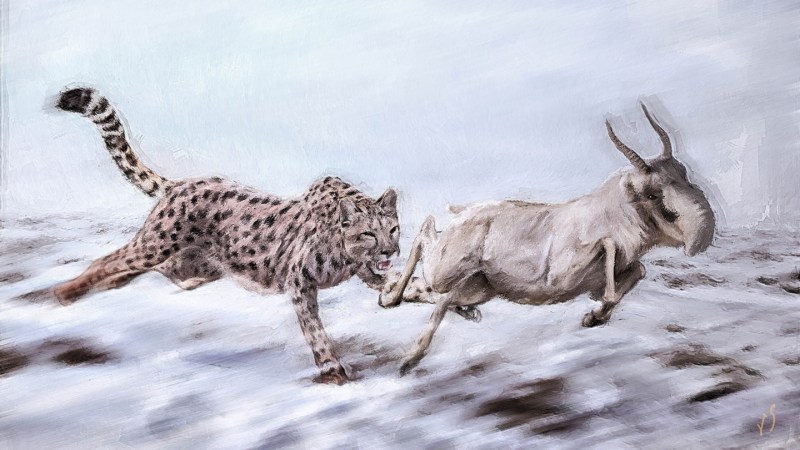
The fossil record has a way of complicating our tidy assumptions, and the story of *Miracinonyx trumani*, the so-called American cheetah, is a prime example. For decades, this animal was cast as a textbook case of convergent evolution, a cat that looked and hunted like an Old World cheetah but was actually something else entirely. Now, ancient DNA has settled the debate with a twist: *M. trumani* was more closely related to the modern puma than to any true cheetah. This is not merely a footnote for paleontology textbooks; it is a recalibration of how we read the past. The animal we thought we knew was not a failed copy of a cheetah but a distinct branch of the puma lineage, one that carved out its own ecological role across Pleistocene North America.
The deeper finding, however, is about diet. The same analysis reveals that *M. trumani* had a more varied diet than previously assumed. That detail matters because it moves the conversation from a simple label of "this species equals that species" to a richer understanding of behavior and ecology. For our readers, many of whom work in conservation, ocean intelligence, or climate research, this is a familiar lesson in disguise. We know from tracking modern apex predators that a flexible diet often signals a resilient species. Yet we still too often treat extinct animals as static symbols rather than dynamic participants in their ecosystems. This study is a reminder that the past was not a simpler version of the present; it was a different world with its own rules. The puma lineage did not just survive; it adapted, and that adaptability is precisely what we need to understand as we face our own era of rapid environmental change.
What we would tell a reader who asks us why this matters beyond the world of paleontology is this: our assumptions about species are only as good as the evidence we demand. The "American cheetah" was a hypothesis built on shape and size, not on genetic inheritance. It took ancient DNA to correct the record, and the correction changes the story we tell about how predators diversify and survive. For those of us monitoring climate indicators today, the takeaway is practical and direct. If a cat with a cheetah's build could actually be a puma with a broader menu, then we cannot rely on morphology alone to predict how a species will respond to shifting environments. We need the genetic, the longitudinal, the empirical. We need to integrate all available data, just as we do when we combine satellite ocean data with in-situ measurements to track a warming current.
The specific consequence to watch is this: as we continue to extract ancient DNA from more fossil sites, we should expect more surprises that overturn long-held narratives. The open question is not whether our current understanding of Ice Age predators is incomplete, but how many of our textbook examples are actually false friends. The next time you read about an extinct species' lifestyle, ask what evidence was used. Was it just bones, or did they check the DNA? The answer will tell you how much to trust the story. For now, the puma's ancestor has been given its proper lineage, and that is a measurable step forward in our ability to read the past accurately.