World’s First Hydrogen-Fueled Engine for Large Commercial Vessels Reduces GHG Emissions By Over 95%
Our take
The recent announcement of Japan Engine’s hydrogen-fueled engine for large commercial vessels, achieving over 95% reduction in greenhouse gas (GHG) emissions during factory testing, represents a significant, albeit early, step towards decarbonizing a notoriously difficult sector. The maritime industry has long been a substantial contributor to global emissions, and while incremental improvements in fuel efficiency have been made, a truly transformative shift requires fundamentally different propulsion systems. This development underscores the growing feasibility of hydrogen as a viable fuel source, moving beyond pilot projects and towards practical application in large-scale commercial operations. It’s particularly noteworthy considering the broader global investments in maritime infrastructure; for instance, [India’s Mazagon Dock To Invest ₹27,000 Crore To Establish Greenfield Shipbuilding Cluster] signals a commitment to modernizing shipbuilding capabilities, which will be crucial for integrating new technologies like hydrogen engines. Further illustrating the ongoing evolution of maritime capabilities, the arrival of [First Additional Large Vessel ‘Judy LaMarsh’ Joins The Great Lakes Region In More Than 3 Decades] demonstrates a continued demand for larger, more efficient vessels, a demand that can now potentially be met with significantly reduced environmental impact.
The 95% GHG reduction figure is compelling, but it's important to contextualize it within the broader lifecycle assessment of hydrogen production and distribution. The environmental benefit is contingent upon the hydrogen being produced through renewable means – electrolysis powered by solar or wind energy, for example. "Green hydrogen" is the key here; hydrogen derived from fossil fuels ("grey hydrogen") would negate much of the emissions advantage. Moreover, the infrastructure required to transport and store hydrogen, particularly in a compressed or liquid form suitable for large vessels, presents a considerable engineering and logistical challenge. Achieving a truly sustainable maritime future requires not only technological breakthroughs like this engine but also the development of robust and globally accessible green hydrogen supply chains. The innovative approach showcased by [Ground-Breaking 100-Foot Full-Foiling Monohull Yacht Driven By Renewable Energy To Redefine Ocean Sailing] highlights the potential for integrating renewable energy sources directly into vessel operations, which, while not directly comparable to large commercial shipping, demonstrates the expanding possibilities for decarbonized marine transport.
The transition to hydrogen-fueled vessels will likely unfold in phases. Initially, we can expect to see adoption in specific routes or vessel types where hydrogen availability is higher and the economic incentives are strongest. Larger container ships and tankers, which consume vast quantities of fuel, represent a particularly attractive target for early adoption due to the potential for significant emissions reductions. However, the capital expenditure required for retrofitting existing vessels or building new ones presents a barrier. Policy support, including carbon pricing mechanisms and subsidies for green hydrogen production, will be essential to accelerate the transition. Furthermore, standardized safety protocols and regulations specific to hydrogen-fueled maritime operations are needed to ensure safe and reliable deployment. The empirical data generated from early adopters of this technology will be invaluable in refining engine design, optimizing hydrogen storage solutions, and informing regulatory frameworks.
Looking ahead, the successful deployment of hydrogen-fueled engines for large commercial vessels hinges on several key factors: the cost-competitiveness of green hydrogen, the scalability of hydrogen production and distribution infrastructure, and the development of robust safety standards. The validated performance of Japan Engine’s prototype engine provides a crucial proof-of-concept, but further longitudinal testing and real-world operational data are needed to fully assess its long-term viability. A critical question remains: how quickly can the global maritime industry calibrate its operations and investments to embrace this transformative technology and build a truly integrated data ecosystem for optimized hydrogen fuel management?
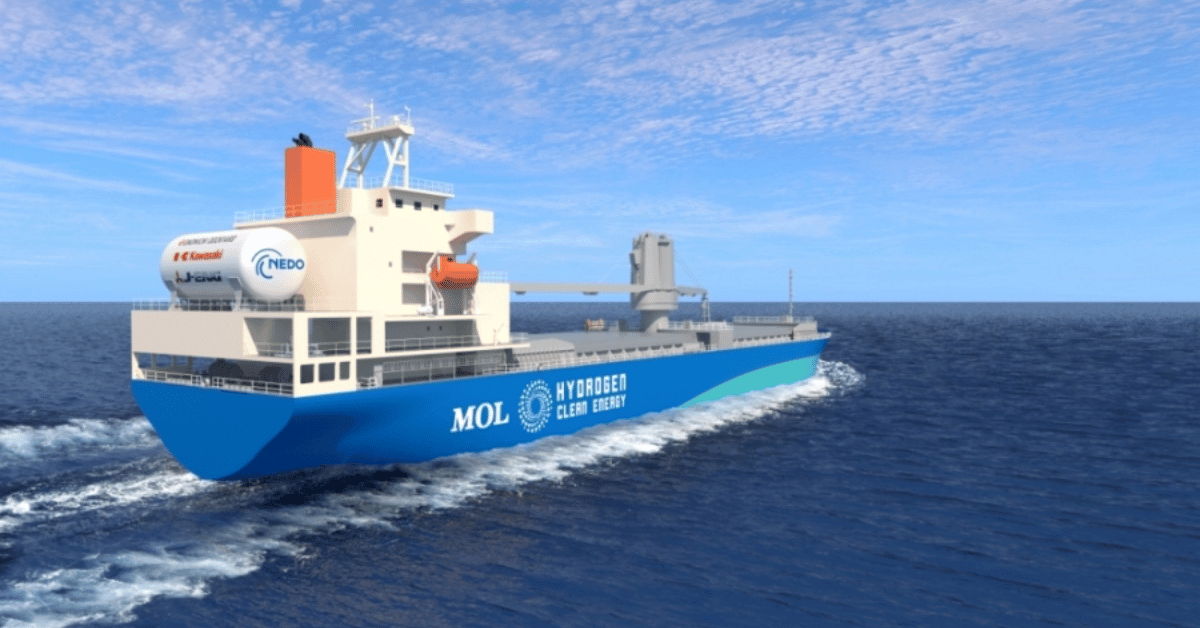
As part of NEDO’s “Green Innovation Fund Project / Next-Generation Ship Development”, Japan Engine Corporation (Hereafter, “Japan Engine”), Kawasaki Heavy Industries, Ltd. (Hereafter, “Kawasaki”), and Yanmar Power Solutions Co., Ltd. are jointly developing the “Development of Marine Hydrogen Engines and MHFS.”
Japan Engine has completed the world’s first hydrogen-fueled engine for large commercial vessels, the 6UEC35LSGH (Hereinafter, “the engine”). To mark the completion of the engine, it was unveiled to project stakeholders at Japan Engine’s headquarters factory on September 7.
During factory testing, the engine achieved a hydrogen co-firing rate of at least 95%, reducing GHG emissions by more than 95% compared with conventional heavy-fuel-oil engines.
Going forward, as part of the “Blue Harmony” project, the engine will be installed on a 17,500 DWT multipurpose vessel to be built by Onomichi Dockyard Co., Ltd. for Mitsui O.S.K. Lines, Ltd. and MOL Drybulk Ltd., with onboard demonstration testing scheduled to begin in April 2028. In addition, Nippon Kaiji Kyokai (Hereafter, “ClassNK”) will conduct safety assessments throughout each stage of the engine’s development and the vessel’s design, construction and operation.
Press Release
Read on the original site
Open the publisher's page for the full experience