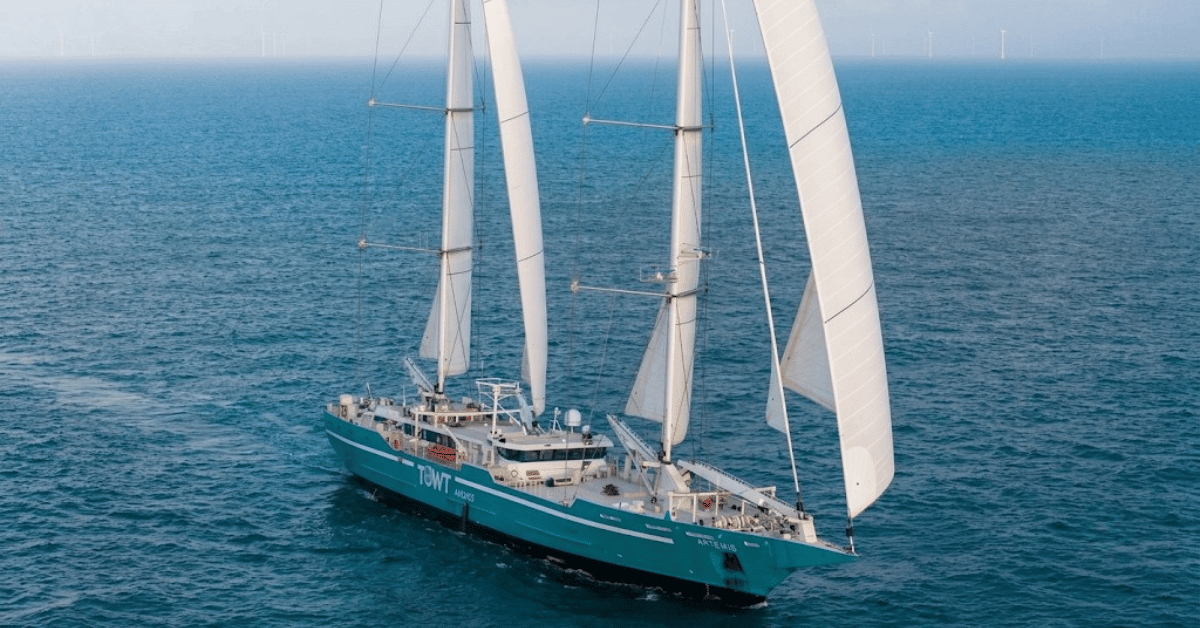
The maritime industry has long treated wind power as a historical footnote, but the Phenix-class vessels now entering service prove that sail propulsion is not a nostalgic gesture, it is an empirically validated path to deep decarbonization. With hybrid electrical systems integrated by Alewijnse and shipbuilding by Piriou, these four new sail-cargo ships are designed to cut CO₂ emissions by up to 90 percent, and that figure is not a theoretical projection. It is the measured outcome of a wind-first operating philosophy, supported by hydro-generation and battery storage, that reserves fossil fuel solely for emergency backup. This is not a pilot or a concept; it is a repeatable, scalable system now under construction in Vietnam.
What makes this development significant for our readers, whether you are a fleet operator weighing retrofit options or a policymaker assessing regulatory targets, is the specificity of the engineering. The Phenix-class vessels use automated soft-rigging sails derived directly from ocean racing technology, combined with hydraulic and wind sensors that enable near-full automation. The parallel hybrid propulsion system generates electricity through propeller rotation while the ship is under sail, recharging batteries without burning fuel. This integrated data ecosystem of sensors, controls, and power management is precisely the kind of calibrated, real-time system that the industry needs to move beyond voluntary decarbonization pledges. The same rigor that European ship recyclers urge EU inclusion of Indian facilities demands for recycling standards now applies to construction and operation: validated systems, not marketing claims, drive measurable progress.
Alewijnse's role in this project is instructive. The company brings 135 years of electrical systems experience across dredging, offshore, transport, and naval vessels, but its competitive advantage here is not just technical depth, it is geographic presence. Alewijnse has facilities in both Romania and Vietnam, the two countries where the Phenix-class hulls are built and outfitted. That local engineering and commissioning capability allows the company to oversee system integration from switchboard production to final commissioning, ensuring that the complex interplay of sail automation, hydro-generation, and battery management functions as a single, reliable unit. This matters because the energy transition in shipping will not succeed on blueprints alone; it requires on-the-ground expertise at shipyards across multiple continents. As measuring carbon thresholds to chart Arctic shipping's low-carbon future makes clear, the industry must simultaneously navigate melting Arctic routes and tightening emissions caps, making proven hybrid architectures like this one increasingly valuable.
The open question is scalability. NEWTOWT has developed the Phenix class with support from a French government grant, and the first two vessels, Anemos and Artemis, are already the largest sailing cargo ships in operation using automated soft-rigging sails. The four newbuilds will bring the fleet to six. But the European Commission's goal of a 90 percent reduction in CO₂ emissions by 2040 will require thousands of vessels, not dozens, to adopt similar hybrid wind-first designs. The specific detail to watch is the cost and complexity of replicating this electrical integration across different ship types and operating routes. If Alewijnse and Piriou can standardize the parallel hybrid architecture and localize production through their existing facilities in Romania and Vietnam, the Phenix-class could serve as a replicable template rather than a one-off showcase. The wind is free, and the engineering is now validated, the next question is how fast the industry can build at scale.