US Navy’s Final Expeditionary Sea Base, The 90,000-Ton USNS Hector A. Cafferata Jr. Delivered
Our take
The delivery of the USNS Hector A. Cafferata Jr. (ESB-8) marks the culmination of the U.S. Navy’s Expeditionary Sea Base (ESB) program, a significant development in maritime operational capabilities. These Mobile Landing Platforms (MLPs), as they’re formally classified, represent a shift toward a more flexible and responsive naval presence, particularly in littoral regions. The ESB program’s completion, following earlier deliveries, underscores the Navy's commitment to projecting power and supporting expeditionary forces globally. This aligns with broader trends in naval strategy, acknowledging the increasing complexity of maritime environments and the need for adaptable platforms. Considering the extended deployments frequently undertaken by naval assets, as highlighted in the recent article US Navy Aircraft Carrier Abraham Lincoln To Dock In Thailand After Record 200 Days At Sea, the ability of the ESB to provide logistical support and a floating staging base becomes invaluable. The Hector A. Cafferata Jr.’s arrival further enhances the Navy’s ability to sustain operations far from established bases.
The ESB class is noteworthy for its versatility. Beyond simply serving as a floating pier for landing craft and amphibious vehicles, these vessels can accommodate helicopters, serve as a forward operating base for unmanned systems, and provide medical support. The increasing focus on maritime security and the potential for conflict in strategically vital waterways, such as those addressed in the article Trump Says U.S. Navy Has Cleared All Mines From Strait Of Hormuz Shipping Lane, Warns Iran, further emphasizes the value of such adaptable assets. The ability to quickly establish a presence and provide support in contested environments is a key advantage. The inclusion of indigenous content in naval vessels, as seen with the Indian Navy’s acquisition of the INS Mangrol, as reported in Indian Navy Receives Third Anti-Submarine Warfare Vessel ‘Mangrol’ From Cochin Shipyard, also demonstrates a global trend toward bolstering maritime capabilities through localized production and collaboration.
The completion of the ESB program reflects a deliberate investment in forward presence and operational flexibility. The platforms’ design facilitates rapid deployment of troops, equipment, and supplies, reducing reliance on land-based infrastructure and enabling a more agile response to evolving geopolitical situations. The integration of various mission capabilities onto a single platform enhances efficiency and reduces logistical burdens. The validated performance of previous ESBs, combined with the increasing sophistication of maritime threats – ranging from piracy to state-sponsored aggression – suggests that the demand for these versatile assets will continue to grow. Data-driven assessments of maritime activity, and the real-time monitoring of potential threats, will be critical in optimizing the deployment and utilization of these platforms.
Looking ahead, the integration of advanced sensor technologies and autonomous systems onto the ESB platforms will be crucial. The ability to leverage ocean intelligence derived from calibrated data streams, including those from satellite and underwater platforms, will enhance situational awareness and enable more proactive responses to emerging challenges. It is worth watching how the U.S. Navy and other maritime forces adapt these platforms to incorporate emerging technologies and address the evolving complexities of the global ocean environment, particularly in light of ongoing climate change impacts on maritime operations and infrastructure.
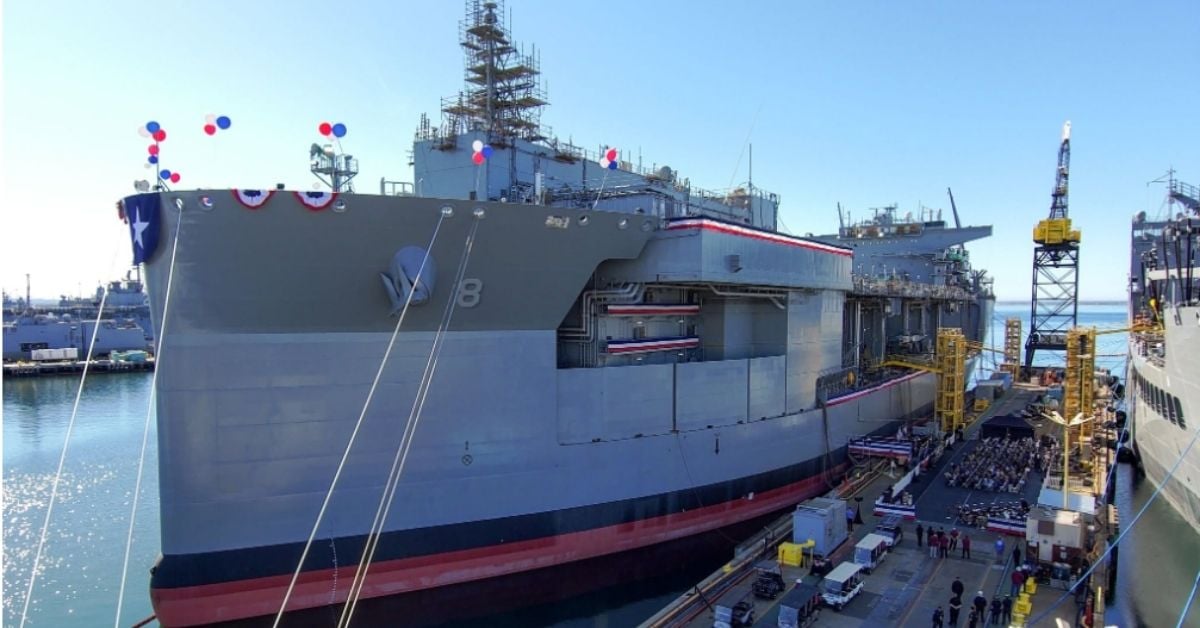
The last expeditionary sea base was delivered to the U.S Navy this week in San Diego, boosting the force’s maritime capabilities. General Dynamics NASSCO built the USS Hector A Cafferata Jr. (ESB-8), belonging to the Lewis B. Puller-class.
The USS Hector A Cafferata Jr. is 239 m long and displaces 90,000 tonnes when fully loaded. Its deck spans 52,000 square feet, and it can accommodate several fighter jets such as the MH-53E Sea Dragon, MH-60S Seahawk helicopters, MV-22B Osprey tiltrotor aircraft, and H-1 helicopters. The warship can reach 15 knots and has a range of 9500 nautical miles, with accommodations for 350 personnel.
The Navy has always forward-deployed these Expeditionary Sea Bases, which support the mine countermeasure ships and special operations forces. They provide logistics support from open waters to the shore for an array of military operations.
An official from the Navy said that everyone was happy to have another ESB in the US naval fleet. Three sea bases were put on extended maintenance periods in 2024 by the Military Sealift Command due to a shortage of sailors.
These included the USS Lewis B Puller, the USS Robert E Simanek and the USS Hershel Williams. Through this measure, the Navy ensured that MSC vessels could remain staffed. The Navy is now preparing the return of the 3 ESB ships, along with the new one which recently joined the fleet.
The Lewis B Puller and Hershel Williams are undergoing maintenance in Croatia and the East Coast Repair & Fabrication Shipyard in Newport News, respectively.
Their crew is also receiving training to attain the new certifications required for resuming operations by the end of this year or the beginning of 2027, when both of them would be out of the shipyards and ready for action.
Robert E Simanek is being upgraded at the shipyard in Mobile, Alabama and will remain there till September next year and will likely enter service in November 2027.
Two other expeditionary sea bases, namely the USS John L Canley and USS Miguel Keith, are a part of the U.S Seventh and Fifth Fleets and have remained in theatre.
Read on the original site
Open the publisher's page for the full experience