Russia’s 20,000-Ton Icebreaker Admiral Makarov Catches Fire During Repairs At Kronstadt Shipyard
Our take
The recent fire aboard Russia’s Admiral Makarov icebreaker, a 20,000-ton vessel undergoing repairs at the Kronstadt Shipyard, highlights a concerning trend of maritime incidents and underscores the complexities of maintaining critical infrastructure in a geopolitically charged environment. The incident, reportedly originating in the steering-gear compartment, adds another layer of challenge to Russia’s naval capabilities, especially given the ongoing pressures on its resources. This event follows a series of concerning incidents at sea, including the recent fire aboard a cargo ship carrying Indian seafarers after a drone strike Cargo Ship Carrying 23 Indian Seafarers Catches Fire After Drone Strike En Route To Pakistan, and the escalating tensions surrounding the seizure of a vessel by Norway linked to a claim by Ukraine’s Naftogaz Russia Demands ‘Immediate Release’ Of Vessel Seized By Norway Over Naftogaz’s $4.2 Billion Claim. These events, while distinct in their causes, collectively point to increased vulnerabilities within Russia’s maritime operations.
The Admiral Makarov is a vital asset for Russia, particularly in the Arctic region, where it performs tasks ranging from scientific research to maintaining navigation routes and projecting naval power. Its role in supporting Russia’s ambitions in the Arctic, including resource extraction and strategic positioning, cannot be overstated. The damage sustained during this fire, and the subsequent repair timeline, will undoubtedly impact these operations. Furthermore, considering Russia’s ongoing commitments in other theaters and the potential impact of sanctions on accessing necessary repair materials and expertise, the incident raises questions about the long-term resilience of its naval fleet. It’s worth noting that Russia has also been considering retiring older assets like the Kilo-class submarines Indian Navy May Retire Up To Three Kilo-Class Submarines Within 5 Years, suggesting a strategic recalibration of naval priorities.
Beyond the immediate operational impact, the fire aboard the Admiral Makarov serves as a reminder of the inherent risks associated with maritime infrastructure, particularly in complex repair environments. While the precise cause is still under investigation, the incident underscores the importance of rigorous maintenance protocols, robust safety systems, and continuous training for personnel involved in ship repairs. The incident also highlights the potential for cascading effects; disruptions to naval capabilities can have broader geopolitical implications, impacting regional stability and international trade routes. Integrated data ecosystems, leveraging real-time sensor data and predictive analytics, are increasingly crucial for proactively identifying and mitigating such risks, enabling preventative maintenance and enhanced operational safety across the global maritime domain. A validated and longitudinal approach to risk assessment, calibrated through empirical data, is essential for ensuring the continued reliability of critical maritime assets.
The frequency of these incidents – the drone strike, the vessel seizure, and now the icebreaker fire – suggests a potentially broader systemic challenge within Russia’s maritime sector. While attributing causation definitively requires further investigation, the confluence of geopolitical pressures, sanctions, and potentially strained maintenance resources warrants careful monitoring. The incident involving the Admiral Makarov is more than just a localized event; it's a data point contributing to a larger picture of evolving maritime security risks. The question now is whether this represents an isolated series of unfortunate events or a harbinger of more significant challenges to come for Russia’s naval capabilities and, by extension, its strategic posture in key regions.
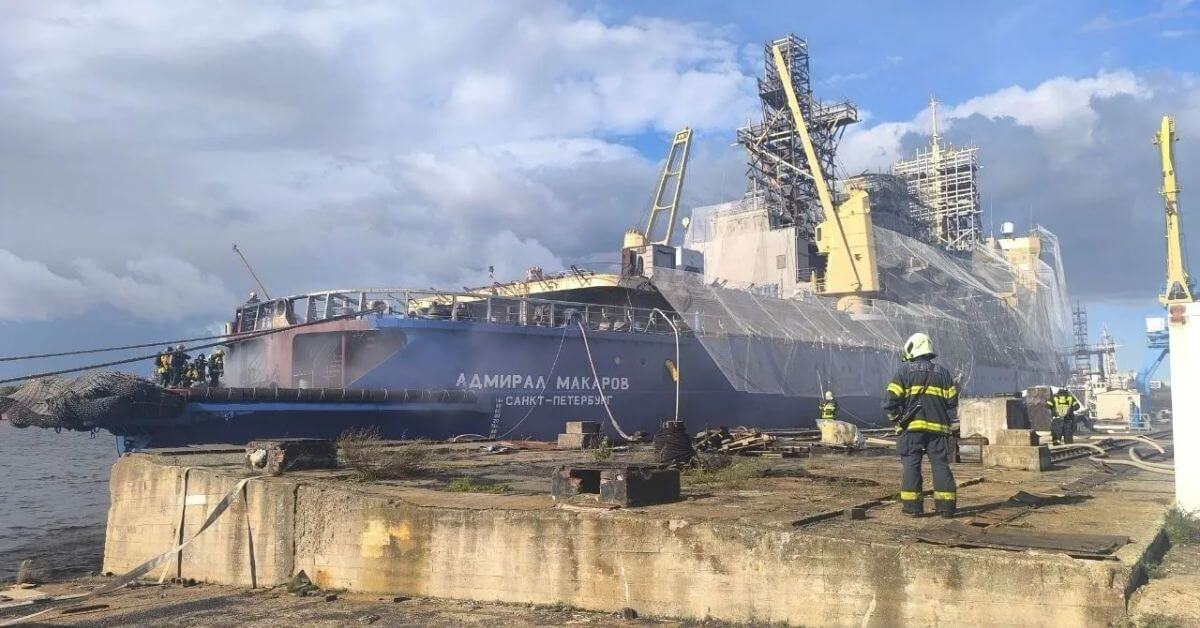
A fire broke out on Russia’s diesel-electric icebreaker Admiral Makarov while it was undergoing repairs at the Kronstadt Marine Plant near St. Petersburg.
The fire started on September 5 in the steering-gear compartment at the stern of the ship, Russian Telegram channel 112 reported. The fire covered an area of about 80 square metres.
Russian emergency services sent 52 personnel and 10 pieces of equipment to fight the fire. Firefighters brought it under control and put out the flames within about two hours.
No one was injured. The cause of the fire and the damage caused to the icebreaker have not been disclosed.
Admiral Makarov has been under repair since spring 2025. Work is being carried out on its hull, propellers and three propeller shafts. Its main engines are also being repaired, with the work expected to continue until the end of 2026.
After the repairs, the icebreaker was expected to escort ships to Russian ports in the eastern Gulf of Finland during the winter navigation season.
Admiral Makarov Icebreaker
The Admiral Makarov, a Project R-1039 diesel-electric icebreaker, was built by Wärtsilä in Helsinki, Finland, in 1975 for the Soviet Union.
It is one of three Yermak-class icebreakers built in Finland. The other two are Yermak, built in 1974, and Krasin, built in 1976.
The vessel is named after Vice-Admiral Stepan Makarov, an oceanographer and polar explorer.
Admiral Makarov has a displacement of about 20,247 tonnes and is 134.84 metres long. It is 26.05 metres wide and has a draft of up to 11 metres.
The Russian Project R-1039 icebreaker Admiral Makarov suddenly caught fire earlier today while it was undergoing repairs at the Kronstadt Marine Plant in St. Petersburg.
This key Russian vessel was in the yards to repair extensive damage caused by its last shipyard fire in 2024. pic.twitter.com/H3v79ou3KQ
— OSINTtechnical (@Osinttechnical) September 5, 2026
Its engines produce about 30.5 megawatts of power. The icebreaker can reach speeds of about 19.5 to 20 knots. It can also move through level ice up to 1.5 metres thick at a speed of about two knots.
The vessel has a crew of 58 and can operate for up to three months without refuelling.
Admiral Makarov operated in Russia’s Far East for many years before later being used in the Arctic. It was transferred to Rosmorport’s Northwestern Basin Branch in late 2025.
Its main job is to escort other ships through difficult ice conditions.
Fire at Kronstadt Shipyard
Kronstadt, on Kotlin Island in the Gulf of Finland, is home to one of Russia’s major naval bases.
In June 2026, Ukrainian drones struck the Russian Project 20380 missile corvette Boykiy while it was undergoing repairs at Kronstadt, according to the supplied reports.
The corvette was in the Veleshinsky dry dock at the Kronstadt Marine Shipyard when the attack took place. A fire broke out aboard the vessel after it was damaged.
The fire aboard Admiral Makarov was a separate incident.
Another serious accident occurred at the Sevastopol Marine Plant in temporarily occupied Crimea in October 2025, when the unfinished PK-700 heavy floating crane capsized, killing two people and injuring at least 20 others.
The fire on Admiral Makarov has now been put out. No casualties were reported.
Authorities have not said what caused the fire or how much damage the icebreaker suffered. The vessel remains under repair, with work on its main engines expected to continue through the end of 2026.
References: united24media, topwar
Read on the original site
Open the publisher's page for the full experience