Pakistan Navy Ship Collides With Indian Warship In Arabian Sea During Routine Surveillance Mission
Our take
The recent collision between a Pakistan Navy vessel and an Indian warship in the Arabian Sea during a routine surveillance mission underscores the escalating tensions and complex maritime security landscape in the region. Such incidents, while potentially accidental, carry significant geopolitical weight, particularly given the historical and ongoing disputes between India and Pakistan. This event follows a pattern of increasingly assertive naval postures in strategically vital waterways, a trend highlighted by recent events like [Norway Helps 69 Russians Stranded In Arctic After Ship Arrest On Ukraine’s Request] and the recurring incidents of maritime disruption in the Strait of Hormuz, as detailed in [Iran Claims Attacks On 10 Ships Near Strait Of Hormuz After US Sinks 5 Iranian Tankers]. The Arabian Sea, a critical trade route and a region experiencing heightened geopolitical volatility, demands a heightened awareness of maritime risk factors.
The frequency of these incidents, mirroring the collision off Istanbul involving the Tugberk Imamoglu and the Alsu [Turkish Navy Locates Sunken Cargo Ship After Collision Off Istanbul, Search For 10 Crew Continues], suggests a confluence of factors contributing to the increased risk of maritime accidents. These include intensified naval patrols, congested shipping lanes, and potentially, a degradation of communication protocols or navigational safety measures in contested areas. While investigations into the specific circumstances of the Pakistan-India collision are ongoing, the broader implications are clear: the potential for miscalculation or escalation is amplified in environments characterized by heightened military presence and unresolved territorial disputes. Data analytics applied to maritime traffic patterns and naval deployments could offer valuable insights into identifying and mitigating these risks, contributing to a more predictable and safer operational environment.
The incident also necessitates a re-evaluation of existing maritime confidence-building measures between India and Pakistan. While both nations possess sophisticated naval capabilities, the lack of robust communication channels and established protocols for de-escalation in the event of accidental encounters poses a serious threat to regional stability. Integrated data ecosystems, leveraging real-time tracking and analysis of naval movements, could improve situational awareness and reduce the likelihood of future incidents. Furthermore, peer-reviewed research into the psychological factors influencing decision-making during maritime encounters, particularly in high-stress environments, is crucial for developing effective training programs and operational guidelines. A validated, longitudinal study of near-miss incidents could provide empirical data to inform policy and enhance maritime safety protocols.
Ultimately, the Arabian Sea collision serves as a stark reminder of the need for enhanced ocean intelligence and collaborative maritime security efforts. The increasing complexity of global trade routes, coupled with the growing strategic importance of maritime domains, demands a proactive and data-driven approach to managing risk. Moving forward, it will be critical to monitor the outcome of the investigations, assess the impact on bilateral relations, and explore opportunities for enhanced communication and cooperation between India and Pakistan to prevent similar incidents from occurring. A crucial question remains: will this collision catalyze a renewed commitment to maritime diplomacy and the development of more robust safety protocols, or will it further exacerbate tensions in a region already grappling with numerous security challenges?
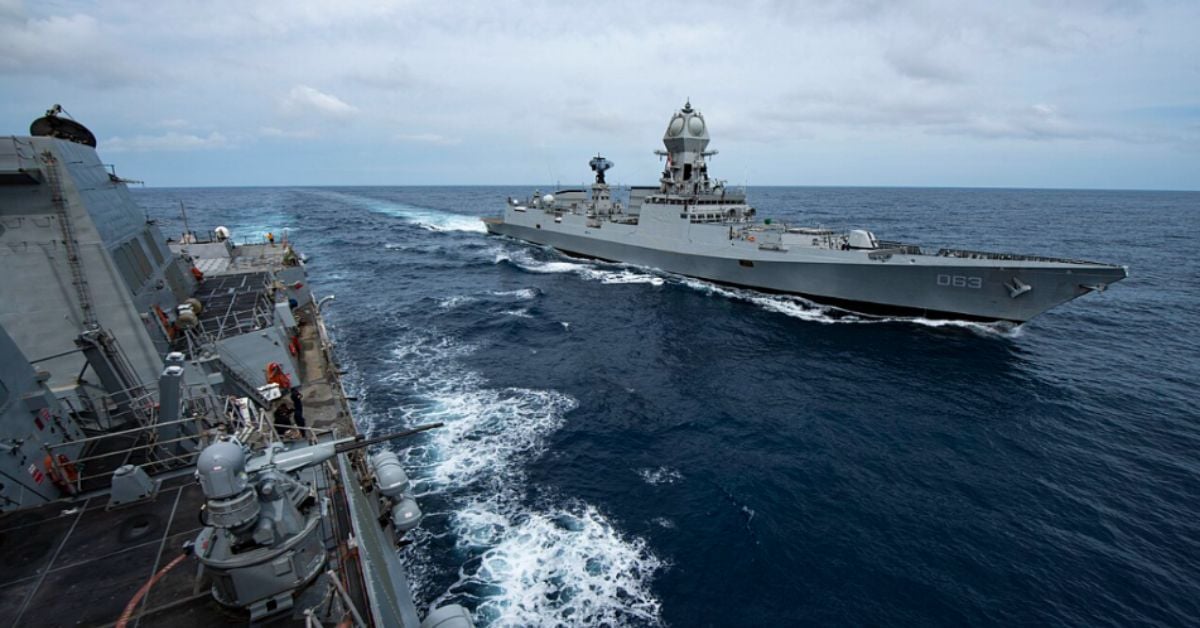
A Pakistan Navy vessel collided with an Indian warship in the Arabian Sea during a routine surveillance operation, after which New Delhi called for the Charge d’Affaires of Pakistan to protest against the security incident in the high seas.
Saad Ahmad Warraich arrived at the Foreign Ministry’s Office in Janpath, Delhi and stayed there for half an hour, where he discussed the matter with top Indian Foreign Ministry Officials. The Pakistani diplomat was directed to convey India’s message to Pakistan’s External Ministry.
Though the incident did not lead to any casualties or damage to the Indian naval ship, it was a breach of Article 10 of the agreement signed between India and Pakistan in 1991 on providing prior information regarding naval exercises, movement of troops and other manoeuvres.
India called Pakistan’s navy ship’s action ‘unacceptable and unprofessional.’ India said Pakistan should be careful and uphold the provisions of the agreements signed between the two sides to prevent such incidents in the future.
The incident occurred on September 15, 2026, 220 km east of Oman, when Pakistan’s recently commissioned corvette of Yarmook-class, the PNS Hunain, collided with the Indian Navy’s Kolkata-class guided missile destroyer.
The Indian naval vessel was involved in a routine surveillance mission when the Pakistani corvette, which was participating in the Seaspark-26 naval exercise, came dangerously close to the former at high speed.
Though warnings were given over VHF Channel 16, PNS Hunain performed an unsafe manoeuvre and tried to cross the Indian vessel’s bow, causing a side-grazing contact.
The Indian destroyer did not suffer any major damage; however, the Pakistani corvette got a hull dent and a crack, after which it had to return to port to undergo repairs.
According to those familiar with the incident, the waters in the North Arabian Sea were rough at the time, and both naval vessels then went their separate ways.
Indian authorities said that Pakistan’s Navy was being aggressive and unprofessional. The incident is the second one of its kind since 2011, when Pakistani frigate PNS Babur and India’s Frigate INS Godavari were involved in a similar situation in the Gulf of Aden while conducting an Anti-Piracy operation.
SEASPARK-26 is the Pakistani Navy’s flagship military exercise, which began on September 2, 2026, off Karachi to test the readiness of its fleet and also new defence strategies across the North Arabian Sea.
It involves naval units, aircraft, marines, special forces, submarine fleet, along with supporting elements from the country’s Army and Air Force.
Read on the original site
Open the publisher's page for the full experience