New ‘Digital’ Toolbox Makes Sustainable Ship Design Concepts, Cutting Hull Optimisation Time from Weeks To Days
Our take
The maritime industry faces a complex calculus: increasing global trade demands necessitate more vessels, yet escalating concerns regarding fuel consumption and emissions require a dramatic shift towards sustainable practices. Recent advancements in ship design, exemplified by Deltamarin’s expanded digital toolbox, represent a crucial step in addressing this challenge. The ability to drastically reduce hull optimization time – from weeks to days – through numerical optimization is not merely an efficiency gain; it’s a potential catalyst for a broader industry-wide transformation. This development arrives at a critical juncture, underscored by recent incidents highlighting the vulnerabilities and environmental risks inherent in maritime operations; a [Passenger Ferry Collides With Tanker Off Malaysia’s Penang Port, Injuring 21 People] and the ongoing concerns surrounding pollution, as illustrated by the [Iran Seizes Bulk Carrier After Alleged Oil And Sludge Discharge In Strait Of Hormuz], necessitate more proactive and sustainable design solutions. The efficiency gains promised by these tools could, in the long run, contribute to a reduction in both accidents and environmental impact.
The core of the innovation lies in harnessing computational power to explore a vast design space, identifying optimal hull shapes that minimize drag and maximize fuel efficiency. Traditional hull optimization relied heavily on physical model testing and iterative adjustments, a time-consuming and costly process. The shift to numerical optimization, leveraging techniques like computational fluid dynamics (CFD), allows for a far more rapid and comprehensive evaluation of design alternatives. This accelerated timeline facilitates the incorporation of sustainability considerations earlier in the design phase, allowing engineers to explore alternative materials, propulsion systems, and hydrodynamic configurations with greater agility. Moreover, this kind of iterative design process can lead to solutions that might have been previously overlooked due to the constraints of traditional methodologies. The implications extend beyond simply reducing fuel burn; optimized hull designs can also contribute to reduced noise pollution, a factor increasingly important for marine ecosystems and coastal communities, especially in light of the [Projectile Narrowly Misses Oil Products Tanker Off Oman & Explodes In Surrounding Waters].
However, realizing the full potential of this technology requires a broader ecosystem of data and collaboration. The accuracy and reliability of numerical simulations are heavily dependent on the quality and completeness of the input data – incorporating validated, longitudinal data on wave conditions, vessel operating profiles, and material properties is essential. This speaks to the broader trend toward integrated data ecosystems within the maritime sector, where real-time sensor data, weather forecasts, and performance analytics converge to inform design and operational decisions. The promise of "ocean intelligence," as we at World Data Ocean define it, hinges on precisely this ability to synthesize disparate data streams into actionable insights. Calibration of these models against empirical data is also critical; while simulations offer a powerful predictive capability, continuous validation against real-world performance is necessary to ensure accuracy and build confidence.
Looking ahead, the convergence of advanced computational design tools, increasingly sophisticated sensor technology, and a growing emphasis on sustainability will likely reshape the maritime landscape. The ability to rapidly prototype and optimize vessel designs will empower shipbuilders to respond more effectively to evolving regulatory requirements and market demands. A key question to watch is how effectively this technology can be integrated across the entire maritime value chain – from naval architects and shipyards to ship operators and port authorities – to unlock its full potential for a more sustainable and resilient global shipping industry. Will these tools lead to a new generation of vessels that are not just more efficient but also fundamentally more adaptable to the challenges of a changing ocean environment?
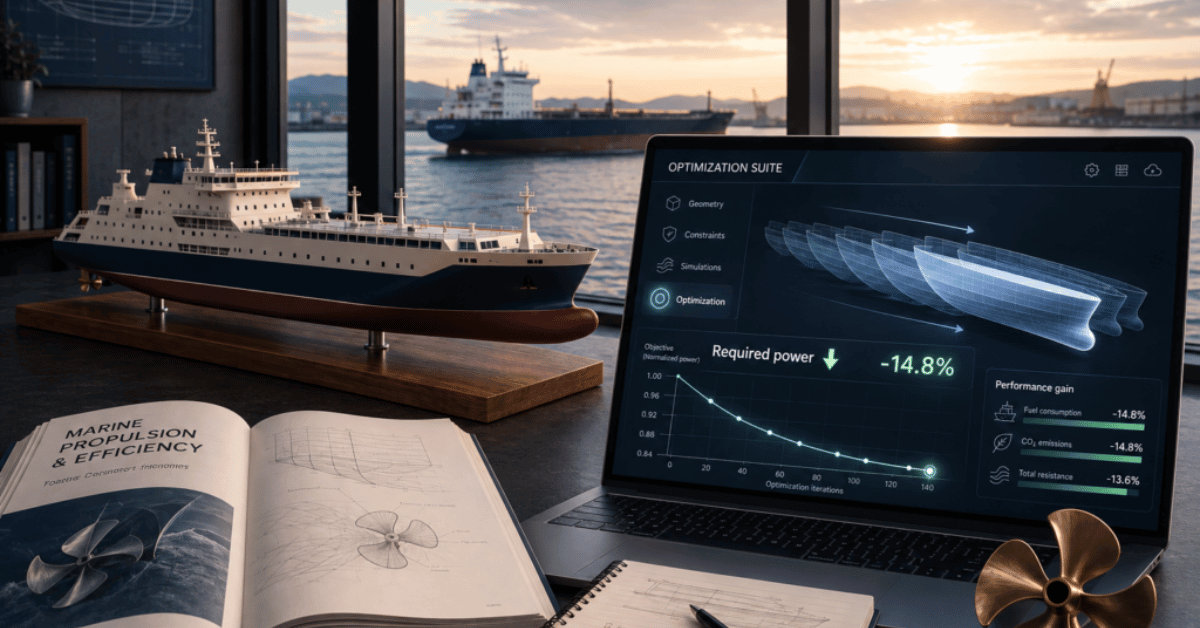
Deltamarin has worked continuously to develop new methods for ship concept design and a digital “toolbox” to enable energy-efficient and sustainable vessel designs. Hydrodynamic optimization is one of Deltamarin’s current development areas, and the company is advancing its capabilities in this field through cooperation with Nocean, including the integration of Nocean’s optimization tool and related know-how.
While Deltamarin has demonstrated for decades its ability to generate excellent hulls, numerical optimization provides an important complement to expert knowledge. It can help with:
- Finding non-intuitive improvements that can be difficult to identify through human expertise alone
- Handling complex multi-condition objectives, such as operational profiles involving multiple draughts and speeds
- Dramatically expanding the design space that can practically be explored during the concept design process – typically hundreds of qualified simulations with various parameter combinations.
The cooperation with Nocean began with a real project involving a large PCTC vessel, where the starting point for the optimization was already a state-of-the-art, highly efficient hull. The case was complex, with nine operating conditions covering three draughts and three speeds, where optimal performance needed to be determined. Deltamarin had previously carried out the hull optimization internally based on human expertise alone, with the work taking several weeks. Nocean demonstrated that its tool was able to identify similar improvements in approximately four to five days. The weighted average of the improvements reached 8% in this case.
Following the successful start of the cooperation and work on several projects, such as a tanker, a twin-skeg LNG carrier and a cruise vessel, Deltamarin saw continued collaboration with Nocean as the natural and most promising way forward. The Nocean tool and related know-how provide a platform for further developing Deltamarin’s concept design methods and integrating hydrodynamic optimization into its existing CFD modelling practices.
“What makes this collaboration particularly exciting is the combination of Deltamarin’s extensive ship design and hydrodynamic expertise with our optimization technology. The objective is not simply to optimize an existing hull, but to give designers the ability to explore a much wider design space across complex operational profiles, while fundamental design decisions are still open. By making this exploration possible within days rather than weeks, optimization can become an integral part of concept design and help identify efficiency gains that would otherwise be extremely difficult to uncover,” says Ivan Schrooyen, Founder and CEO of Nocean.
“For Deltamarin, this hydrodynamic optimization enables us to shift informed, data-based decision-making to an earlier stage of the concept project, when it is still possible to influence key ship design decisions – from main dimensions to various other hard points driven by alternative fuels, for instance. This means that instead of only chasing the last few % we can gain in hull performance, we can identify larger opportunities for improvement, leading to savings of tens of percent in ship concept fuel efficiency,” says Mia Elg, R&D Manager at Deltamarin.
The practical impact of combining advanced numerical optimization with Deltamarin’s hydrodynamic and ship design expertise is that Deltamarin can create fundamentally more energy-efficient and environmentally sustainable designs for our customers. The reduced design time allows more variations to be studied, leading to more informed, data-based decision-making early in vessel development, when key design parameters can still be influenced.
Deltamarin is a leading ship designer capable of developing bespoke designs across maritime and offshore markets, with successful concept design as one of its key competencies.
Nocean is a Norwegian engineering company specialized in software and services related to advanced ship hydrodynamics and hull optimization.
Read on the original site
Open the publisher's page for the full experience