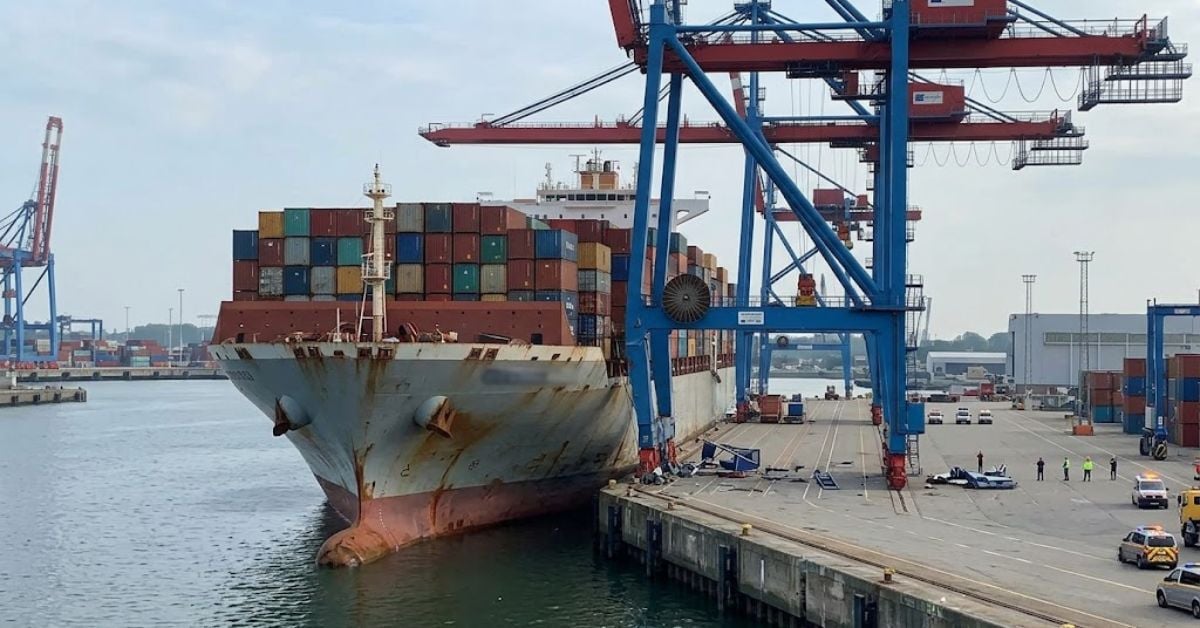
The collision between the CMA CGM Pointe Noire and a container-handling crane at Livorno's Terminal Darsena Toscana is a stark reminder that even routine port maneuvers carry risks that can ripple through global supply chains. This incident, which reduced a six-crane terminal to just two functional units, did not result from a storm or system failure, but from a ship's bridge striking a crane parked for maintenance. The cause remains under investigation, and the crane's removal and restoration will take months. For an industry that depends on precision and predictability, this is not a footnote, it is a signal.
The immediate consequence is measurable: reduced container-handling capacity at a key Mediterranean hub. The Port Authority restricted waters in front of quay 14, and the terminal must now operate with only two of its six Paceco cranes. The Port Authority and Coast Guard are investigating, and the vessel remains detained. The terminal's general manager stated that the crane's position had been agreed with pilots and the Maritime Authority, yet the collision still occurred. This raises a practical question for operators and port managers: can current maneuvering protocols and real-time spatial awareness keep pace with the scale of modern vessels? The 272-metre CMA CGM Pointe Noire is not exceptional in size, yet a single misjudgment in a turning basin sidelined critical infrastructure.
These events underscore why validated ocean intelligence matters beyond open-water forecasting. The same physics-guided models that predict buoy displacement can be calibrated for port environments, tracking vessel trajectories relative to fixed assets, accounting for tugboat interaction and current. When a crane's position is known and a ship's approach is measured in real time, the gap between procedural agreement and actual execution becomes visible. Meanwhile, the push for fleet readiness, as seen in efforts like validated AI inspection scaled to $300M for fleet readiness, demonstrates that validated, empirical tools are already being deployed to reduce downtime in naval operations. Commercial terminals face the same imperative.
The specific detail to watch is not the crane's repair timeline, but the investigation's findings on the ship's maneuver. The captain has been summoned; the Coast Guard is examining the vessel's approach. If the data from the ship's voyage data recorder, port radar logs, and tugboat telemetry can be integrated into a single, peer-reviewed analysis, the industry may gain a longitudinal case study on navigational risk. Without that integration, this incident becomes just another delay. We know that integrated data ecosystems are advancing in ship repair and fleet management. The same empirical rigor should be applied to understanding how a 272-metre vessel, under tow, collides with a stationary crane. The takeaway is direct: validated, real-time ocean intelligence is not just for predicting buoy displacement, it is for preventing the predictable.