Our World in Data
52 stories filed under Our World in Data on World Data Ocean. The newest of them: “Three nations concentrate nearly 60% of Latin America's poverty burden”, “AI compute doubles every six months, reshaping empirical research”, and “US healthcare spending per capita leads G7 nations without leading outcomes”. Three nations, Brazil, Venezuela, and Mexico, concentrate nearly 60% of Latin America's poverty burden. Since 2010, the training computation of notable AI systems has doubled every six months, reshaping the landscape of empirical research. A Global Hub for Ocean Intelligence 4 World Data Ocean is a centralized digital platform where researchers, scientists, and ocean enthusiasts converge to… The list below is every Our World in Data story on World Data Ocean, newest first.
Three nations concentrate nearly 60% of Latin America's poverty burden
Three nations, Brazil, Venezuela, and Mexico, concentrate nearly 60% of Latin America's poverty burden. This is a measurable concentration of hardship that demands a calibrated response. Understanding these geographic patterns is the first step toward effective intervention. For a parallel look at how resource supply chains and demographic shifts intersect with economic vulnerability, see our related piece on tracing cobalt from Congo's mines to China's refineries.
AI compute doubles every six months, reshaping empirical research
Since 2010, the training computation of notable AI systems has doubled every six months, reshaping the landscape of empirical research. This accelerated trajectory demands rigorous, validated methodologies to ensure our ocean intelligence keeps pace. Understanding drives protection, and these measurable advances offer new tools for calibrating climate indicators. For deeper context on how demographic shifts interact with these tools, see our related coverage on divergent population trajectories reshaping global climate indicators.
US healthcare spending per capita leads G7 nations without leading outcomes
The United States spends more per capita on healthcare than any other G7 nation, yet its health outcomes do not lead the group. This is a measurable, empirical disconnect that demands scrutiny. Higher spending does not automatically translate to better results, and understanding why is essential. Our related coverage on how two centuries of uneven growth have shaped today's global inequality offers a broader context for these kinds of systemic disparities. The data compels us to ask harder questions.
Two centuries of uneven growth have shaped today's global inequality
Two centuries of uneven economic growth have carved the contours of today's global inequality, a measurable divide that demands calibrated, empirical understanding. This is not an abstraction; it is a validated pattern of winners and laggards, visible in longitudinal data. Understanding drives protection, of both people and the systems they depend on. For a parallel view of demographic divergence, our analysis of global mortality patterns reveals regions where deaths outpace births, offering another integrated data point on planetary imbalance.
Global livestock data reveals 80 billion land animals harvested annually
Eighty billion land animals are slaughtered for meat every year, a figure so large it resists comprehension. This is not an abstraction; it is the measurable, annual output of a global food system operating at industrial scale. These numbers demand our attention, not for shock, but for the empirical clarity they provide. Understanding drives protection. For deeper context on how demographic shifts reshape demand, see our related coverage on the aging global population.
Measuring the share of women who reach reproductive end without children
A significant and measurable share of women now reach the end of their childbearing years without having children. This longitudinal shift demands empirical attention, not alarm. Understanding the precise, validated proportion is essential for calibrating our models of demographic change and societal health. We see this as a critical climate indicator, as population dynamics are deeply integrated with resource use. For deeper context on how we track biological outcomes, see our related work on the measurable share of births shaped by assisted reproductive technologies.
Global mortality patterns reveal regions where deaths outpace births
Regions where deaths outpace births are becoming measurable indicators of demographic and economic strain. These mortality patterns, validated by longitudinal data, reveal a global shift that demands integrated understanding. The same empirical rigor that tracks Britain's validated decline in smoking, once widespread, now uncommon, applies here. From orbit to ocean floor, we follow the data. These are not abstract statistics; they are climate indicators of human systems, demanding calibrated, purposeful attention.
Meat consumption patterns reveal measurable link between national wealth and diet
A measurable link exists between national wealth and meat consumption: people in richer countries tend to eat more meat. This empirical pattern raises urgent questions about sustainability and equity. Understanding these dynamics is essential for informed policy. For deeper context on global challenges, our analysis of "Global literacy gaps among youth reveal urgent need for measurable education action" offers a parallel view of disparities that demand calibrated, integrated responses.
Tracking the measurable share of births shaped by assisted reproductive technologies
One in every 30 to 40 births in high-income countries now begins with IVF or similar technologies. This measurable share of births shaped by assisted reproduction is a quiet revolution in family formation and human biology. The data is validated and longitudinal, showing a steady, calibrated rise over decades. Understanding this shift matters as much as tracking other global trends, such as how meat consumption patterns reveal a measurable link between national wealth and diet.
Fifty years of Moore's Law in calibrated, measurable transistor growth
Fifty years of calibrated, measurable transistor growth have validated Moore's Law as a remarkably accurate predictor. This isn't just a technical curiosity; it is empirical proof that sustained, integrated innovation can deliver predictable progress. Understanding this trajectory helps us grasp the pace of change itself. For a parallel in measurable global trends, see our related coverage on the validated, peer-reviewed data behind centuries of declining homicide rates.
Divergent population trajectories reshape global climate indicators
India, China, Europe, and the United States are charting profoundly different demographic futures, and these divergent population trajectories are reshaping global climate indicators. As some nations age and others grow, the pressure on resources and emissions shifts in measurable ways. Understanding these calibrated, real-time changes is essential. For deeper context, our piece on the aging global population doubling by mid-century explores how these demographic shifts are reshaping coastal systems.
Measurable shift in homophobic attitudes across Western Europe and US
A measurable shift is underway: homophobic attitudes have fallen across Western Europe and the United States, according to Our World in Data. This is not a marginal trend but a calibrated, empirical change in social climate indicators. Understanding drives protection, and these longitudinal data validate that societal progress is real. For deeper context on how empirical research itself is being reshaped, see our related coverage on AI compute doubling every six months.
Mapping the global nuclear arsenal: validated data on sovereign stockpiles
Nine countries hold nearly all the world's nuclear weapons, and the validated data on sovereign stockpiles reveals a stark concentration of power. These arsenals are measurable, empirical facts of global security, not abstract threats. Understanding the precise numbers is a form of ocean intelligence for the geopolitical realm. For a parallel in how validated data reshapes our understanding of long-term human behavior, see our related piece on the "Centuries of empirical data reveal a measurable decline in global homicide rates."
Cooling access divides measured across global climate indicators
Access to cooling is not a universal reality, it is a measured divide. Global climate indicators reveal stark inequalities in air conditioning access worldwide. This is not merely a comfort gap; it is a matter of survival in a warming world. Understanding these disparities is essential for informed climate action. For another perspective on measurable global divides, see our coverage of meat consumption patterns, which reveals a clear link between national wealth and diet.
Singapore's economic rise measured in validated per capita gains since 1960
Singapore's economic transformation is measured in validated per capita gains. Since 1960, GDP per capita has climbed from one-third of Western Europe's level to twice as much. This is not a story of luck, but of calibrated, long-term policy. Understanding such measurable progress matters. For deeper context on global inequalities, see our related work on cooling access divides measured across climate indicators.
Centuries of empirical data reveal a measurable decline in global homicide rates
Centuries of empirical data, validated across cultures and continents, reveal a measurable decline in global homicide rates. This is not a story of a problem solved, but of a long-term trend worth understanding. The data is clear: violence has diminished dramatically over the centuries. This measurable shift in human behavior parallels other encouraging social changes, such as the decline in homophobic attitudes documented in our piece on a *Measurable shift in homophobic attitudes across Western Europe and US*.
Aging global population doubles by mid-century, reshaping coastal systems
By mid-century, the global population aged 65 and older will double, a shift that will fundamentally reshape coastal systems. This demographic transformation demands integrated, measurable data to understand its impact on ocean health and climate resilience. As communities age, the need for real-time ocean intelligence becomes urgent. For deeper context on how uneven growth patterns shape global challenges, see our related analysis, "Two centuries of uneven growth have shaped today's global inequality." Understanding drives protection.
Britain's shift from widespread smoking to an uncommon habit is now empirically validated
Britain's shift from widespread smoking to an uncommon habit is now empirically validated. This measurable, real-time progress demonstrates how sustained public health efforts can reshape national behavior. It is a quiet but powerful success story, one of collective action and clear, peer-reviewed evidence. For deeper context on measurable global improvements, consider our related piece "Measurable progress in aviation security shows hijackings in sustained decline." Understanding drives protection, whether in health or security.
Global fertility patterns reveal which nations fall above or below replacement level
Global fertility patterns reveal which nations fall below or above the replacement level of roughly 2.1 children per woman. Many high-income countries now sit well below that threshold, while several in Sub-Saharan Africa remain above it. These diverging trends carry profound implications for population structure and resource demands. For deeper context on how we measure planetary change, see our related coverage of "Measuring the Ocean's Warming Pulse at 2,000 Meters." Understanding these demographic signals is as vital as tracking our climate indicators.
Measurable progress in aviation security shows hijackings in sustained decline
Measurable progress in aviation security shows hijackings in sustained decline. Once a recurring threat, airline hijackings are now rare, validated by empirical data that underscores the power of calibrated, integrated security systems. This is not luck; it is the result of global collaboration and real-time intelligence. Understanding drives protection. For a parallel in measured global challenges, see our related coverage on global displacement and uneven national responsibility.
Global mortality patterns reveal distinct regional health priorities
Heart disease remains the world's leading cause of death, but global mortality patterns reveal distinct regional health priorities, from infectious diseases in Sub-Saharan Africa to non-communicable conditions in Europe and Asia. These data are validated, measurable indicators of where public health systems must focus next. Understanding these regional differences drives smarter, more targeted action. For deeper perspective on interconnected global systems, our piece "A Shared Data Ecosystem to Deepen Global Ocean Understanding" explores how integrated data frameworks can inform planetary health.
Global displacement measured in uneven national responsibility
National responsibility for hosting refugees is anything but uniform. Some countries carry a disproportionate burden while others accept far fewer displaced people, a measurable disparity in global solidarity. This uneven distribution demands empirical attention, not alarm. Understanding these imbalances is the first step toward calibrated, collaborative policy. For deeper context on planetary pressures, see *Measuring the Ocean's Warming Pulse at 2,000 Meters*.
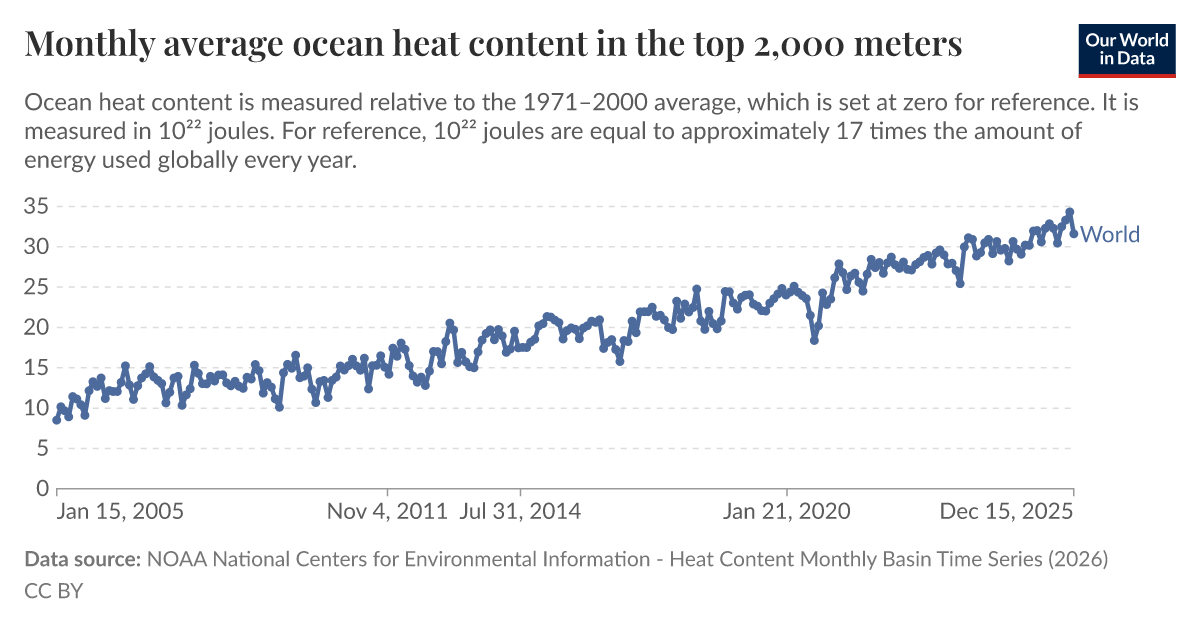
Measuring the Ocean's Warming Pulse at 2,000 Meters
Two thousand meters down, the ocean is warming measurably and without pause. Monthly average heat content in the top 2,000 meters provides one of the most empirically grounded climate indicators available, validated, peer-reviewed, and increasingly urgent. This isn't a distant signal; it is a calibrated pulse we can track in real time. Understanding drives protection. For deeper context on how global experts are building the data framework to monitor these changes, see "Global experts unite to steer Ocean Decade's data and knowledge framework."
New data validates fishing gear as the primary source of Pacific plastic
New data validates what many have long suspected: fishing gear is the primary source of plastic in the Great Pacific Garbage Patch. This is not a problem of straws and bags, but of industrial scale. Measurable, peer-reviewed evidence now points directly to the fishing industry. Understanding drives protection. For deeper context on how we track these accumulating pollutants alongside climate indicators, explore our coverage of "Mapping Ocean Plastic Accumulation to Future Climate Indicators." The ocean demands empirical solutions, not alarm.