climate science
World Data Ocean keeps climate science in one place: 7 stories so far. The section currently leads with “Atmospheric CO₂ reaches record highs in 2024, validated by global data”, “Measuring the Ocean's Warming Pulse at 2,000 Meters”, and “Ocean Color Shift Reveals Measurable Climate Indicators Worldwide”. Atmospheric CO₂ reached record highs in 2024, validated by global data from the World Meteorological Organization. Two thousand meters down, the ocean is warming measurably and without pause. A Global Hub for Ocean Intelligence 4 World Data Ocean is a centralized digital platform where researchers, scientists, and ocean enthusiasts converge to… The list below is every climate science story on World Data Ocean, newest first.

Atmospheric CO₂ reaches record highs in 2024, validated by global data
Atmospheric CO₂ reached record highs in 2024, validated by global data from the World Meteorological Organization. This is not an anomaly, it is a calibrated signal of accelerating change. Each measurable increase reinforces what the geological archive already tells us: the planet responds to pressure. Understanding drives protection. For deeper context on Earth's thresholds, see our coverage of "Five mass extinctions recorded in Earth's geological archive." The data is clear. The question is what we do with it.
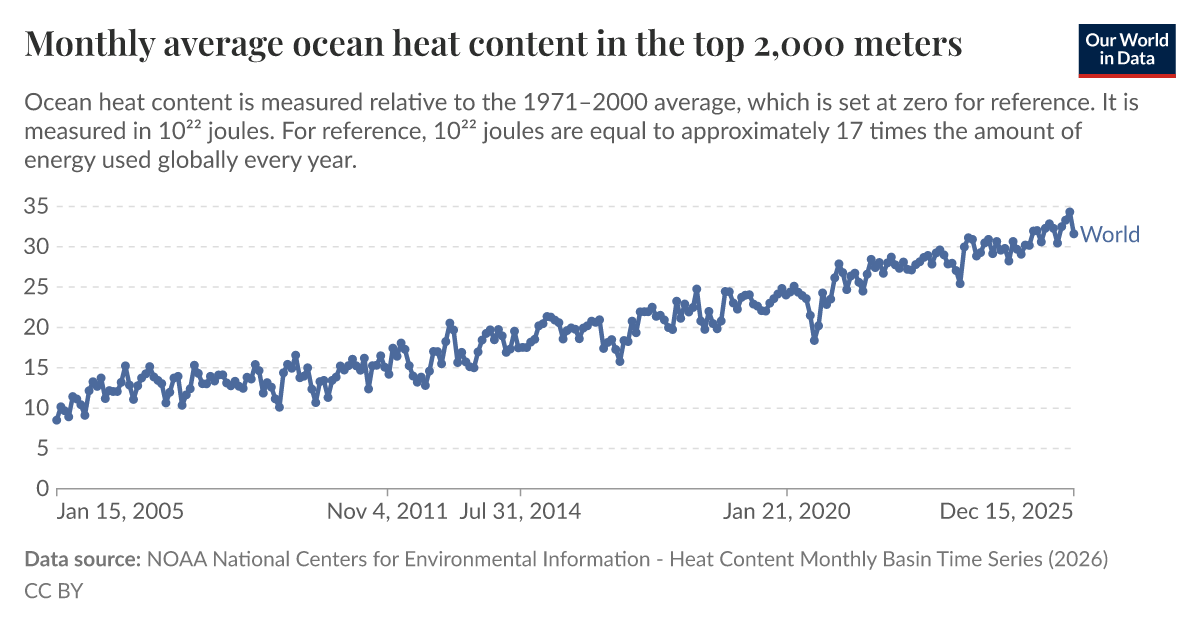
Measuring the Ocean's Warming Pulse at 2,000 Meters
Two thousand meters down, the ocean is warming measurably and without pause. Monthly average heat content in the top 2,000 meters provides one of the most empirically grounded climate indicators available, validated, peer-reviewed, and increasingly urgent. This isn't a distant signal; it is a calibrated pulse we can track in real time. Understanding drives protection. For deeper context on how global experts are building the data framework to monitor these changes, see "Global experts unite to steer Ocean Decade's data and knowledge framework."
Ocean Color Shift Reveals Measurable Climate Indicators Worldwide
A measurable shift in ocean color, detected across decades of satellite data, now offers a new, empirical window into global climate change. These are not subtle variations; they are validated indicators of biological and chemical transformation at planetary scale. Understanding drives protection. For deeper context, our coverage of "Decades of Atlantic circulation data reveal measurable climate indicators" complements this finding, reinforcing how integrated ocean intelligence reveals the pulse of a changing Earth.
El Niño and La Niña no longer define cool and warm years
El Niño and La Niña no longer define cool and warm years. "Cool" years are now hotter than the "warm" years of the past. This is not speculation; it is a measured, empirical recalibration of our climate baseline. The shift is validated by decades of peer-reviewed data. The ocean economy is booming, but as UNCTAD's integrated climate indicators show, its longevity depends on understanding these changes. The urgency is clear, and the data demands action.
A data-driven model reveals how the atmosphere drives ocean dynamics
The atmosphere is not just a backdrop, it is the engine. A new data-driven global ocean model now resolves how atmospheric forcing drives ocean dynamics, turning validated, real-time climate indicators into measurable ocean intelligence. This is empirical science with purpose: understanding drives protection. For deeper insight into how calibrated data supports global stewardship, explore our related coverage on building a sustainable data ecosystem. From orbit to ocean floor, the connections become clear.

Seismic records measure a strengthening pulse beneath warming oceans
A strengthening pulse beneath warming oceans is now measurable through seismic records. These readings confirm that ocean waves are gaining force as the planet warms, a direct, empirical signal of climate change. We do not need to imagine the impact; the data speaks. This is not speculation. It is calibrated observation. For deeper context on why such monitoring matters, see our coverage of the proposed US cuts that risk losing this calibrated ocean intelligence. Understanding drives protection.

Calibrated data, not altered truth: refining the global temperature record
Calibrated data is not altered truth. When the global temperature record is refined through validated, peer-reviewed methods, we gain a more accurate understanding of our climate. These adjustments, grounded in empirical science, correct for known biases, they do not manufacture a narrative. This is how we build trust in the measurements that guide us. For deeper context on the forces driving these changes, our coverage of record atmospheric CO₂ levels in 2024 offers a parallel view.